How American Identity Actually Formed (And Keeps Changing)
By Roy Kaden on October 15, 2026
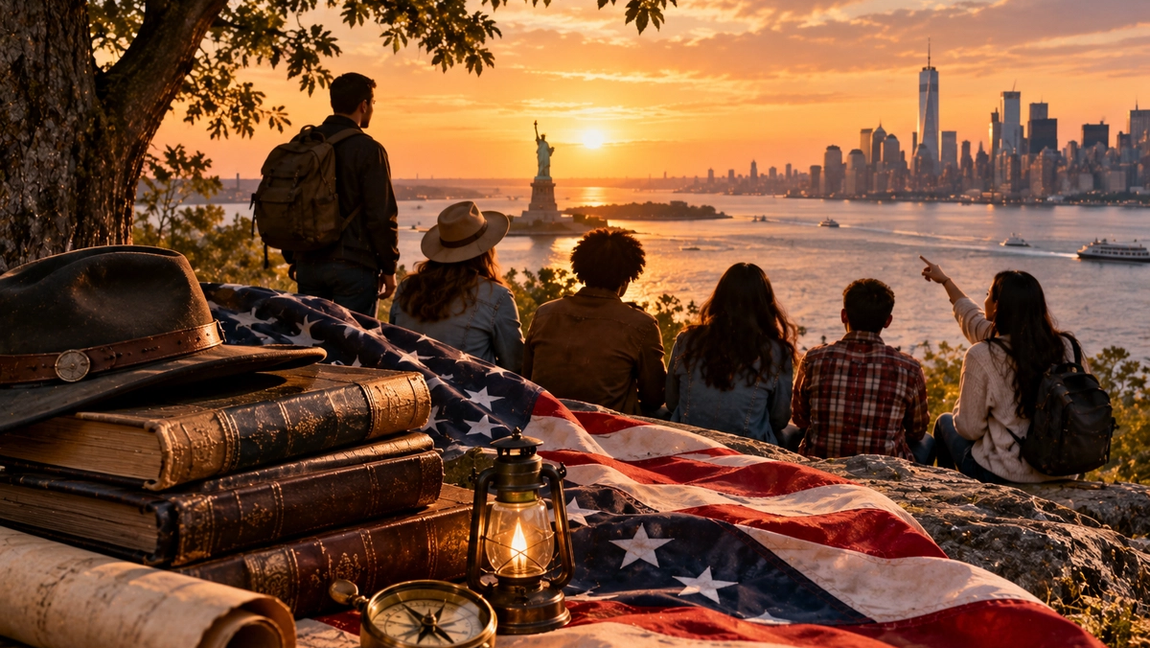
Ask ten Americans what it means to be American and you may get ten different answers. One person might talk about freedom and individualism, another about immigration and opportunity, another about the Constitution, military service, religion, entrepreneurship, diversity, or simply the experience of growing up surrounded by American culture. Some definitions emphasize what Americans share, while others reveal how deeply the country continues to disagree about who belongs and what its ideals actually require.
That disagreement is not a modern problem. It has existed from the beginning because American identity was never created in a single moment. It developed through the collision of Indigenous civilizations, European colonization, African slavery, immigration, territorial expansion, religious movements, wars, political struggles, economic transformations, and generations of people demanding access to promises that were often more inclusive in theory than in practice.
The United States did not begin with a finished national identity that later generations simply inherited. Americans have been arguing over that identity for more than two centuries, and each generation has changed the answer.
Before There Was an America, There Were Already Many Americas
The history of American identity does not begin with the arrival of Europeans.
Long before the United States existed, North America contained hundreds of Indigenous nations with distinct languages, governments, economies, religions, diplomatic relationships, and cultural traditions. Communities adapted to environments ranging from the deserts of the Southwest to the forests of the Northeast and the agricultural societies of the Mississippi Valley.
European colonization did not enter an empty continent.
It entered an extraordinarily complex human landscape.
Spanish, French, Dutch, and English colonists then established different settlements with different goals. Some came for trade, some for land, some for religious reasons, and others because governments and companies hoped to expand imperial power.
Enslaved Africans were forcibly brought into these societies, adding cultures, languages, agricultural knowledge, religious traditions, and resistance movements that would become fundamental to American development.
The future United States was culturally mixed long before anyone called its people Americans.
The Colonists Did Not Initially Think of Themselves as Americans
For much of the colonial period, European settlers were more likely to identify with their colony, religion, local community, or European heritage than with a unified American nation.
A resident of Virginia and a resident of Massachusetts could have very different economies, religious traditions, political cultures, and social structures.
The thirteen colonies did not naturally form one community.
They were separate British colonies.
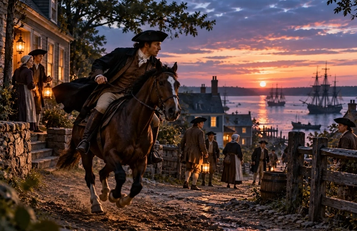
Even during the growing conflict with Britain in the 1760s and 1770s, many colonists initially demanded the rights they believed they possessed as British subjects rather than independence from Britain.
The idea of a distinct American political identity developed gradually as resistance to British policies encouraged colonists to recognize shared interests.
The Revolution did not simply result from an existing American identity.
It helped create one.
Independence Created a Nation Before It Created a Shared Identity
The Declaration of Independence offered an extraordinarily powerful statement: “all men are created equal” and possess certain unalienable rights.
Those words eventually became central to American identity.
Their implementation was much narrower.
Slavery remained legal.
Women lacked equal political rights.
Native peoples were generally excluded from the political community envisioned by the new republic.
Voting was largely controlled by states and commonly restricted by property, race, sex, and other qualifications.
The contradiction between universal language and limited citizenship became one of the defining tensions of American history.
Instead of making the Declaration irrelevant, that contradiction eventually made its language politically explosive.
Later generations could point back to the country’s stated principles and ask an uncomfortable question: if these rights are universal, why do they not apply to us?
American identity would repeatedly expand through that argument.
The Constitution Created a Political Identity
When the Constitution took effect in 1789, it created a stronger national government but did not erase state loyalties.
Americans still thought of themselves as Virginians, New Yorkers, Pennsylvanians, South Carolinians, and residents of other states.
The Constitution nevertheless provided something crucial: a common political framework.
The presidency, Congress, federal courts, elections, and constitutional amendments gradually became national institutions around which Americans could organize political life.
Yet disagreement began almost immediately.
Alexander Hamilton and Thomas Jefferson developed competing visions of the country’s economic and political future. Americans argued over banks, taxation, foreign alliances, executive power, and the proper relationship between states and the federal government.
There was never a golden age when everyone agreed about what America meant.
Political disagreement became part of American identity almost as quickly as the institutions themselves.
Race Was Built Into Early Definitions of Belonging
The early United States frequently spoke the language of universal liberty while organizing citizenship around racial distinctions.
The Naturalization Act of 1790 restricted naturalization to “free white persons” who met its requirements, illustrating how race became embedded in legal definitions of national membership.
Meanwhile, hundreds of thousands of Black people remained enslaved.
Native nations existed in complicated political relationships with the United States while facing increasing pressure on their lands.
The contradiction was enormous.
The country presented itself as a republic founded on liberty while denying freedom or equal citizenship to large portions of the population.
That contradiction did not sit quietly in the background.
It shaped American politics for generations.
Immigration Quickly Complicated the Meaning of “American”
One of the most enduring American ideas is that the country is a nation of immigrants.
That description contains substantial truth, but it can hide how fiercely Americans have repeatedly argued about immigration.
Large numbers of Irish immigrants arrived during the nineteenth century, particularly during and after the Great Famine.
German immigration also transformed cities, farming regions, religious communities, and political life.
Many established Americans reacted with suspicion.
Irish Catholics were accused of being controlled by the pope and incapable of participating responsibly in a Protestant republic. German communities were criticized for maintaining their language and cultural traditions.
The Know-Nothing movement built political influence partly through hostility toward immigrants and Catholics.
Yet within generations, Irish and German Americans became deeply integrated into national life.
The pattern would repeat.
Westward Expansion Changed Who Americans Thought They Were
During the nineteenth century, territorial expansion became central to national identity.
The Louisiana Purchase dramatically increased the country’s territory.
Settlers moved west.
The United States fought Mexico and acquired enormous areas of land.
The phrase “Manifest Destiny” expressed the belief that American expansion across the continent was somehow natural or divinely intended.
For many white Americans, the frontier became associated with independence, opportunity, self-reliance, and national greatness.
For others, expansion meant dispossession.
Native nations were pushed from ancestral lands through warfare, treaties, coercion, and forced removal.
Mexican communities found themselves living inside territory that became part of the United States.
The expansion of slavery into western territories became one of the country’s most dangerous political questions.
The frontier helped create the mythology of American individualism.
It also depended heavily on government policy, military force, displacement, and contested land.
Both realities shaped the national identity.
Slavery Nearly Destroyed the American Experiment
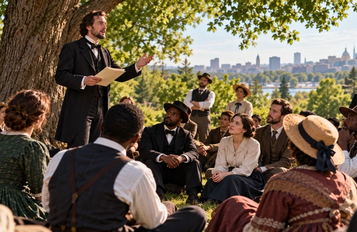
By the middle of the nineteenth century, Americans increasingly faced a question the country’s founding documents had never resolved.
Could a republic claiming to value liberty permanently coexist with slavery?
Southern political leaders defended slavery as essential to their economic and social system.
Abolitionists demanded its destruction.
Enslaved people resisted slavery through escape, rebellion, family survival, political action, military service, and countless everyday acts of resistance.
The conflict eventually became impossible to contain politically.
Southern states seceded following Abraham Lincoln’s election in 1860.
The Civil War followed.
The war was not simply a military conflict over territory.
It became a struggle over the meaning of the United States itself.
Would the country remain a union containing slavery, divide into separate nations, or emerge as a different republic?
The Civil War Changed the Meaning of Citizenship
Union victory preserved the United States, but the constitutional changes following the war transformed the definition of American citizenship.
The Thirteenth Amendment abolished slavery.
The Fourteenth Amendment established birthright citizenship and promised equal protection under the law.
The Fifteenth Amendment prohibited denying voting rights on the basis of race, color, or previous condition of servitude, although those protections would later be systematically undermined.
These amendments represented an extraordinary expansion of the constitutional meaning of belonging.
Citizenship was no longer supposed to depend on being white.
In practice, however, Reconstruction’s collapse allowed white supremacist governments across the South to establish segregation and suppress Black political participation.
The legal definition of American citizenship had expanded.
The lived reality remained deeply unequal.
That gap between constitutional ideals and everyday experience would become another recurring feature of American identity.
Millions of New Immigrants Remade the Country Again
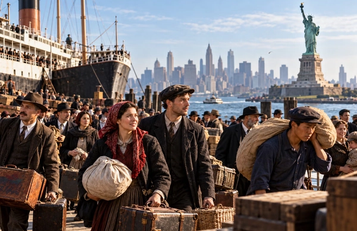
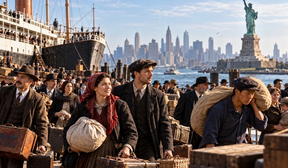
Between the late nineteenth and early twentieth centuries, immigration transformed the United States on an enormous scale.
Millions arrived from Italy, Poland, Russia, Greece, Austria-Hungary, and other parts of Europe.
Jewish immigrants fled persecution.
Asian immigrants built communities despite severe discrimination and legal exclusion.
Immigrants worked in mines, factories, railroads, construction sites, farms, shops, and domestic service.
Cities became multilingual and culturally complex.
Once again, many established Americans feared the newcomers would never assimilate.
Immigrants were described as culturally incompatible, politically dangerous, criminal, impoverished, or unwilling to become American.
Congress eventually imposed increasingly restrictive immigration laws, including national-origin quotas designed to limit arrivals from certain parts of Europe and exclusionary policies directed at Asian immigrants.
Yet foods, music, neighborhoods, religious traditions, businesses, labor movements, and cultural practices brought by these supposedly unassimilable immigrants gradually became part of ordinary American life.
America changed them.
They changed America.
Assimilation was never a one-way process.
Black Americans Reshaped National Culture During the Great Migration
Beginning in the early twentieth century and accelerating during both world wars, millions of Black Americans left the rural South for cities in the North, Midwest, and West.
The Great Migration transformed the demographic map of the United States.
Chicago, Detroit, New York, Philadelphia, Los Angeles, and other cities developed large Black communities.
The movement changed politics, labor, literature, religion, sports, and music.
The Harlem Renaissance helped establish Black writers and artists as major forces in American culture.
Blues, jazz, gospel, rhythm and blues, rock and roll, soul, hip-hop, and numerous other musical traditions emerged from or were profoundly shaped by Black American experiences.
Much of what the world eventually recognized as American popular culture came from communities that had been denied full participation in American political and economic life.
That contradiction is central to understanding the country.
Groups excluded from narrow definitions of American identity repeatedly helped create the culture through which America represented itself.
The World Wars Created a Stronger National Identity
The two world wars brought Americans from different regions and backgrounds into common national institutions.
Military service mixed people who might otherwise never have met.
Industrial mobilization moved millions of workers.
Government propaganda emphasized shared national purpose.
World War II in particular helped strengthen an image of the United States as a defender of democracy.
Yet wartime unity contained serious contradictions.
The military remained segregated during World War II.
Japanese Americans were forcibly removed from their homes and incarcerated.
Black Americans fighting fascism overseas returned to a country where segregation remained legal.
Those contradictions helped fuel postwar civil rights activism.
If America defined itself internationally through democracy and freedom, activists asked, why were those principles not fully protected at home?
Once again, Americans used the country’s stated identity to demand changes in the country’s actual behavior.
The 1950s Created One of America’s Most Powerful Self-Images
Postwar prosperity helped create an enduring picture of American life.
Suburban houses.
Cars.
Televisions.
Shopping centers.
Stable jobs.
Growing families.
Consumer abundance.
The image was powerful enough that decades later it still influences debates about whether America has declined from some earlier golden age.
But the postwar experience was not equally available to everyone.
Housing discrimination restricted where many Black families could live.
Women faced strong cultural expectations regarding marriage and domestic life even though millions worked outside the home.
Poverty remained significant.
Gay Americans faced legal and social persecution.
Native communities continued confronting the consequences of federal policies.
The 1950s image was real for some Americans.
It was never the complete national experience.
The Civil Rights Movement Forced America to Confront Its Own Language
The civil rights movement transformed American identity partly by taking the country’s founding language seriously.
Activists demanded that constitutional rights and democratic principles apply regardless of race.
The movement involved court cases, boycotts, marches, voter-registration campaigns, sit-ins, community organizing, federal legislation, and enormous personal risk.
The Civil Rights Act of 1964 and Voting Rights Act of 1965 became major landmarks in the struggle against legally enforced racial discrimination.
The movement also influenced other groups.
Women challenged discrimination.
Latino activists organized around labor, education, and political rights.
Native American activists demanded sovereignty and recognition.
Gay and lesbian activists increasingly challenged laws and social exclusion.
The meaning of equal citizenship expanded because people previously excluded from full participation insisted that they belonged within the American promise.
The 1960s and 1970s Changed Culture as Much as Politics
American identity changed dramatically during the cultural upheavals of the 1960s and 1970s.
Young people challenged older expectations about authority, clothing, sexuality, music, gender roles, and war.
The Vietnam War produced profound disagreement over patriotism itself.
Was patriotism demonstrated by supporting the government during wartime, or could opposing a war also be patriotic?
The women’s movement challenged assumptions about education, employment, marriage, reproduction, and family life.
Environmental activism created new ideas about the relationship between economic growth and environmental protection.
Watergate damaged confidence in government.
The result was not a new national consensus.
It was a broader understanding that Americans could disagree intensely about the country while still claiming to represent its values.
Immigration Changed America Again After 1965
Changes to immigration law in 1965 transformed the demographic future of the United States.
Earlier national-origin quotas had heavily favored immigration from parts of Europe.
The new system helped increase immigration from Asia, Latin America, the Caribbean, Africa, and elsewhere.
American cities and suburbs changed again.
New communities established businesses, religious institutions, restaurants, newspapers, schools, and cultural organizations.
As before, debates emerged over assimilation, language, employment, borders, and national identity.
And as before, the newcomers’ children increasingly grew up combining family traditions with American culture.
The question “Where are you really from?” reveals one of the tensions that continues to shape American identity.
For a country built through repeated immigration, Americans have often struggled to accept that someone can look, speak, worship, or eat differently while being completely American.
Popular Culture Became One of America’s Strongest Forms of Identity
American identity is not created only through laws and political speeches.
It is also created through movies, music, sports, food, television, fashion, and language.
Hollywood exported images of American life around the world.
Jazz became internationally recognized.
Rock and roll blended Black musical traditions with country, gospel, blues, and other influences.
Hip-hop emerged from communities in New York and eventually became a global cultural force.
Baseball acquired the label of the national pastime, while American football became enormously influential domestically.
Basketball spread internationally.
Foods introduced or transformed by immigrant communities became so integrated into everyday life that their foreign origins were often forgotten.
Pizza, hamburgers, hot dogs, tacos, bagels, barbecue traditions, Chinese American food, and countless regional dishes became part of the country’s cultural vocabulary.
American culture became recognizable precisely because it constantly absorbed outside influences and transformed them.
Individualism Became a Powerful American Ideal
One of the strongest themes in American identity is individualism.
The self-made person appears repeatedly in American mythology.
The frontier settler.
The entrepreneur.
The inventor working in a garage.
The immigrant starting a business.
The athlete overcoming difficult circumstances.
The artist ignoring convention.
These stories reflect real possibilities within American society, but they can also obscure the importance of institutions and communities.
Railroads depended on government land grants and enormous workforces.
Suburban homeownership expanded through public policies and federally supported financing.
Businesses rely on roads, courts, education systems, financial institutions, and public infrastructure.
Even the most successful individuals operate inside social systems.
American culture nevertheless remains unusually attracted to stories in which individuals reinvent themselves.
That belief in reinvention may be one of the country’s most persistent characteristics.
Religion Has Always Been Both Unifying and Divisive
Religion has played an enormous role in American identity, but there has never been a single American religious experience.
Different colonies were shaped by different denominations.
Religious revivals repeatedly transformed American culture.
Protestant Christianity influenced politics, reform movements, education, abolitionism, temperance, and social life.
Catholic and Jewish immigration expanded the country’s religious diversity.
Later immigration brought larger Muslim, Hindu, Buddhist, Sikh, and other communities.
At the same time, the number of Americans identifying with no religion has grown.
The First Amendment prevented the establishment of a national religion while protecting religious exercise, creating a system in which religion could become culturally powerful without one denomination officially controlling the state.
Arguments over the proper relationship between faith and public life have therefore existed throughout American history.
They are not a recent invention.
September 11 Changed Ideas About Patriotism Again
The September 11 attacks created an intense wave of national solidarity.
American flags appeared across neighborhoods and businesses.
Military service gained renewed cultural prominence.
The attacks also generated difficult questions about security, surveillance, immigration, religious prejudice, and America’s role in the world.
Muslim Americans and people perceived as Muslim sometimes faced discrimination and violence.
The wars in Afghanistan and Iraq produced new debates about military power and patriotism.
Once again, Americans disagreed not only about policies but about what loyalty to the country required.
That debate has appeared repeatedly in American history.
During almost every major war, Americans have argued about whether dissent weakens the country or represents one of the freedoms the country exists to protect.
The Internet Created New Ways of Being American
For most of American history, national identity was shaped through institutions that controlled information relatively tightly.
Newspapers, schools, churches, political parties, radio networks, and television broadcasters acted as major cultural gatekeepers.
The internet disrupted that system.
Americans could suddenly find communities based on interests rather than geography.
People could encounter political ideas outside traditional media.
Immigrant families could maintain constant contact with countries of origin.
Regional cultures could become national trends overnight.
Social media accelerated the process further.
The result has been both connection and fragmentation.
Americans consume much of the same national culture while simultaneously inhabiting completely different information environments.
Two neighbors can experience the same country through entirely different streams of news, entertainment, politics, and social commentary.
The United States has always contained multiple versions of itself.
Technology has simply made those differences harder to ignore.
There Has Never Been One “Real America”
Political and cultural debates frequently invoke the idea of the “real America,” usually meaning a particular type of community, lifestyle, region, or set of values.
History makes that concept difficult to defend.
Is the real America a farming community in Iowa, a neighborhood in Queens, a reservation in Arizona, a Black church in Atlanta, a Vietnamese American community in California, a ranch in Texas, a Puerto Rican neighborhood in Orlando, a technology company in Seattle, or a small town in Appalachia?
All of them are America.
The country has always contained regional differences.
New England was never identical to the South.
The industrial Midwest developed differently from the agricultural West.
Border regions mixed languages and cultures.
Cities experienced immigration differently from rural communities.
American identity has never required everyone to live the same way.
It has required millions of different people to somehow imagine themselves as belonging to the same political community.
What Americans Share Is Often an Argument
Perhaps the most unusual part of American identity is that disagreement itself has become part of the national tradition.
Americans argue about the Constitution because the Constitution matters to them.
They argue about freedom because different people define freedom differently.
They argue about equality because the country has never completely resolved what equality requires.
They argue about immigration because immigration has repeatedly transformed the country.
They argue about patriotism because people disagree about whether loving a country means defending its traditions or demanding that it change.
These arguments can become destructive.
They can also produce reform.
The same country that excluded groups from citizenship later expanded citizenship.
The same Constitution that originally tolerated slavery was amended to abolish it.
The same political system that denied women the vote eventually recognized women’s suffrage nationwide.
American identity has changed partly because people refused to accept existing definitions of who counted as American.
The Definition of “American” Keeps Getting Larger
At different points in history, groups now considered unquestionably American were portrayed as outsiders.
Irish Catholics were treated with suspicion.
Italian immigrants were described as incapable of assimilation.
Jewish immigrants faced discrimination.
Asian immigrants were legally excluded.
Black Americans were denied basic citizenship rights even after slavery ended.
Native Americans were subjected to policies intended to destroy languages and cultures.
Latino communities faced repeated questions about belonging even when their families had lived in parts of what became the United States for generations.
Over time, the boundaries shifted.
That does not mean prejudice disappeared.
It means the definition of belonging proved more flexible than many people expected.
The American identity that exists today would have been almost unimaginable to someone living in 1790.
The identity Americans possess a century from now will probably be equally surprising to us.
American Identity Has Always Been a Work in Progress
The United States is often described as a country founded on an idea rather than a single ethnicity, dynasty, or ancient national culture.
There is truth in that description, but the idea itself has never been interpreted in only one way.
Freedom has expanded and contracted.
Citizenship has changed.
Immigration has repeatedly transformed communities.
Economic change has created new opportunities while destroying older ways of life.
Wars have strengthened national unity and divided it.
Technology has connected Americans while giving them new reasons to disagree.
Every generation inherits an America built by people who came before and then modifies it, sometimes intentionally and sometimes without realizing what it is doing.
That is why debates about American identity never really end.
The country keeps changing because the people inside it keep changing.
America Is Less a Finished Identity Than an Ongoing Negotiation
There is no single moment when American identity was completed.
It was not finished in 1776 when the Declaration of Independence was adopted, because most people living in the country did not enjoy the equality its language promised. It was not finished after the Civil War, because emancipation did not create immediate racial equality. It was not finished when women gained the vote, when immigration laws changed, when segregation became illegal, or when new generations of immigrants became citizens.
Each change answered one question and created others.
That may be the most consistent feature of American identity.
The country repeatedly makes enormous claims about freedom, equality, opportunity, and self-government, then spends generations arguing about who should receive them and what those words actually mean.
Sometimes the gap between the ideal and reality has been enormous.
But the ideal itself has provided people with language for challenging that gap.
American identity therefore cannot be reduced to a flag, a language, a religion, an ancestry, a political party, or a particular way of life.
It is an accumulation of people who arrived through radically different circumstances, including people whose ancestors were already there, people who came voluntarily, people who were brought by force, people who fled persecution, and people who crossed borders that sometimes moved around them.
They did not create one perfectly unified culture.
They created a country that continually argues about what it is.
That argument can be exhausting, uncomfortable, and sometimes dangerous.
It is also deeply American.
The United States has never stopped asking who counts as American because the answer has never stopped changing.