The Lost Colony of Roanoke: What Actually Happened
By Helen Poole on October 15, 2026

Few mysteries in early American history have been retold as dramatically as the Lost Colony of Roanoke. More than one hundred English settlers established a colony on an island off the coast of what is now North Carolina, their governor sailed back to England for supplies, and when he finally returned several years later, every colonist had vanished.
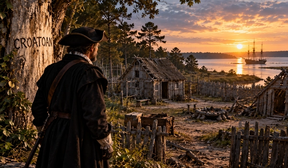
There were no bodies, no obvious battlefield, and no surviving English account explaining where they had gone. The most famous clue was a single word carved into a wooden post: CROATOAN.
That combination has inspired centuries of theories involving massacres, starvation, Spanish attacks, secret relocation, shipwrecks, and, much later, supernatural explanations. The actual evidence points toward something less mysterious but arguably more interesting. Roanoke was an extremely vulnerable settlement surrounded by Indigenous communities with whom the English had complicated relationships, and the colonists had already discussed leaving the island if circumstances became desperate.
The real question may therefore not be why the settlers disappeared, but where they went after they decided Roanoke could no longer support them.
Roanoke Was Not England’s First Attempt at Roanoke
The famous Lost Colony was actually part of a larger English effort to establish a permanent presence in North America.
During the late sixteenth century, England was competing with Spain for wealth and influence across the Atlantic. Spain had already built an enormous American empire, while England was still experimenting with overseas colonization.
Sir Walter Raleigh received permission from Queen Elizabeth I to establish colonies in North America, and expeditions began exploring the region around what is now North Carolina.
The English called the broader territory Virginia in honor of Elizabeth, the “Virgin Queen.”
In 1585, an earlier group of English men established a settlement on Roanoke Island.
The colony quickly ran into trouble.
Food supplies became uncertain, relations with local Indigenous communities deteriorated, and the settlers struggled to sustain themselves.
When English privateer Sir Francis Drake arrived in 1586 after operations against Spanish possessions in the Caribbean, the colonists abandoned the settlement and returned to England with him.
That should have been a warning.
Instead, England tried again.
The Second Colony Included Families
In 1587, another expedition sailed for North America under Governor John White.
This group was different.
Rather than consisting primarily of soldiers and explorers, it included women and children, suggesting that the settlers intended to create a permanent community.
Roughly 115 colonists arrived.
Among them was White’s daughter, Eleanor Dare, who was pregnant.
Soon after arriving, she gave birth to Virginia Dare.
Virginia became famous as the first English child born in England’s American colonies.
But the settlers inherited many of the problems that had damaged the previous attempt.
Roanoke was isolated, supplies were limited, and relationships with nearby Indigenous peoples were complicated by violence that had occurred during earlier English expeditions.
The colony needed help.
The English Had Already Damaged Local Relationships
Roanoke was not an empty wilderness waiting for Europeans.
Indigenous societies had lived throughout the region for generations, with established communities, political relationships, agricultural systems, and trade networks.
The English depended heavily on Indigenous knowledge and food.
But earlier encounters had created distrust.
During the first Roanoke expedition, English settlers had responded harshly to perceived offenses, including an infamous incident in which they burned an Indigenous village after accusing residents of stealing a silver cup.
Violence like this had consequences.
By the time the 1587 settlers arrived, they were entering a region where some Indigenous communities already had good reasons to distrust them.
Not every relationship was hostile, however.
The Croatoan people, who lived primarily on an island south of Roanoke, had maintained friendlier relations with the English.
That relationship would become extremely important.
John White Left the Colony at the Worst Possible Time
The settlers persuaded Governor John White to return to England for supplies.
Normally, that might have meant being away for several months.
Instead, European politics trapped him across the Atlantic.
England was preparing for a major confrontation with Spain, culminating in the Spanish Armada’s attempted invasion in 1588.
English authorities needed ships for national defense and restricted vessels from sailing on colonial supply missions.
White desperately wanted to return to Roanoke but could not secure a successful voyage.
Several attempts failed.
Years passed.
Imagine what that meant for the colonists.
They had expected their governor to return with food, equipment, and assistance.
Instead, they were effectively abandoned on the edge of an unfamiliar continent.
White did not finally return until 1590.
By then, he had been gone for approximately three years.
When White Returned, Everyone Was Gone
White reached Roanoke Island in August 1590.
He found the settlement deserted.
The houses had been dismantled.
There were no colonists waiting for him.
There were no bodies indicating that the entire community had been killed there.
Then White discovered the clues that created one of America’s oldest mysteries.
The letters CRO had been carved into a tree.
The word CROATOAN had been carved into a post.
To modern readers, this can sound like an eerie final message.
To White, it had a much more practical meaning.
Croatoan was the name associated with both a nearby Indigenous people and the island where they lived, now generally identified with Hatteras Island.
Even more importantly, White and the settlers had apparently agreed before his departure that if the colonists relocated, they would carve the name of their destination somewhere visible.
If they had been forced to leave under serious danger, they were supposed to include a Maltese cross as a distress signal.
White found no such cross.
From his perspective, the message appeared to indicate that the colonists had deliberately moved to Croatoan.
So Why Didn’t White Just Go to Croatoan?
This is one of the most frustrating parts of the story.
White wanted to investigate.
Weather and sailing conditions prevented him from doing so.
The expedition experienced difficulties near Roanoke, including the loss of an anchor, and worsening conditions made continuing dangerous.
The ship eventually sailed away without reaching Croatoan.
White never found his daughter, his granddaughter Virginia Dare, or the other settlers.
That failure transformed what might have been a relatively straightforward relocation story into a mystery lasting more than four centuries.
The most obvious clue pointed toward Croatoan.
Nobody reached the island in time to confirm what had happened.
The Simplest Theory Is That They Joined the Croatoan
One of the strongest explanations is also one of the oldest.
At least some of the colonists may have moved south and lived with the Croatoan people.
The idea makes practical sense.
The settlers needed food, protection, and local knowledge.
The Croatoan had previously maintained relatively friendly relations with the English.
The colonists explicitly left the word CROATOAN behind.
They also appear to have dismantled buildings rather than fleeing suddenly, suggesting an organized departure.
If a struggling group of settlers had to survive without promised supplies from England, joining or living near an Indigenous community would have been far more realistic than attempting to survive entirely alone.
That does not mean every colonist necessarily went there.
The group may have divided.
And that possibility leads to another major theory.
Some Colonists May Have Moved Inland
Before White left, the settlers had discussed relocating from Roanoke.
Some evidence suggests they may have considered moving inland, possibly toward the Chesapeake Bay or into areas where food and fresh water were more reliable.
Archaeologists have therefore investigated locations beyond Roanoke and Hatteras.
One area of interest has been a site inland near the Albemarle Sound.
Researchers examining one of John White’s maps discovered that a patch had been placed over a symbol that appeared to represent a fort-like structure.
Archaeological work in the region later uncovered European objects dating broadly to the period of the colony.
These discoveries are intriguing, but they have not produced definitive proof that Lost Colonists lived there.
European goods could move through trade networks, and objects alone do not establish who owned them.
Still, the evidence supports a possibility historians increasingly take seriously: the settlers may not have moved together.
Some could have gone south toward Croatoan.
Others may have moved inland.
If so, there was never one final destination to discover.
Archaeology on Hatteras Island Has Added More Clues
Archaeological investigations on Hatteras Island have also uncovered European artifacts from around the period of the Lost Colony.
Objects associated with European manufacture have been found alongside Indigenous material.
Supporters of the Croatoan theory argue that some of these finds could be consistent with English settlers living among Indigenous communities.
The problem is proving exactly how the objects arrived.
Europeans traded with Indigenous communities, meaning an English artifact found at an Indigenous site does not automatically prove an English person lived there.
An object could have been traded, given away, recovered from an abandoned settlement, or transported through regional exchange networks.
Archaeology therefore gives historians clues rather than a neat answer.
The evidence is suggestive.
It is not a signed confession from 1587.
A Massacre Is Possible, but Probably Not the Whole Story
Another theory suggests that Indigenous groups hostile to the English killed the colonists.
There is historical evidence that violence may have affected at least some members of the colony.
Later English settlers at Jamestown heard reports suggesting that people from the Roanoke colony had lived among Indigenous communities before being killed.
The reliability of those reports is difficult to establish because they were recorded years later and came through complicated political circumstances.
Even if some former Roanoke settlers were eventually killed, that does not mean everyone died at the same place or at the same time.
The disappearance may have unfolded over years.
The colonists could have relocated, separated into smaller groups, lived among different communities, and experienced different fates.
That scenario is less satisfying than one dramatic event.
History is often like that.
The Spanish Probably Did Not Destroy Roanoke
Spain certainly had reasons to oppose English colonization.
The two countries were rivals, and Spanish officials were aware that England was attempting to establish settlements in North America.
Spanish forces had previously destroyed French colonial settlements in Florida.
A Spanish attack on Roanoke was therefore not impossible in principle.
But there is no convincing evidence that Spanish forces found and destroyed the Lost Colony.
Spanish officials themselves continued trying to determine where the English settlement was located.
If Spain had eliminated it, Spanish records would probably have provided clearer evidence.
The theory remains imaginable.
It simply does not fit the surviving evidence as well as relocation does.
They Probably Did Not Simply Vanish at Sea
Another possibility is that the settlers attempted to sail back to England themselves.
They had access to a smaller vessel and might eventually have decided that waiting for White was hopeless.
But crossing the Atlantic in inadequate vessels would have been extraordinarily dangerous.
If they attempted it and were lost at sea, there would naturally be no settlement to discover.
The problem is the CROATOAN message.
If the entire colony had decided to sail for England, carving the name of a nearby Indigenous community would make little sense.
The clue strongly suggests that at least some settlers intended to move somewhere connected with Croatoan.
Starvation and Disease Probably Played a Role
Even if the colonists relocated successfully, survival would have remained difficult.
They faced food shortages, unfamiliar diseases, uncertain harvests, and political instability.
Tree-ring research indicates that the region experienced severe drought during the period surrounding the Roanoke settlement.
That would have made agriculture more difficult not only for the English but also for Indigenous communities upon whom the settlers depended.
A starving European colony arriving and asking neighboring communities for food could create enormous pressure on local resources.
Some settlers may therefore have died from hunger or disease even after leaving Roanoke.
Again, the disappearance does not require one explanation.
Different people may have experienced different outcomes.
The Colonists May Have Been Absorbed Into Indigenous Communities
One of the most fascinating possibilities is that surviving colonists gradually became part of local Indigenous societies.
If a small number of English settlers joined a much larger Indigenous community, their distinct European identity could disappear surprisingly quickly.
They might marry into local families, adopt local languages and customs, and raise children who belonged primarily to the communities around them.
Within a generation or two, there might no longer be an identifiable “English colony” to find.
Later Europeans occasionally reported encountering Indigenous people in the region whom they believed displayed European physical characteristics or cultural practices.
Such accounts have fueled theories about descendants of the Lost Colonists.
However, those observations are difficult to verify and were often shaped by European assumptions about race and identity.
Modern historians therefore treat them cautiously.
Still, cultural absorption remains entirely plausible.
The colonists did not necessarily need to die for the colony to disappear.
They only needed to stop existing as a separate English community.
Why Haven’t We Solved the Mystery?
Part of the problem is environmental.
The coastline around Roanoke has changed dramatically over the centuries.
Erosion, storms, shifting shorelines, and development have altered or destroyed archaeological sites.
Part of the original settlement may now be underwater or simply gone.
The documentary record is also painfully limited.
The colonists did not leave behind journals explaining their decisions after White departed, at least none that survived.
Indigenous accounts were largely preserved through European writers, meaning historians do not have the same kind of written record from the communities most likely to have known what happened.
Archaeologists are therefore trying to reconstruct the fate of more than one hundred people from scattered objects, old maps, environmental evidence, and reports written years after the events.
That is not enough to produce certainty.
It is enough to make some explanations much stronger than others.
The Word CROATOAN Is Less Mysterious Than It Sounds
Popular culture has transformed CROATOAN into something almost supernatural.
It appears in horror stories, television shows, novels, conspiracy theories, and paranormal mythology.
But in 1590, the word was essentially an address.
White knew what Croatoan meant.
He knew where it was.
He believed the colonists might have gone there.
The eerie part of the story is not that the settlers left an incomprehensible message.
It is that White understood the message and still never managed to follow it.
Had weather allowed him to reach Croatoan immediately, the Lost Colony might never have become a mystery at all.
So What Most Likely Happened?
No explanation has been proven beyond doubt, but the available evidence supports a fairly ordinary human story.
The colonists waited for supplies that did not arrive.
Their food situation became increasingly difficult.
They knew remaining on Roanoke indefinitely was dangerous.
Eventually, they abandoned the settlement in an organized way.
At least some probably moved toward Croatoan and may have lived with or near the Croatoan people. Others may have traveled inland. Over time, some likely died from disease, hunger, conflict, or other hardships, while survivors may have been absorbed into Indigenous communities.
By the time English colonization became permanently established in the region, the original Roanoke group may no longer have existed as a recognizable colony.
There probably was no single night when 115 people mysteriously disappeared.
The colony likely dissolved gradually.
The Real Mystery Is What Happened After They Left
Roanoke remains fascinating because people naturally want a clean ending.
We want archaeologists to discover a hidden settlement containing unmistakable evidence and finally announce exactly what happened to Virginia Dare and everyone around her.
That discovery may never come.
But the absence of a complete answer should not make the most likely explanation seem less compelling.
The Lost Colonists were not characters in a supernatural mystery. They were families attempting to survive an ambitious and badly supported colonial experiment thousands of miles from England.
Their governor left expecting to return.
War kept him away.
The settlers adapted.
They packed what they could, dismantled parts of their settlement, and apparently left a message telling him where at least some of them intended to go.
When White finally returned, he was years too late.
That may be the most haunting part of Roanoke.
The colonists did leave a clue.
History simply never got there in time to see where it led.