The Speeches Every American Should Read at Least Once
By Helen Poole on October 15, 2026
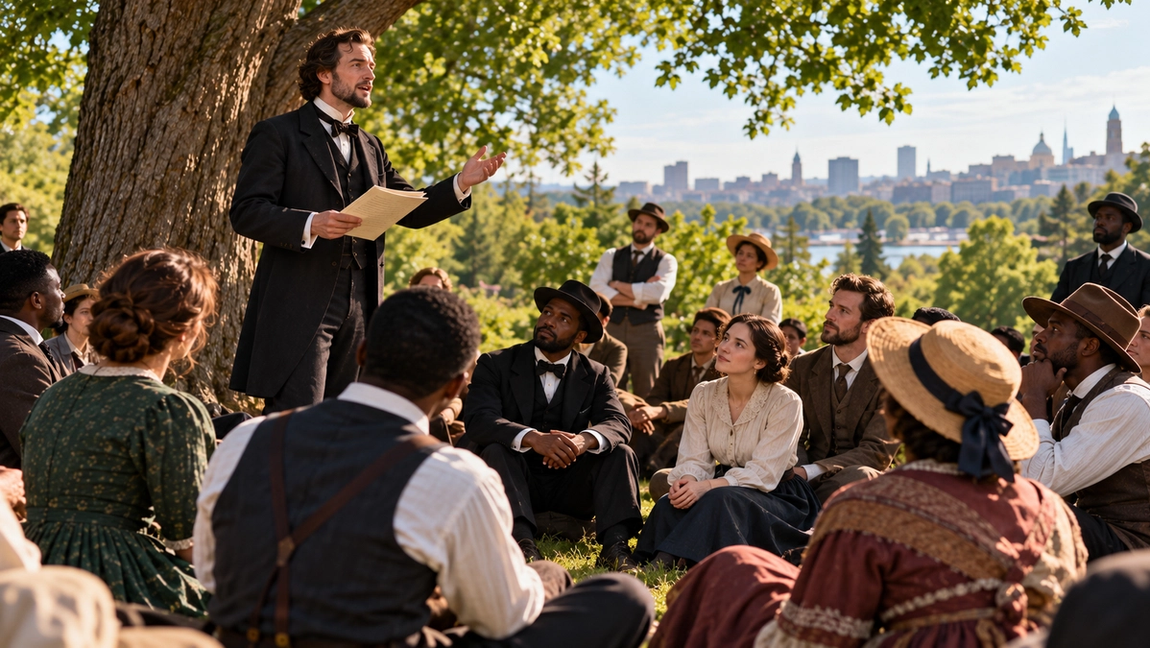
American history can be told through elections, wars, laws, court decisions, inventions, migrations, and social movements. It can also be told through speeches. At critical moments, Americans have tried to explain what the country was, what it had failed to become, and what it should become next. Some of those words were delivered by presidents standing before Congress. Others came from formerly enslaved people, civil rights leaders, Native leaders, suffragists, soldiers, and citizens who were challenging the country rather than governing it.
The most important American speeches are not important simply because they contain memorable lines. They matter because they reveal the arguments Americans were having at the time. The Declaration might promise equality while slavery continued. A president might speak about preserving democracy while millions of citizens lacked equal rights. A civil rights leader might invoke the country’s founding ideals precisely because those ideals were not being honored.
Reading the speeches themselves, rather than only the famous sentences extracted from them, makes American history considerably more complicated. It also makes it more human.
George Washington’s Farewell Address, 1796
George Washington’s Farewell Address is often remembered primarily for its warnings about political parties and foreign alliances, but the document is much broader than those familiar summaries suggest.
Washington was leaving the presidency after two terms at a moment when the American political system was still experimental. Nobody could be certain that executive power would transfer peacefully or that the new republic would survive the political divisions already developing inside it.
The address warned Americans about sectional divisions, excessive party loyalty, foreign influence, public debt, and political behavior that placed faction above national interest. Washington was especially concerned that partisan identity could become powerful enough to make citizens view political opponents as enemies.
The irony is that organized political parties were already developing around members of Washington’s own administration.
That makes the address particularly interesting today. It is not the statement of a leader who successfully prevented political division. It is the warning of a leader who could already see that political division would become a permanent feature of American democracy.
Frederick Douglass’s “What to the Slave Is the Fourth of July?” 1852
Few speeches expose the contradiction inside American ideals more powerfully than Frederick Douglass’s Fourth of July address.
Douglass had escaped slavery and become one of the country’s most influential abolitionists. Speaking in Rochester, New York, on July 5, 1852, he confronted the enormous distance between America’s celebration of liberty and the continued existence of slavery.
The brilliance of the speech lies partly in the fact that Douglass did not reject the country’s founding principles.
He used them against the country.
If Americans truly believed in liberty, equality, natural rights, and resistance to tyranny, then slavery was not merely an unfortunate exception to American values. It was a direct violation of them.
Douglass forced his audience to consider what a celebration of national freedom looked like to people who were themselves denied freedom.
It remains one of the clearest examples of a recurring American tradition: demanding that the United States live up to the principles it already claims to believe.
Abraham Lincoln’s House Divided Speech, 1858
Before Abraham Lincoln became president, he delivered one of the most consequential speeches of his political career while accepting the Republican nomination for the U.S. Senate in Illinois.
“A house divided against itself cannot stand,” Lincoln declared, borrowing language from the Bible.
He was speaking about slavery.
Lincoln argued that the United States could not permanently continue with slavery legal in some places and prohibited in others. He did not predict exactly how the conflict would be resolved, but he believed the political system was moving toward a more decisive outcome.
At the time, some political allies considered the language dangerously provocative.
History makes it sound prophetic because we know what followed.
Within three years, the country was at war.
Reading the full speech reveals something important about historical foresight. Lincoln did not know that the Civil War would begin in 1861 or precisely how slavery would eventually end. He simply recognized that the political compromises designed to contain the conflict were becoming increasingly unstable.
Abraham Lincoln’s Gettysburg Address, 1863
The Gettysburg Address is so famous that its familiarity can hide how radical its argument was.
Lincoln delivered it in November 1863 at the dedication of a cemetery following the Battle of Gettysburg.
The speech was extraordinarily brief.
Yet in only a few hundred words, Lincoln reframed the meaning of the Civil War.
He reached back not to the Constitution but to the Declaration of Independence and its claim that all men are created equal. He described the war as a test of whether a nation founded on such principles could survive.
This mattered because the United States created in 1787 had protected slavery through constitutional compromises.
Lincoln’s language suggested that equality represented a deeper national principle against which the country should ultimately be measured.
The Gettysburg Address did not simply honor soldiers who had died.
It offered a new explanation of what their deaths were supposed to mean.
Abraham Lincoln’s Second Inaugural Address, 1865
If the Gettysburg Address is Lincoln’s most famous speech, his Second Inaugural may be his most complicated.
He delivered it in March 1865, when Union victory in the Civil War was approaching.
A victorious president could easily have delivered a triumphant speech condemning the defeated South.
Lincoln did something different.
He focused heavily on slavery and treated the war as a terrible national judgment rather than simply a contest between innocent Northerners and guilty Southerners.
Both sections of the country, he noted, had participated in the system that allowed slavery to exist.
He then concluded by calling for reconstruction “with malice toward none” and “with charity for all.”
The address is worth reading because it combines moral clarity about slavery with an unusual refusal to turn victory into simple self-congratulation.
Lincoln was assassinated a little more than a month later.
Americans would never know how his approach might have shaped Reconstruction.
Sojourner Truth’s 1851 Women’s Rights Speech
Sojourner Truth, who had been born into slavery in New York, became a major advocate for abolition and women’s rights.
Her speech at the Women’s Rights Convention in Akron, Ohio, in 1851 became one of the most famous interventions in American women’s history.
It is often known as “Ain’t I a Woman?”
There is an important complication.
The most famous version of the speech was published years later by activist Frances Dana Barker Gage and was written in a dialect that does not accurately reflect Truth’s own speech patterns. An earlier account differs significantly.
That makes the speech important for two reasons.
Truth challenged arguments that women were naturally too weak or delicate to possess equal rights by pointing to her own experience as a Black woman who had endured hard physical labor and slavery.
But the history of the speech also demonstrates how famous historical quotations can evolve after an event.
Reading it carefully means considering not only what Truth argued but how her words were later remembered.
Chief Joseph’s Surrender Speech, 1877
Chief Joseph of the Nez Perce is associated with one of the most famous statements in Native American history, ending with the declaration that he would “fight no more forever.”
The words are traditionally connected with the surrender of the Nez Perce in 1877 after an extraordinary flight of more than a thousand miles as the group attempted to escape U.S. forces.
The historical context matters more than the isolated quotation.
The Nez Perce had faced increasing pressure over land and treaties. After months of pursuit and fighting, those who remained with Joseph were exhausted, hungry, and suffering in freezing conditions.
Like many famous Native American speeches preserved through non-Native intermediaries, the exact wording deserves careful historical treatment.
Yet the episode remains essential because it forces readers to view American westward expansion from the perspective of people being displaced by it.
The same expansion celebrated as opportunity by settlers could mean dispossession and military defeat for Native nations.
American history contains both experiences.
Susan B. Anthony’s Speech After Her Arrest for Voting, 1873
In the 1872 presidential election, Susan B. Anthony cast a ballot in Rochester, New York.
Women did not possess a federally protected right to vote.
Anthony was arrested.
Before her trial, she delivered a speech arguing that denying women the vote violated the principles of American citizenship.
Her argument was particularly effective because she used the Constitution and the language of democratic government against the system excluding women from political participation.
Anthony’s case demonstrates how American reform movements often operate.
Activists identify a principle the country already claims to support, demonstrate that existing law violates that principle, and force institutions to confront the contradiction.
Women would not gain constitutional protection for voting nationwide until ratification of the Nineteenth Amendment in 1920, fourteen years after Anthony’s death.
She never lived to cast a legal presidential ballot under the amendment she had spent decades demanding.
Theodore Roosevelt’s “The Man in the Arena,” 1910
The most famous section of Theodore Roosevelt’s 1910 speech at the Sorbonne in Paris concerns “the man who is actually in the arena.”
It has since been quoted by athletes, politicians, entrepreneurs, military leaders, and motivational speakers.
But the broader speech, formally titled “Citizenship in a Republic,” is more interesting than the motivational excerpt suggests.
Roosevelt was discussing the responsibilities of citizens in democratic societies.
He believed democracy required participation rather than passive criticism. Citizens could not expect political institutions to function if they treated public life as something performed entirely by other people.
The famous passage praises the person who attempts difficult work, fails, learns, and tries again rather than the observer who only criticizes.
Its continued popularity reflects a broader American attraction to action, risk, and personal effort.
Reading the full address places that idea where Roosevelt intended it: inside a discussion about citizenship.
Franklin D. Roosevelt’s First Inaugural Address, 1933
When Franklin D. Roosevelt took the presidential oath in March 1933, the United States was deep in the Great Depression.
Banks were failing.
Unemployment was catastrophic.
Businesses had collapsed.
Families had lost savings.
Confidence in economic institutions was severely damaged.
Roosevelt’s declaration that “the only thing we have to fear is fear itself” became one of the most recognizable lines in American political history.
But the full speech makes clear that Roosevelt was not telling Americans that their problems were imaginary.
He described an extremely serious economic emergency.
His point was that panic could make the crisis even worse by preventing collective action.
The speech prepared the country for an unusually active federal response.
Whatever one thinks of individual New Deal policies, Roosevelt’s first inaugural illustrates how political leadership can involve changing the public’s understanding of what government is expected to do during a crisis.
Franklin D. Roosevelt’s “Four Freedoms” Speech, 1941
In January 1941, months before the United States formally entered World War II, Roosevelt used his State of the Union address to describe four freedoms he believed people everywhere should possess: freedom of speech, freedom of worship, freedom from want, and freedom from fear.
The speech helped frame the international conflict as something larger than conventional national rivalry.
Roosevelt was describing a world in which democratic freedoms required protection against authoritarian expansion.
The speech also exposed American contradictions.
Racial segregation remained legal.
Black Americans faced widespread discrimination.
Japanese American incarceration would begin the following year.
The United States could articulate universal freedoms more easily than it could guarantee them equally at home.
That gap would become politically important.
Civil rights activists would increasingly ask why a country fighting for freedom abroad tolerated discrimination within its own borders.
Dwight D. Eisenhower’s Farewell Address, 1961
President Dwight D. Eisenhower had spent much of his life in the military.
That made his warning about the growing “military-industrial complex” especially striking.
In his 1961 farewell address, Eisenhower described the enormous permanent defense establishment that had developed during World War II and the Cold War.
He did not argue that the United States should eliminate its military power.
The Cold War made national defense essential in his view.
His concern was that the relationship between government, the armed forces, scientific research, and private industry had become powerful enough to influence national priorities.
Eisenhower’s warning remains relevant because it came from someone who understood military institutions from the inside.
He was not warning that defense itself was dangerous.
He was warning that concentrated institutional power requires democratic oversight even when that power exists for legitimate reasons.
John F. Kennedy’s Inaugural Address, 1961
John F. Kennedy’s inaugural address belongs to the Cold War.
The United States and Soviet Union were locked in a global struggle, nuclear weapons threatened civilization, newly independent nations were emerging from colonial rule, and Americans were debating their country’s international responsibilities.
Kennedy’s language emphasized sacrifice, service, alliances, and determination.
His call for Americans to ask what they could do for their country became the most famous sentence.
But the speech is also filled with the confidence and anxiety of early-1960s America.
Kennedy promised that the United States would defend liberty internationally while also calling for negotiations and arms control.
Less than two years later, the Cuban Missile Crisis would bring the superpowers terrifyingly close to nuclear confrontation.
The speech captures an America that felt extraordinarily powerful while simultaneously living under the possibility of annihilation.
Martin Luther King Jr.’s “I Have a Dream,” 1963
The ending is so famous that it can overshadow the rest of the speech.
Martin Luther King Jr. delivered his address during the March on Washington for Jobs and Freedom in August 1963.
The dream section gave the speech its enduring emotional power.
But King began with something much less comfortable.
He described America as having failed to honor a promise.
Using the metaphor of a financial obligation, King argued that the Declaration of Independence and Constitution had effectively promised rights that Black Americans had been denied.
Once again, the strategy was not to reject American ideals.
It was to insist on their fulfillment.
The speech also addressed police brutality, segregation, voting rights, economic injustice, and the urgency of change.
Reading only the dream passages can turn King into a symbol of vague national harmony.
Reading the entire speech reveals a leader demanding immediate structural change.
Malcolm X’s “The Ballot or the Bullet,” 1964
To understand the full range of Black political thought during the civil rights era, Americans should read Malcolm X alongside Martin Luther King Jr.
In “The Ballot or the Bullet,” delivered in 1964, Malcolm X discussed Black political power, economic control, self-determination, and the limitations of depending on white political institutions to deliver equality.
His language was sharper and more confrontational than King’s.
That difference matters.
The civil rights era was not one unified movement following one strategy.
Black Americans debated integration, nationalism, nonviolence, self-defense, electoral politics, economics, religion, and the appropriate response to racial violence.
Malcolm X’s speech reveals those debates.
It also helps explain why political leaders increasingly recognized that ignoring demands for racial equality could produce consequences far beyond peaceful demonstrations.
Lyndon B. Johnson’s “We Shall Overcome,” 1965
After violence against voting-rights demonstrators in Selma, Alabama, President Lyndon B. Johnson addressed Congress in March 1965.
His speech was remarkable because a sitting president adopted the language of the civil rights movement.
Johnson described voting rights not simply as a regional political issue but as an American moral problem.
He then used the movement’s own phrase: “We shall overcome.”
The speech helped build support for what became the Voting Rights Act of 1965.
Its historical importance lies partly in the relationship between activism and government.
Presidents often receive credit for major legislation.
But Johnson’s speech existed because activists had spent years organizing, marching, registering voters, facing violence, and forcing the federal government to respond.
Political leadership frequently follows pressure created outside government.
Robert F. Kennedy’s Indianapolis Speech, 1968
On April 4, 1968, Robert F. Kennedy arrived in Indianapolis for a presidential campaign appearance and learned that Martin Luther King Jr. had been assassinated.
Many people in the crowd had not yet heard the news.
Kennedy had to tell them.
Speaking without the elaborate staging associated with presidential campaigns, he acknowledged the grief and anger that would follow.
He then referred to his own experience of having a family member killed, an unmistakable reference to the assassination of his brother, President John F. Kennedy.
Kennedy urged the crowd not to respond with hatred.
The speech is remembered partly because Indianapolis avoided the large-scale unrest that occurred in numerous other American cities that night, although many factors contributed to that outcome.
Two months later, Kennedy himself would be assassinated.
Knowing what came next gives the speech an emotional weight its audience could not possibly have anticipated.
Martin Luther King Jr.‘s “I’ve Been to the Mountaintop,” 1968
King’s final speech is difficult to read without thinking about what happened the following day.
He delivered it in Memphis, Tennessee, on April 3, 1968, while supporting striking sanitation workers.
The speech addressed economic justice, collective action, boycotts, nonviolence, and the struggle facing the workers.
Near the end, King spoke about threats against his life and suggested that he might not personally reach the future he envisioned.
The following evening, he was assassinated.
Because of that timing, the ending can sound almost prophetic.
But focusing only on King’s awareness of death risks overlooking why he was in Memphis.
He was supporting workers.
By 1968, his activism had increasingly connected racial equality with economic inequality, labor rights, poverty, and opposition to the Vietnam War.
The final speech therefore reveals a King whose political agenda had become broader and, in some respects, more controversial than the simplified version remembered today.
Ronald Reagan’s Challenger Address, 1986
On January 28, 1986, the space shuttle Challenger broke apart shortly after launch, killing all seven crew members.
Millions of Americans witnessed the disaster through television, including schoolchildren who had been following the mission because teacher Christa McAuliffe was aboard.
President Ronald Reagan addressed the nation that evening.
The speech had a difficult task.
It needed to acknowledge grief without turning away from the risks inherent in exploration.
Reagan spoke directly to the families, the country, and children who had watched the disaster.
The address demonstrates a different function of presidential rhetoric.
Not every important speech announces a policy or demands political action.
Sometimes leaders are expected to provide language for a national experience that millions of people are struggling to process simultaneously.
Barack Obama’s “A More Perfect Union,” 2008
During the 2008 presidential campaign, Barack Obama delivered “A More Perfect Union” in response to controversy surrounding inflammatory remarks by his former pastor, Jeremiah Wright.
Instead of addressing the controversy only as a campaign problem, Obama used the speech to discuss race in the United States more broadly.
He addressed Black anger rooted in discrimination while also discussing resentment among white Americans who felt their economic struggles were dismissed or blamed on privileges they did not feel they possessed.
The speech was notable for refusing a simple moral division in which one side possessed legitimate grievances and the other did not.
Obama argued that America’s racial history had produced different experiences that could not be solved by pretending those experiences did not exist.
Whatever one’s political views, the speech is useful as a snapshot of how race, class, generational change, and national identity were being discussed in the early twenty-first century.
Speeches From Outside the Presidency Often Tell Us More
Presidential speeches dominate historical collections because presidents possess enormous visibility and professional archives.
But some of the most revealing American speeches came from people who lacked formal political power.
Frederick Douglass challenged a country that still permitted slavery.
Sojourner Truth challenged both racial and gender hierarchies.
Susan B. Anthony challenged a political system that prohibited her from voting.
Martin Luther King Jr. challenged segregation.
Malcolm X challenged assumptions about integration and political power.
Their speeches matter precisely because they were not official statements of what America already was.
They were arguments about what America should become.
That distinction is essential.
Governments often describe a country’s ideals.
Movements reveal where those ideals are failing.
The Famous Line Is Usually Not the Whole Speech
One reason these speeches deserve to be read rather than simply quoted is that famous lines can distort the arguments surrounding them.
“I have a dream” can make King’s speech sound purely optimistic if the earlier discussion of injustice is removed.
“The only thing we have to fear is fear itself” can sound like generic motivational advice when separated from the banking collapse and economic emergency of 1933.
“The man in the arena” can become a personal-development slogan when removed from Roosevelt’s argument about democratic citizenship.
Washington’s warning about political parties can be used as evidence that parties themselves were somehow unconstitutional, even though organized political competition emerged almost immediately.
Quotations survive because they are short.
History usually requires the paragraphs around them.
The Best Speeches Reveal America’s Central Contradiction
Across two centuries, many of America’s most powerful speeches return to the same problem.
The United States describes itself through universal principles.
Freedom.
Equality.
Self-government.
Opportunity.
Rights.
Citizenship.
Yet the country has repeatedly failed to apply those principles equally.
That gap has generated some of its most important political language.
Douglass asked what Independence Day meant to an enslaved person.
Anthony asked how a government based on consent could deny women political participation.
King asked why Black Americans were still waiting for rights supposedly guaranteed to citizens.
Native leaders confronted a government whose expansion frequently violated promises made through treaties.
Later movements would use similar language to demand recognition and equality.
American rhetoric is often most powerful when someone takes the country’s ideals more seriously than its institutions do.
Why These Speeches Still Matter
These speeches should not be read because every argument inside them remains correct or because their authors should be treated as flawless heroes.
They should be read because they allow us to encounter political ideas before history cleaned them up.
The speakers did not know how events would end.
Lincoln delivered the Gettysburg Address without knowing whether the Union would ultimately win the war.
Roosevelt spoke during the Great Depression without knowing whether his policies would succeed.
King spoke in Washington without knowing whether Congress would pass the major civil rights legislation that followed.
Kennedy addressed Indianapolis without knowing that he himself had only two months left to live.
That uncertainty matters.
A speech is a historical person attempting to persuade people while the future is still open.
Read the Speeches, Not Just the Quotes
Modern culture has reduced many historical speeches to a handful of sentences printed on posters, shared on social media, or repeated during commemorations.
The complete speeches are usually more uncomfortable.
They contain political arguments that have been forgotten.
They reveal prejudices belonging to their era.
They include demands that once sounded radical and ideas that later became ordinary.
They also show how Americans repeatedly borrowed language from earlier generations.
Lincoln returned to the Declaration of Independence.
Douglass used America’s revolutionary principles against slavery.
King drew upon the Declaration, Constitution, Bible, abolitionist tradition, and American patriotic language.
Later presidents borrowed the language of movements that had once challenged presidential power.
American political rhetoric is therefore a conversation stretching across generations.
The most famous speakers were rarely speaking only to the people standing in front of them. They were responding to arguments inherited from the past and, knowingly or not, providing language that future generations would use in arguments of their own.
That is why these speeches are worth reading at least once in full.
They do not provide a single definition of America.
They reveal something more useful: Americans arguing, across centuries, over what their country is supposed to mean.