The Zodiac Killer: What We Actually Know
By Roy Kaden on October 15, 2026
Few unsolved criminal cases have generated as much mythology as the Zodiac Killer. More than half a century after the murders, books, documentaries, amateur investigators, online communities, and professional researchers continue trying to identify the person who terrorized Northern California during the late 1960s.
Part of the fascination comes from the crimes themselves, but the Zodiac became something larger because he deliberately created a public identity. He sent letters to newspapers, designed a symbol for himself, produced coded messages, claimed responsibility for murders, threatened additional violence, and seemed to understand exactly how to keep journalists, police, and the public paying attention.
Over the decades, however, the confirmed facts have become mixed with disputed victims, questionable letters, elaborate theories, and dozens of proposed suspects. The Zodiac claimed to have killed far more people than investigators have ever definitively connected to him, and several people have been publicly accused despite the absence of evidence strong enough to establish their guilt.
Strip away the mythology and the case becomes both clearer and more frustrating. Investigators know quite a lot about what the Zodiac did. What they still do not know is who he was.
The Confirmed Story Begins on Lake Herman Road
On the night of December 20, 1968, teenagers David Faraday and Betty Lou Jensen were parked near Lake Herman Road outside Benicia, California.
They were attacked shortly after 11 p.m.
Both were shot and killed.
At the time, there was nothing publicly identifying the crime as the beginning of a serial murder case. Investigators worked the case, but no arrest followed.
Seven months later, another attack changed everything.
In the early hours of July 5, 1969, Darlene Ferrin and Michael Mageau were sitting in a parked car at Blue Rock Springs Park in Vallejo.
A man approached their vehicle and shot them.
Ferrin died.
Mageau survived.
Shortly afterward, someone called the Vallejo Police Department from a public telephone and reported the attack. The caller also claimed responsibility for the Lake Herman Road murders.
For the first time, police had a direct connection between the two crimes.
Then the letters started arriving.
The Killer Wanted the Newspapers Involved
On July 31, 1969, three California newspapers received remarkably similar letters: the San Francisco Chronicle, the San Francisco Examiner, and the Vallejo Times-Herald.
The writer claimed responsibility for the Lake Herman Road and Blue Rock Springs attacks.
He included details that investigators believed were known only to police and the killer.
Each letter also contained one-third of a 408-symbol cipher.
The writer demanded that the newspapers publish the cipher, threatening additional killings if they refused.
The newspapers printed the material.
This was the moment the case changed from a murder investigation into a public spectacle.
The killer was no longer simply attempting to avoid police.
He wanted an audience.
A Schoolteacher and His Wife Solved the First Major Cipher
The 408-symbol cipher immediately attracted public attention.
Professional and amateur codebreakers attempted to solve it.
The breakthrough came not from a government intelligence agency but from Donald and Bettye Harden, a California schoolteacher and his wife.
They correctly guessed that the writer might begin by discussing his enjoyment of killing and used patterns in the symbols to work through the substitution cipher.
Their solution revealed a disturbing message in which the writer described killing people and expressed beliefs about victims becoming his servants after death.
What the cipher did not contain was the information everyone wanted most.
His name.
The writer had specifically suggested that the cipher would reveal his identity.
It did not.
That pattern would continue throughout the case.
The Zodiac repeatedly promised revelations while giving investigators just enough information to keep them searching.
The Name “Zodiac” Appeared in Another Letter
On August 4, 1969, another letter arrived at the San Francisco Examiner.
This time, the writer began by identifying himself as “the Zodiac.”
The name stuck.
He also used a distinctive crosshair-like symbol, which became permanently associated with the case.
The decision to create a name and symbol was significant because it transformed an unknown killer into a recognizable character.
The press could now refer to him easily.
The public could recognize his symbol.
Every new letter became news.
Whether intentionally or not, the Zodiac had created something resembling a brand around his crimes.
That public identity would ultimately become far more famous than the person behind it.
The Lake Berryessa Attack Was Different
On September 27, 1969, college students Bryan Hartnell and Cecelia Shepard were relaxing near Lake Berryessa in Napa County.
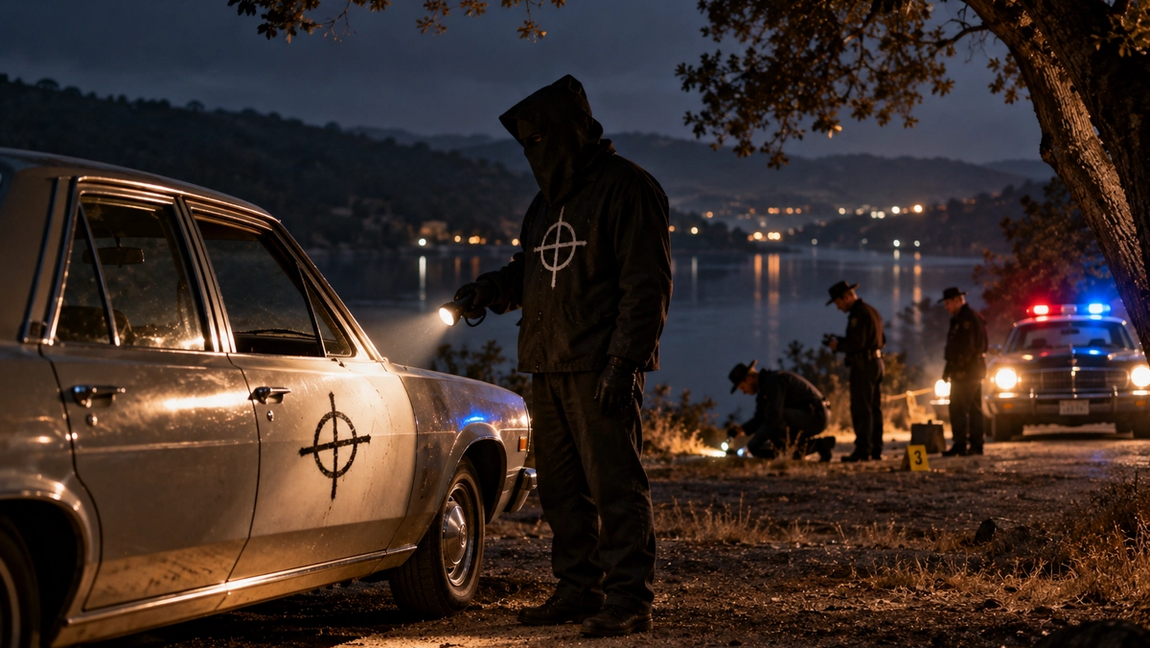
A man approached them wearing an unusual hooded costume marked with the Zodiac’s crosshair symbol.
He carried a gun but told the couple a story suggesting he needed money and a vehicle.
He then tied them up.
After restraining them, he attacked both with a knife.
Before leaving, the attacker wrote on Hartnell’s car door, listing dates associated with the earlier Zodiac attacks and adding the date of the Lake Berryessa attack.
Hartnell survived.
Shepard died from her injuries two days later.
The attack provided investigators with something extremely important: a surviving witness who had interacted with the attacker for several minutes.
Yet the costume concealed much of his appearance.
The Zodiac had once again managed to reveal himself while remaining hidden.
The Murder of Paul Stine Brought the Zodiac Into San Francisco
On October 11, 1969, taxi driver Paul Stine picked up a passenger in San Francisco.
The passenger directed him to the Presidio Heights neighborhood.
There, Stine was shot and killed.
Teenagers observing from a nearby house witnessed part of the crime and contacted police.
A police radio message mistakenly described the suspect as a Black man.
That error may have had enormous consequences.
Two patrol officers reportedly encountered a white man in the area but did not detain him, apparently because he did not match the description they had received.
The Zodiac later claimed that police had stopped or passed him shortly after the murder.
Whether every detail of his version was accurate remains uncertain.
What happened next removed much of the doubt that Stine’s murder was connected to the Zodiac.
A letter arrived at the San Francisco Chronicle containing a bloodstained piece of Stine’s shirt.
The writer had physical evidence from the crime scene.
This was not simply someone falsely claiming responsibility after reading about the murder.
Five People Were Killed in the Canonical Zodiac Attacks
The Zodiac claimed a much larger number of victims.
At various points, his letters suggested that his total was increasing dramatically.
Investigators have never confirmed those numbers.
The attacks most firmly associated with the Zodiac involve seven victims, five of whom died: David Faraday, Betty Lou Jensen, Darlene Ferrin, Cecelia Shepard, and Paul Stine were killed, while Michael Mageau and Bryan Hartnell survived.
Other murders and disappearances have been proposed as possible Zodiac crimes.
Some are intriguing.
None has been established with the same level of confidence as the canonical attacks.
That distinction is important because accepting the Zodiac’s own claims uncritically means allowing an unidentified murderer to write his own criminal history.
He had obvious reasons to exaggerate.
The Zodiac Sent a Much Harder Cipher
In November 1969, the Zodiac mailed another cipher to the San Francisco Chronicle.
This one contained 340 characters and became known as the Z340.
Unlike the first major cipher, it resisted solution for decades.
Professional cryptographers, amateur codebreakers, computer scientists, and Zodiac enthusiasts attempted to decipher it.
For 51 years, nobody produced a convincing solution.
Then, in 2020, David Oranchak, Sam Blake, and Jarl Van Eycke successfully cracked it using a combination of computational techniques and human analysis.
The solution was independently verified by the FBI.
The message again contained the Zodiac’s characteristic boasting and references to death.
Once again, however, it did not reveal his identity.
One of the most famous unsolved codes in American criminal history had finally been solved.
The larger mystery remained exactly where it had been.
Not Every Zodiac Letter Is Necessarily Authentic
The Zodiac case contains another major complication.
Once his letters became famous, newspapers and police received additional communications supposedly written by him.
Some are widely accepted as genuine.
Others remain disputed.
Copycats could imitate his symbol, writing style, spelling mistakes, and references once those details became public.
This makes reconstructing the Zodiac’s actual communication history difficult.
A letter appearing to come from the Zodiac is not automatically evidence that it did.
Investigators have had to consider handwriting, postal information, internal details, physical evidence, and other characteristics when evaluating authenticity.
The uncertainty matters because theories about the Zodiac’s identity often depend heavily on particular letters.
If the letter supporting a theory was actually written by a hoaxer, the theory can collapse with it.
The Zodiac May Have Claimed Crimes He Did Not Commit
One of the biggest problems with serial offenders who communicate with the media is that they can claim responsibility for crimes they had nothing to do with.
The Zodiac appears to have enjoyed increasing his supposed victim count.
That does not mean every claim was true.
Several unsolved murders have been proposed as possible Zodiac crimes because they occurred in California, involved young victims, or shared certain characteristics with the confirmed attacks.
The 1966 murder of college student Cheri Jo Bates in Riverside is among the most frequently discussed.
Bates was killed near Riverside City College, and anonymous letters were later connected with the case.
For years, some investigators and researchers considered whether the murder might have been an early Zodiac crime.
The connection remains unproven.
The problem is that once a killer becomes famous, almost every unsolved crime with superficial similarities can become attached to the legend.
Possibility gradually begins sounding like fact.
The Kathleen Johns Incident Added Another Mystery
In March 1970, Kathleen Johns was driving with her infant daughter near Modesto, California, when a man reportedly signaled that something was wrong with her car.
The man offered assistance.
Afterward, Johns said a wheel came off her vehicle and that the man offered to drive her to a service station.
Instead, according to her account, he drove around for an extended period while making threatening statements.
Johns eventually escaped with her child.
She later identified a police sketch of the Zodiac as resembling the man.
The Zodiac subsequently appeared to claim responsibility for the incident in a letter.
Whether he actually encountered Johns remains disputed.
He may simply have read newspaper coverage and taken credit.
Again, the Zodiac understood the value of uncertainty.
Once his name became attached to an incident, separating reality from his self-created mythology became difficult.
Arthur Leigh Allen Became the Most Famous Suspect
Over the decades, investigators examined numerous suspects.
The most famous was Arthur Leigh Allen.
Allen lived in California and attracted police attention partly because of statements and circumstances investigators considered suspicious.
He reportedly owned a Zodiac-brand watch displaying a crosshair-style logo, and people who knew him provided information that drew additional scrutiny.
Police searched his properties during the investigation.
Yet suspicion is not the same as proof.
Allen’s fingerprints did not clearly match prints associated with the Zodiac investigation, and handwriting comparisons did not establish that he wrote the letters.
Later attempts to use DNA evidence also failed to conclusively identify him as the Zodiac.
Allen died in 1992 without being charged with the Zodiac murders.
He remains central to books, documentaries, and popular theories, but no law-enforcement agency has established that he was the killer.
Many Other Men Have Been Named
Arthur Leigh Allen is far from the only person accused of being the Zodiac.
Over the years, authors, journalists, investigators, relatives, and amateur researchers have proposed numerous candidates.
Some theories depend on handwriting similarities.
Others rely on geographic connections, military backgrounds, photographs, coded interpretations, personal histories, or supposed hidden messages inside the Zodiac’s ciphers.
A recurring problem is confirmation bias.
Once someone decides that a particular person was the Zodiac, almost any detail can begin looking meaningful.
A birthday matches a date.
A workplace was near a crime scene.
A phrase resembles something in a letter.
A photograph looks vaguely like a police sketch.
Taken individually, these details may be interesting.
Together, they can create an impressive-looking theory without producing actual forensic evidence.
That is why identifying a plausible suspect is much easier than solving a criminal case.
A Group Claimed to Have Identified the Zodiac in 2021
In 2021, a private group calling itself the Case Breakers announced that it believed the Zodiac was a man named Gary Francis Poste.
The claim generated enormous media attention.
The group cited photographs, alleged similarities to police sketches, biographical information, and interpretations of the Zodiac’s communications.
Law-enforcement authorities did not accept the announcement as a solution to the case.
The FBI stated that the Zodiac investigation remained open.
Poste, who died in 2018, has therefore joined the long list of publicly proposed suspects rather than becoming the confirmed identity of the Zodiac.
The episode demonstrated how quickly a theory can become an internet headline.
“Researchers name possible suspect” can easily become “Zodiac identified” as the story spreads.
Those are not the same statement.
DNA Sounds Like the Obvious Solution, but It Is Complicated
Modern forensic genetics has solved cold cases that once appeared impossible.
Investigators can sometimes recover DNA from decades-old evidence and use genetic genealogy to identify suspects through relatives.
That naturally raises a question.
Why hasn’t DNA solved the Zodiac case?
The problem is the quality and origin of the available biological material.
Some Zodiac letters were mailed with stamps and envelopes that might theoretically contain saliva, but establishing that biological material came from the killer rather than a postal worker, laboratory employee, investigator, or another source can be difficult.
Evidence from the late 1960s was not collected under modern DNA protocols.
Items were handled by many people.
Some samples may be incomplete or contaminated.
A DNA profile is useful only if investigators can establish that it genuinely belongs to the person who committed the crimes.
Otherwise, sophisticated technology can produce a very precise answer to the wrong question.
The Police Sketch Is Useful but Far From a Photograph
After Paul Stine’s murder, witnesses helped police create a composite sketch of the suspect.
The image became one of the most recognizable police sketches in American history.
It shows a white man with short hair and glasses.
Countless Zodiac theories begin by comparing a suspect’s photograph with that drawing.
The problem is that composite sketches have limitations.
Witnesses observed the suspect under stressful circumstances and from a distance. Human memory is imperfect, particularly when recalling unfamiliar faces.
The sketch can help describe the general appearance reported by witnesses.
It cannot function like facial-recognition evidence.
Many white men living in California during the late 1960s could be made to resemble the drawing if the right photograph is selected.
Looking similar to a police sketch does not make someone the Zodiac.
Why Did the Confirmed Murders Apparently Stop?
The last canonical Zodiac murder occurred in October 1969, although letters continued afterward.
Why the confirmed attacks stopped remains unknown.
The killer may have died.
He may have been imprisoned for another offense.
He may have moved away.
He may have decided that continuing the murders created too much risk.
He may also have continued committing crimes that were never successfully connected to the Zodiac identity.
Another possibility is that the letters themselves became more important to him than the murders.
By late 1969, the Zodiac had achieved enormous public attention.
He could frighten millions of people simply by mailing an envelope.
That required far less risk than approaching victims in person.
Without knowing his identity, there is no way to determine which explanation is correct.
The Zodiac Was Not an Impossible Criminal Mastermind
Popular culture sometimes portrays the Zodiac as an almost superhuman criminal genius who constantly outsmarted investigators.
The evidence does not require that interpretation.
He made mistakes.
He left survivors.
He was seen by witnesses.
Police may have passed him near the Stine crime scene.
He left handwriting samples, fingerprints of uncertain evidentiary value, and enormous amounts of correspondence.
Some of his codes contained errors.
His ability to remain unidentified may have depended partly on the limitations of criminal investigation in the late 1960s.
Police departments did not share information through modern digital databases. Surveillance cameras were rare. DNA profiling did not exist. Mobile phones did not record movements. License-plate readers and widespread electronic transactions were decades away.
Someone committing the same series of crimes today would leave an entirely different trail.
The Zodiac may have been clever.
He was also operating in an era that made disappearing much easier.
The Media Helped Create the Zodiac Legend
The killer understood newspapers remarkably well.
He knew that threatening letters would generate headlines.
He knew that codes would attract public attention.
He knew that claiming additional victims would keep people afraid.
Newspapers faced a difficult decision.
Ignoring the letters might provoke further threats.
Publishing them gave the killer exactly what he wanted.
The result was a strange relationship in which the Zodiac committed crimes and then participated in shaping the story told about them.
That is one reason his case remains so famous compared with other unsolved murders from the same period.
He did not merely leave evidence.
He left a narrative.
And he made himself the central character.
What Do We Actually Know?
Once the speculation is removed, the reliable core of the case is surprisingly small.
Someone attacked seven people during four canonical incidents in Northern California between December 1968 and October 1969, killing five of them. The killer communicated with newspapers and police, provided information demonstrating knowledge of at least some crimes, used the name Zodiac and a crosshair symbol, and sent coded messages.
Two victims survived encounters associated with the Zodiac.
Witnesses observed a suspect.
Investigators collected letters, fingerprints, descriptions, and other evidence.
One major cipher was solved shortly after it was sent, while another remained unsolved until 2020.
Despite all of that evidence, no suspect has ever been conclusively identified as the Zodiac Killer.
Everything beyond that core requires different levels of caution.
The Zodiac may have killed additional people.
He may have written additional letters.
He may have committed crimes before 1968 or after 1969.
One of the famous suspects may have been responsible.
All of those things are possible.
None has been proven.
The Biggest Mystery Is Surprisingly Ordinary
The Zodiac case has accumulated so many codes, symbols, suspects, theories, disputed letters, and possible victims that it can seem impossibly complicated.
But the central mystery is extremely simple.
Who was the man behind the letters?
Somewhere in Northern California during the late 1960s, there was a person who went to work, bought food, interacted with neighbors, drove roads, received mail, and existed in ordinary society while secretly becoming one of America’s most notorious unidentified killers.
Someone probably knew him.
Someone may have worked beside him.
Someone may have seen his handwriting.
Someone may even have suspected something and dismissed the thought because it seemed impossible.
That is what makes the Zodiac case more unsettling than the codes themselves.
The most likely answer is not hidden inside an elaborate cipher or supernatural mystery. It is probably buried somewhere in ordinary records, forgotten evidence, or the life of a man whose name investigators once encountered without realizing its significance.
More than half a century later, the Zodiac’s greatest success is not that nobody has developed theories about his identity.
Thousands have.
It is that nobody has yet produced the evidence needed to prove one.