The Strange Case of the Mary Celeste’s American Connection
By Sonia Frankel on October 15, 2026
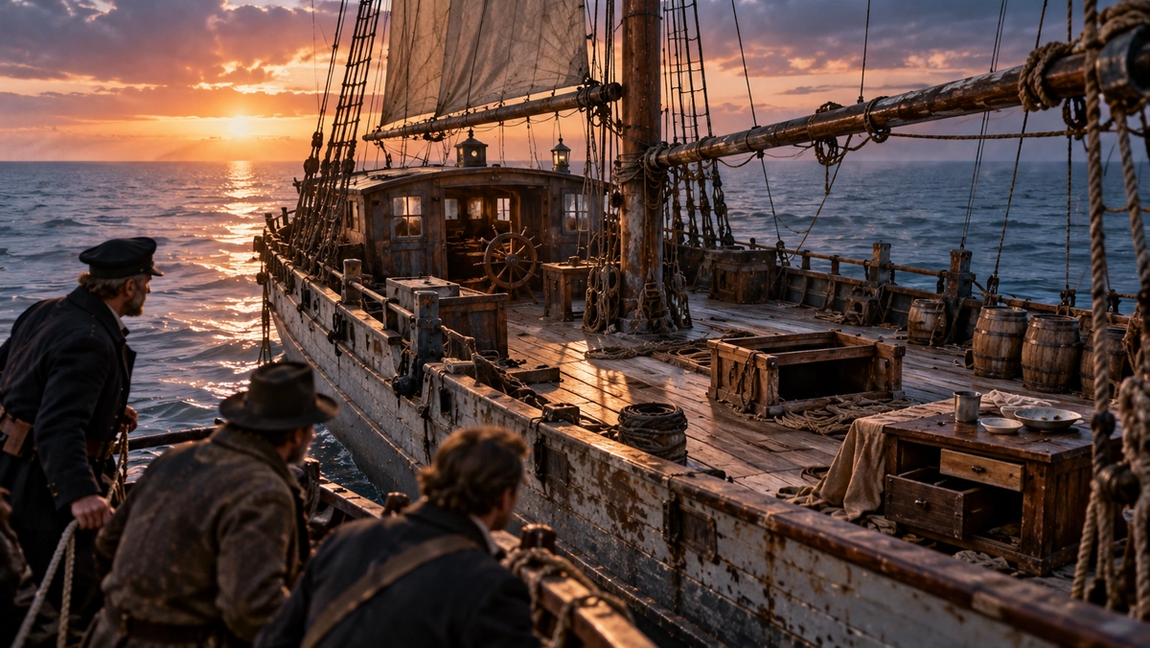
The Mary Celeste is usually remembered as one of history’s great maritime mysteries: a ship discovered drifting across the Atlantic in 1872 with its cargo largely intact, its crew nowhere to be found, and no obvious evidence explaining why everyone aboard had abandoned it. Over time, the story accumulated all the ingredients of a classic ghost ship legend, including untouched meals, mysterious disappearances, supernatural forces, piracy, sea monsters, and even suggestions that the crew had simply vanished from the deck without warning.
Much of that popular version is fiction. The real Mary Celeste was not found in perfect condition with breakfast still steaming on the table, and there is no evidence that anything supernatural occurred aboard it. What is often overlooked is another important part of the story: the vessel was deeply connected to the United States. It was American-owned when it disappeared, sailed from New York, carried an American captain and his family, and was headed toward Europe with a commercial cargo loaded in New York Harbor.
The actual mystery is therefore not simply why a crew disappeared from a ship in the Atlantic. It is why an experienced American captain apparently decided that leaving a seaworthy vessel in the middle of the ocean was safer than remaining aboard.
The Mary Celeste Did Not Begin With That Name
The ship that would eventually become the Mary Celeste was originally built in Nova Scotia and launched in 1861 under the name Amazon. Its early career was troubled by accidents and changes in command, helping later writers build the idea that the vessel had somehow been cursed, although nineteenth-century sailing ships routinely experienced dangerous voyages, damaged equipment, illnesses, and changes of ownership.
After suffering significant damage near Cape Breton Island in 1867, the vessel was considered a wreck and sold. American owners later acquired and repaired it, and the ship was eventually registered in the United States under a new name: Mary Celeste.
By the early 1870s, it was an American merchant brigantine operating in the busy Atlantic trade. There was nothing inherently mysterious about its purpose. Ships like the Mary Celeste carried commercial goods between American and European ports every day, and the people aboard accepted that crossing the Atlantic still involved substantial risks.
The voyage that made the ship famous began as one of those ordinary commercial journeys.
Captain Benjamin Briggs Was an Experienced American Sailor
The captain of the Mary Celeste was Benjamin Spooner Briggs, a Massachusetts-born mariner who came from a family with extensive experience at sea. Briggs had spent much of his life aboard ships and had worked his way into command, making him exactly the kind of person an owner would trust with a valuable vessel and cargo.
He was not traveling alone.
His wife, Sarah, accompanied him, as did their two-year-old daughter, Sophia. Their older son remained in Massachusetts with relatives because he was attending school.
The presence of Briggs’s family is important because it complicates theories suggesting that he casually abandoned the vessel or deliberately disappeared. Whatever decision he made aboard the Mary Celeste affected not only himself and his crew but also his wife and young daughter.
Briggs had every reason to be cautious.
If he ordered everyone into the ship’s small boat, he presumably believed remaining aboard presented an even greater danger.
Understanding what could have produced that belief is the key to the entire mystery.
The Voyage Began in New York Harbor
On November 7, 1872, the Mary Celeste departed New York Harbor bound for Genoa, Italy.
Its cargo consisted primarily of approximately 1,700 barrels of industrial alcohol.
The alcohol was valuable but also potentially dangerous because fumes could accumulate if barrels leaked.
Briggs commanded a crew of seven men, bringing the total number of people aboard to ten when his wife and daughter were included.
The Atlantic crossing initially appears to have been relatively ordinary, although the ship later encountered difficult weather.
Nothing in the surviving evidence indicates that Briggs expected the voyage to become historically significant.
He was simply transporting cargo from the United States to Europe.
Several days later, another vessel left New York on a similar Atlantic route.
That ship would eventually find the Mary Celeste.
The Dei Gratia Found Something That Did Not Look Right
On December 5, 1872, the British brigantine Dei Gratia was sailing between the Azores and Portugal when its crew spotted another vessel moving strangely.
The ship appeared to be drifting.
Captain David Morehouse recognized it as the Mary Celeste, which he knew had departed New York ahead of him.
The situation immediately seemed unusual.
The Dei Gratia approached, and crew members boarded the abandoned vessel.
What they found would generate more than a century of speculation.
The Mary Celeste was empty.
Captain Briggs was gone.
His wife and daughter were gone.
Every member of the crew was gone.
The ship’s small boat was also missing.
That last detail became one of the most important pieces of evidence because it strongly suggested that the people aboard had deliberately abandoned the vessel rather than suddenly disappearing.
The Ship Was Damaged, but It Was Not Sinking
Popular versions of the story often describe the Mary Celeste as being found in perfect condition, as though its occupants had vanished from a completely normal ship.
That is misleading.
The vessel had taken on water, although not enough to place it in immediate danger of sinking. Some equipment was damaged or missing, and the ship had clearly experienced difficult conditions.
One of its pumps had reportedly been taken apart, while another was not functioning properly. The sounding equipment used to determine how much water had entered the ship may also have contributed to uncertainty about its condition.
The cargo was mostly intact, although several barrels of alcohol were later found to be empty.
Personal belongings remained aboard.
There was still food and water.
The ship itself was capable of sailing.
This combination is what makes the case so puzzling.
The Mary Celeste was in trouble, but when the Dei Gratia found it, the trouble did not appear severe enough to explain why an experienced captain had placed ten people into a small boat in the open Atlantic.
Something must have looked much worse when Briggs made the decision.
The Missing Lifeboat Changes the Entire Story
The fact that the ship’s boat was missing is arguably more important than any supposedly mysterious object found aboard.
It tells us that the crew probably did not vanish unexpectedly.
They left.
Evidence suggested that the boat may have been secured to the Mary Celeste by a line before eventually becoming separated.
If that interpretation is correct, Briggs may not have intended to abandon the vessel permanently. He could have ordered everyone temporarily into the boat while keeping it attached to the larger ship.
That would make sense if he believed an explosion, sinking, or another immediate disaster was possible but hoped to return once the danger passed.
The tragedy may have occurred when the line connecting the boat and ship broke.
A sailing vessel under wind could quickly move away from a small open boat.
Once separated, the people aboard would have had little chance of catching it.
The Mary Celeste could then continue drifting safely across the Atlantic while the captain, his family, and crew were left behind in a boat designed for short emergency use rather than an ocean voyage.
If that happened, the mystery becomes tragically simple.
The ship survived the emergency.
The people who left it did not.
The Alcohol Cargo May Be the Most Important Clue
The Mary Celeste was carrying barrels of industrial alcohol, and nine barrels were later discovered empty.
The barrels were not all constructed from exactly the same type of wood. Some were reportedly made from more porous material, potentially allowing alcohol vapor to escape more readily.
That has led to one of the strongest theories about why Briggs abandoned the ship.
Imagine being aboard a wooden sailing vessel filled with barrels of alcohol and suddenly smelling powerful fumes coming from the cargo hold. The captain might reasonably fear that the cargo was leaking and that an explosion could occur.
He would have had no modern equipment capable of telling him precisely how dangerous the concentration of vapor had become.
His wife and two-year-old daughter were aboard.
Waiting to see whether the ship exploded would have been an extraordinary risk.
Under those circumstances, temporarily evacuating into the boat could have seemed like the safest decision.
Experiments conducted much later have also demonstrated that alcohol vapor can produce pressure events without necessarily leaving the dramatic burn marks people might expect from a conventional fire.
There is no definitive evidence that such an event occurred aboard the Mary Celeste, but the cargo provides a plausible reason why an experienced captain might suddenly become afraid of remaining aboard.
The Water in the Hold May Have Looked More Dangerous Than It Was
Another strong explanation involves the ship’s pumps and the captain’s ability to determine how much water was entering the vessel.
Sailing ships routinely accumulated some water in their holds, and pumps were used to remove it. The danger came when the crew could no longer determine whether the water level was stable or increasing.
The Mary Celeste had recently undergone work that may have left debris inside the vessel.
If debris clogged the pumps, Briggs could have faced a frightening situation. He knew water was entering the ship but may not have been able to pump it out effectively or accurately determine how rapidly the level was rising.
The vessel was also carrying a heavy cargo.
From the captain’s perspective, a damaged pump combined with water in the hold and potentially leaking alcohol could have suggested that the ship was becoming unsafe.
When the Dei Gratia discovered the vessel days later, the water level did not appear catastrophic.
Briggs did not have the benefit of knowing that.
Captains make decisions based on what they believe is happening at the time, not on what investigators discover afterward.
Weather May Have Made Everything Worse
The Atlantic around the Azores can produce difficult weather, and the Mary Celeste had encountered rough conditions during its voyage.
Briggs’s navigation records indicate that the ship had been dealing with challenging winds and seas.
Bad weather could have contributed to several problems simultaneously.
Water could enter the vessel.
Cargo could shift.
Barrels could leak.
Pumps could become difficult to operate.
Navigation could become less certain.
Any one of those problems might have been manageable.
Together, they could create the impression that the ship was approaching a serious emergency.
This is an important feature of many historical mysteries.
People often search for one dramatic event that explains everything.
Real disasters frequently result from several smaller problems occurring at the same time.
The Crew Probably Did Not Mutiny
One early theory suggested that the crew had consumed the ship’s alcohol, become violent, murdered Captain Briggs and his family, and escaped.
The evidence does not support that scenario particularly well.
The cargo consisted of industrial alcohol rather than ordinary drinking liquor, and consuming it could have been extremely dangerous.
There was also little evidence of violent conflict aboard the vessel.
No bodies were found.
No convincing blood evidence established a massacre.
The crew members had generally been considered experienced and reliable.
A mutiny followed by abandoning a functional ship in a small boat would also have been a strange plan.
The theory provided a dramatic explanation, which made it attractive to newspapers and later writers.
It did not provide strong evidence.
Piracy Does Not Fit Very Well Either
Pirates provide an obvious explanation whenever people disappear from a ship, but the Mary Celeste does not look much like a successful piracy case.
The cargo remained largely aboard.
Personal possessions were left behind.
The vessel itself was abandoned rather than stolen.
If pirates had attacked primarily for financial gain, leaving a valuable ship and most of its cargo drifting in the Atlantic would make little sense.
Another theory suggested that Captain Morehouse and the crew of the Dei Gratia had somehow been involved.
Because they salvaged the abandoned vessel and later claimed compensation, suspicion naturally followed.
A British vice-admiralty inquiry examined the circumstances carefully.
Officials questioned whether wrongdoing might have occurred, but no evidence established that Morehouse or his crew had murdered the people aboard the Mary Celeste.
The salvage crew’s discovery may have been unusual.
That does not make them killers.
There Was No Half-Eaten Breakfast Waiting on the Table
One of the most famous images associated with the Mary Celeste is a dining table filled with recently prepared food, as though the crew had disappeared halfway through breakfast.
It makes for an excellent ghost story.
It is not an accurate description of the evidence.
Many of the most dramatic details associated with the ship were created or exaggerated after the event.
A major source of confusion was a fictionalized story written by Arthur Conan Doyle in 1884, years before he became world-famous for Sherlock Holmes.
Doyle’s story altered the ship’s name slightly and invented numerous details.
Because the real case was already mysterious, fictional elements gradually became mixed with historical ones.
Later retellings repeated those details until they sounded authentic.
The result is that many people know a version of the Mary Celeste that never existed.
The real case needs no supernatural additions.
Ten people leaving a seaworthy ship in the middle of the Atlantic and never returning is strange enough.
The American Captain’s Family Makes the Decision More Understandable
Benjamin Briggs is sometimes portrayed as though he inexplicably panicked and abandoned his ship.
That interpretation overlooks the personal circumstances aboard.
Briggs was not simply responsible for cargo and sailors.
His wife and toddler were with him.
That may have changed how he evaluated danger.
A captain traveling only with professional sailors might accept a certain level of risk while investigating a leaking cargo or damaged pump.
A father responsible for his young daughter might make a different calculation.
If Briggs smelled alcohol vapor, believed the ship was taking on dangerous amounts of water, or feared an explosion, he did not have to be certain that disaster was coming.
He only had to believe that remaining aboard was riskier than temporarily leaving.
Ironically, that cautious decision may have caused the tragedy.
The Mary Celeste survived.
The boat apparently did not.
The Ship Continued Sailing After Everyone Was Gone
One of the eeriest aspects of the case is that the Mary Celeste apparently continued moving after it had been abandoned.
Wind and currents carried the vessel away from wherever Briggs and the others entered the boat.
That movement could explain why searchers never found them.
If the boat became separated from the ship during poor weather, the distance between them could increase rapidly.
From the small boat, the crew might have watched the Mary Celeste move farther away until it disappeared beyond the horizon.
They would then have been left with limited supplies and little protection from the Atlantic.
The larger ship, meanwhile, remained afloat long enough to be discovered.
That reversal is what gives the case its haunting quality.
The people probably left because they believed the ship was dangerous.
The ship was ultimately the safest place they could have been.
The Investigation Could Not Prove What Happened
When the Mary Celeste was brought to Gibraltar, a salvage inquiry examined the vessel and the circumstances surrounding its abandonment.
Officials considered whether a crime had occurred.
Questions were raised about possible violence, fraud, and the actions of the Dei Gratia crew.
Nothing established a convincing criminal explanation.
The absence of the people who could explain the decision created an impossible investigative problem.
Every important theory eventually reaches the same barrier.
Briggs knew why he ordered the ship abandoned.
His crew probably knew.
Sarah Briggs may have known.
None of them survived to explain it.
Investigators were left examining the ship after conditions aboard had changed during days of drifting.
The scene they inspected was not necessarily the scene Briggs had seen when he made his decision.
The Mary Celeste Was Not Cursed
After the disappearance, the ship continued sailing under different owners.
Its later career was not particularly fortunate, which helped strengthen stories that the vessel was cursed.
Eventually, in 1885, the Mary Celeste was deliberately wrecked near Haiti as part of an insurance fraud scheme.
That final chapter was criminal rather than supernatural.
The ship’s unusual history made it easy for writers to connect unrelated accidents and misfortunes into a larger story about a doomed vessel.
Humans are extremely good at finding patterns after something mysterious happens.
Once a ship becomes known as a ghost ship, every accident begins looking like part of the curse.
There is no evidence that the Mary Celeste was cursed.
It was a nineteenth-century merchant vessel operating in an industry where accidents, storms, illness, shipwrecks, and deaths were common.
What made it unusual was one voyage for which the final witnesses disappeared.
The American Connection Is Central to the Story
Although the Mary Celeste disappeared in the Atlantic and was discovered by a British vessel, its famous final voyage began as an American commercial operation.
The ship was American-owned and registered.
Its captain came from Massachusetts.
His wife and daughter were American.
The cargo had been loaded in New York.
The vessel departed from New York Harbor.
Its disappearance therefore belongs partly to American maritime history, particularly the era when American merchant ships routinely crossed the Atlantic carrying goods between rapidly expanding commercial ports.
The story also captures something about nineteenth-century America that is easy to forget.
The country’s economy depended heavily on sailors undertaking journeys that remained genuinely dangerous.
There were no satellite weather forecasts, GPS systems, emergency beacons, helicopters, or instant communications with shore.
Once a ship disappeared over the horizon, its captain was largely on his own.
A decision made incorrectly in the middle of the Atlantic could not easily be reversed.
What Most Likely Happened?
There is no definitive answer, but the strongest explanation does not require pirates, mutiny, murder, sea monsters, or supernatural forces.
The Mary Celeste probably experienced a combination of conditions that made Captain Briggs believe the vessel was in immediate danger.
The ship had taken on water.
Its pumping system was giving him reasons for concern.
The cargo included large quantities of alcohol, some of which had leaked.
The vessel had experienced difficult weather.
Briggs may therefore have believed that the ship was either sinking or facing a dangerous event involving the cargo.
He ordered everyone into the small boat, possibly intending to remain connected to the Mary Celeste while assessing the danger.
Something then separated the boat from the ship.
Perhaps the line broke.
Perhaps weather conditions worsened.
Perhaps the ship suddenly moved faster than expected.
Once the two vessels separated, the situation became almost impossible.
The Mary Celeste continued sailing.
The small boat carrying ten people disappeared into the Atlantic.
The Mystery Is Probably About a Mistake, Not a Disappearance
The popular version of the Mary Celeste asks how ten people could vanish from a perfectly good ship.
The historical evidence suggests a better question.
What convinced ten people that leaving the ship was safer than staying aboard?
That difference changes the entire mystery.
The missing boat indicates that they almost certainly left deliberately. The damaged equipment, water in the hold, difficult weather, and potentially leaking cargo provide several reasons why they might have done so. The absence of clear evidence of violence makes piracy and mutiny less persuasive, while the survival of the ship shows that whatever danger Briggs perceived did not ultimately destroy it.
The tragedy may therefore have resulted from a completely understandable decision made with incomplete information.
Benjamin Briggs could not know that the Mary Celeste would remain afloat.
He could only judge what he saw, heard, and smelled around him while responsible for his crew, his wife, and his two-year-old daughter.
More than 150 years later, the abandoned ship still receives most of the attention.
But the real story belongs to the people in the missing boat.
Somewhere in the Atlantic, they may have watched the Mary Celeste sail away without them, carrying the answer to the mystery safely toward Europe while the people who knew the truth disappeared into the sea.