Why Every American Generation Thinks It Lives in Unprecedented Times
By Helen Poole on October 15, 2026
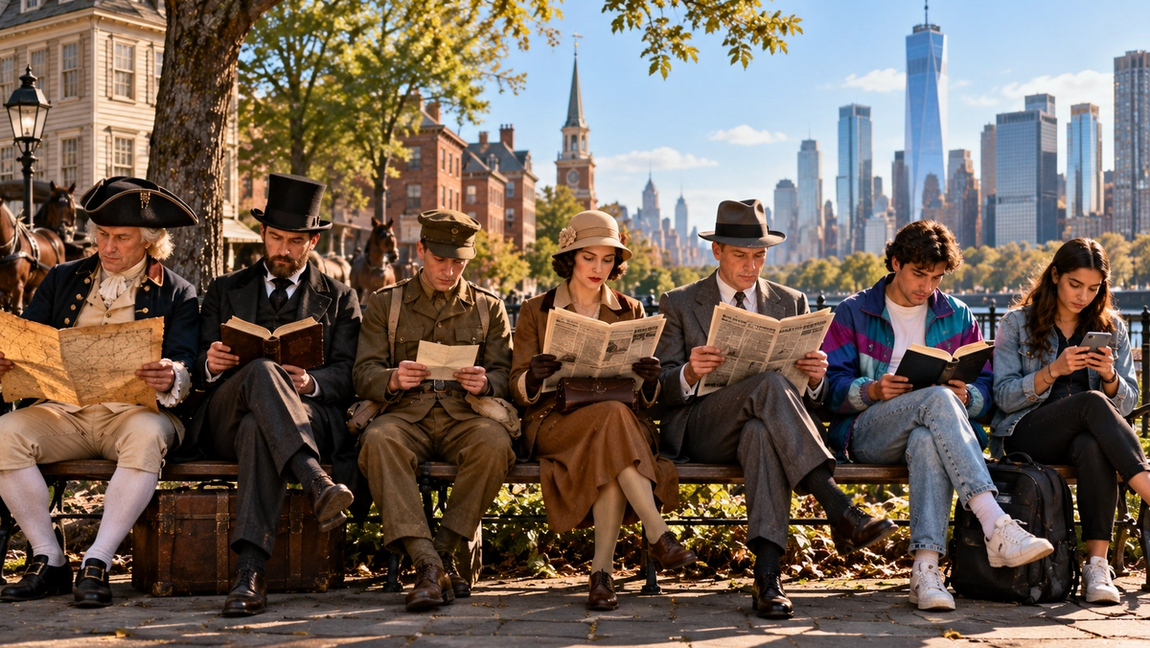
Almost every American generation eventually becomes convinced that the country has entered completely unfamiliar territory. Politics suddenly seems more hostile than ever, technology appears to be changing society faster than humans can handle, young people seem different from previous generations, traditional institutions appear to be weakening, the economy feels unusually uncertain, and some new crisis creates the impression that the old rules no longer apply.
Sometimes that feeling is justified. History really does produce moments when something fundamentally new happens, from the arrival of nuclear weapons to the creation of the internet. Yet Americans have also been declaring their own era uniquely chaotic for centuries, often using language remarkably similar to what later generations would say about entirely different crises.
The United States has experienced a revolution, a civil war, presidential assassinations, financial panics, mass migration, pandemics, world wars, political violence, economic depressions, technological revolutions, cultural upheavals, and repeated predictions that the republic was approaching collapse. Knowing that does not make modern problems unimportant. It simply reminds us that living through history feels very different from reading about it afterward.
The Founding Generation Thought the Republic Might Collapse Almost Immediately
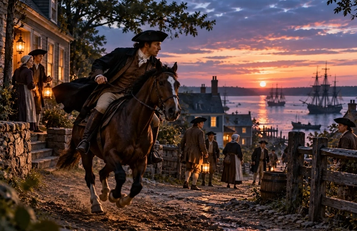
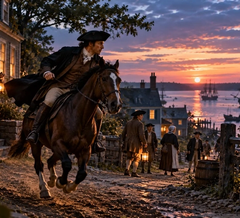
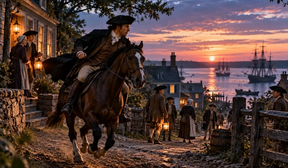
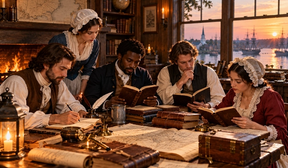
Modern Americans sometimes imagine the early republic as a period of unusual political unity, when the country’s founders calmly established institutions everyone respected. The reality was far messier. Within years of the Constitution taking effect, the people who had helped create the new government were accusing one another of threatening the future of the republic.
Political newspapers were vicious. Federalists and Democratic-Republicans portrayed each other as dangerous extremists. Thomas Jefferson’s opponents suggested that his political movement would produce chaos and radicalism, while Jefferson’s allies accused Federalists of attempting to create something resembling monarchy.
The election of 1800 became especially bitter. Americans were still conducting an experiment in republican government at a time when peaceful transfers of political power were far from guaranteed internationally. When Jefferson defeated John Adams and power passed between rival political factions, the country successfully completed something that now appears routine but then felt historically uncertain.
To the people living through it, American democracy did not look stable because nobody yet knew whether it would survive.
The 1830s Felt Like the Country Was Being Reinvented
By the era of Andrew Jackson, American society was changing quickly. Voting rights were expanding for many white men, political campaigning was becoming more populist, newspapers were becoming more influential, and westward expansion was transforming the country’s geography.
Supporters of Jackson celebrated these changes as democratic.
Opponents often viewed them as evidence that political culture was becoming reckless and dangerous.
The period also included fierce battles over the national bank, federal authority, tariffs, Native American removal, and slavery. Political disagreements were not polite debates conducted by detached statesmen. They involved enormous questions about who counted as part of the political community and what kind of nation the United States would become.
Americans living through the 1830s had good reasons to believe the country they had inherited was disappearing.
In many ways, it was.
A new version was taking its place.
The 1850s Really Did Feel Like the Country Was Breaking Apart
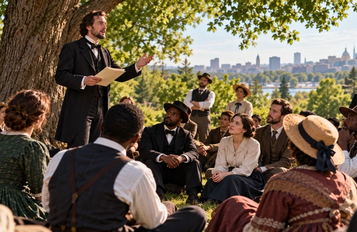
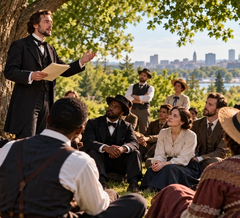
If any American generation had a strong claim to living through unprecedented political instability, it was the generation immediately before the Civil War.
The conflict over slavery had become impossible to contain.
Political parties fractured.
Violence erupted in Kansas.
A congressman nearly beat Senator Charles Sumner to death with a cane inside the U.S. Capitol after Sumner delivered an antislavery speech.
The Supreme Court’s Dred Scott decision intensified national divisions.
John Brown attempted to trigger a slave uprising through his raid on Harpers Ferry.
Americans increasingly stopped viewing political opponents simply as people with different policies and began seeing them as existential threats.
Then Abraham Lincoln won the election of 1860 without carrying most Southern states.
Secession followed.
Within months, Americans were shooting at one another.
More than 600,000 soldiers would die during the Civil War, and modern estimates often place the total even higher.
For people living through those years, warnings that the country might collapse were not exaggerations.
The country actually did split.
The remarkable part is that it was eventually reunited.
The 1890s Had Economic Panic, Labor Violence, and Political Anxiety
The late nineteenth century is sometimes remembered through images of elegant mansions, industrial expansion, railroads, and extraordinary economic growth.
It was also an age of severe inequality, dangerous working conditions, financial instability, and violent labor conflict.
The Panic of 1893 triggered a major economic depression. Banks failed, businesses collapsed, unemployment rose, and families faced severe hardship.
Labor disputes sometimes became violent confrontations involving workers, corporations, private security forces, police, and even federal troops.
At the same time, enormous corporations were transforming the economy. Railroads connected distant markets, factories reorganized work, and industrial fortunes reached levels that seemed almost unimaginable.
Americans debated whether concentrated corporate power threatened democracy itself.
That concern sounds surprisingly modern.
Replace railroads and steel companies with technology platforms and multinational corporations, and some arguments from the 1890s would feel remarkably familiar.
New Technology Has Been “Destroying Society” for Generations
Every major communications technology seems to produce anxiety about what it is doing to people’s minds and relationships.
The telegraph accelerated information.
The telephone allowed people to communicate without meeting face to face.
Radio brought outside voices directly into the home.
Movies exposed audiences to new cultural influences.
Television was accused of destroying conversation and encouraging passive entertainment.
Video games generated fears about attention, violence, and social isolation.
The internet created concerns about misinformation, privacy, pornography, addiction, and the decline of traditional media.
Smartphones intensified many of those anxieties.
Social media added another layer by turning ordinary people into publishers, performers, commentators, and targets of constant comparison.
Now artificial intelligence is producing a new version of the same question: what happens when technology changes how humans work, learn, create, communicate, and decide what is real?
The details genuinely change.
The emotional pattern does not.
A technology arrives, younger people adopt it quickly, institutions struggle to adapt, and older generations wonder whether something essential is being lost.
Sometimes they are partly right.
They are simply rarely the first generation to feel that way.
The Early 1900s Were Filled With Fear About Immigration
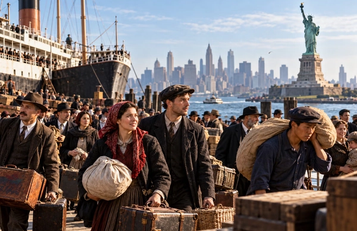
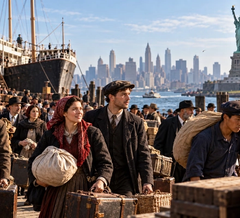
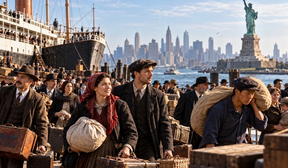
Between the late nineteenth and early twentieth centuries, millions of immigrants arrived in the United States, particularly from Southern and Eastern Europe.
Cities changed rapidly.
New languages could be heard in neighborhoods, factories, schools, and markets. Catholic and Jewish populations grew. Communities developed around Italian, Polish, Greek, Russian, Hungarian, and other immigrant identities.
Many native-born Americans became convinced that the country was changing too quickly.
Immigrants were accused of refusing to assimilate, depressing wages, bringing crime, introducing radical politics, and threatening American culture.
Those fears contributed to restrictive immigration laws during the 1920s.
Yet the descendants of many groups once considered dangerously foreign eventually became understood as ordinary parts of American society.
The pattern would repeat with later immigration from Latin America, Asia, the Caribbean, Africa, and elsewhere.
Each generation tends to remember earlier immigration after assimilation has occurred.
It experiences current immigration while that process is still happening.
That difference dramatically changes perception.
World War I Made Modern Warfare Feel Terrifyingly New
When the United States entered World War I in 1917, Americans encountered a type of industrial warfare that seemed radically different from earlier conflicts.
Machine guns, heavy artillery, submarines, poison gas, aircraft, and enormous armies demonstrated how technology could transform killing.
Millions had already died in Europe.
The war also transformed American society at home. The federal government expanded its role in the economy, propaganda campaigns encouraged public support, and dissent could bring intense social and legal pressure.
Then, just as the war was ending, influenza spread around the world.
The 1918 influenza pandemic killed enormous numbers of people, including many young adults.
Imagine experiencing global war and a devastating pandemic almost simultaneously without knowing how either would end.
People living through 1918 did not experience it as a chapter in a textbook.
They experienced it as an uncertain present.
The 1920s Looked Like a Cultural Revolution
After World War I, American culture changed rapidly.
Cars became more common.
Radio connected households to national entertainment and advertising.
Movies created celebrities with unprecedented cultural reach.
Jazz spread.
Women’s fashion changed.
Young people challenged older expectations surrounding dating, dancing, drinking, and sexuality.
Women had gained the constitutional right to vote nationwide.
Prohibition attempted to eliminate the legal alcohol industry and instead helped produce illegal markets and organized crime.
Older Americans frequently worried that traditional morality was disappearing.
The decade also saw intense conflicts involving race, religion, immigration, and national identity.
The Scopes Trial turned the teaching of evolution into a national cultural battle.
The Ku Klux Klan experienced a major revival.
Arguments over what America was becoming filled newspapers and political campaigns.
The idea of a national “culture war” is much older than the phrase commonly used to describe it today.
Then the Economy Seemed to Collapse
The prosperity of the 1920s ended dramatically after the stock market crash of 1929 and the economic collapse that followed.
Banks failed.
Businesses closed.
Unemployment reached catastrophic levels.
Families lost savings and homes.
Farmers who had already been struggling faced additional disaster.
Nobody living through the early years of the Great Depression knew when recovery would arrive.
There was no future textbook available explaining that the Depression would eventually end.
Instead, Americans watched familiar institutions fail around them while political movements around the world became increasingly radical.
Franklin D. Roosevelt’s New Deal dramatically expanded the federal government’s role in economic and social life.
Supporters believed government intervention was necessary to rescue capitalism and provide security.
Critics believed Roosevelt was transforming the relationship between citizens and the state too dramatically.
The arguments surrounding government spending, regulation, welfare, and economic intervention that emerged during this era never entirely disappeared.
World War II Made the Future of Democracy Feel Uncertain
Modern Americans know that the Allies won World War II.
Americans living through 1941 did not.
Nazi Germany controlled or dominated much of Europe.
Imperial Japan had expanded across Asia and the Pacific.
Pearl Harbor demonstrated that the United States itself could be attacked.
American families sent millions of people into military service without knowing whether they would return.
Cities practiced air-raid precautions.
Industries reorganized around wartime production.
Food and consumer goods were rationed.
Japanese Americans were forcibly removed from their homes and incarcerated by the federal government.
Then the war ended with the use of atomic bombs against Hiroshima and Nagasaki.
Humanity had entered the nuclear age.
For the first time, governments possessed weapons capable of destroying entire cities almost instantly.
That was genuinely unprecedented.
The 1950s Were Not as Calm as Nostalgia Suggests
The 1950s are often remembered through images of suburban houses, family dinners, booming consumer culture, and postwar prosperity.
That picture captures part of the era.
It leaves out another part.
Americans lived under the possibility of nuclear war with the Soviet Union.
Children participated in civil-defense drills.
Families built fallout shelters.
Political careers were destroyed during anticommunist investigations.
The Korean War killed tens of thousands of Americans.
The civil rights struggle was intensifying as Black Americans challenged segregation.
Television was rapidly changing politics and culture.
Teenagers embraced rock and roll, alarming many parents who believed popular culture was becoming dangerous.
Even one of America’s supposedly most stable decades contained enormous anxiety about social change and national survival.
The 1960s Felt Like the Country Was Coming Apart
The 1960s produced almost every ingredient associated with the feeling of national crisis.
President John F. Kennedy was assassinated in 1963.
Malcolm X was assassinated in 1965.
Martin Luther King Jr. was assassinated in 1968.
Robert F. Kennedy was assassinated weeks later.
The Vietnam War divided the country.
Civil rights protests transformed American politics.
Urban unrest erupted in several cities.
Young Americans challenged traditional attitudes toward race, gender, sexuality, authority, clothing, music, and war.
Television brought images of violence into American homes.
By 1968, the United States was dealing simultaneously with political assassinations, racial conflict, antiwar demonstrations, overseas warfare, generational rebellion, and intense presidential politics.
People were not imagining the instability.
They were living through it.
Yet the country continued.
The 1970s Produced a Crisis of Trust
If the 1960s challenged American social stability, the 1970s challenged Americans’ confidence in their institutions.
The Vietnam War ended in defeat for South Vietnam.
The Pentagon Papers revealed that government officials had misled the public about aspects of the war.
The Watergate scandal led Richard Nixon to resign the presidency in 1974.
Oil crises produced long lines at gas stations.
Inflation damaged household budgets.
Crime became a major concern.
Industrial competition increased.
Cities faced financial difficulties.
For many Americans, the idea that government leaders could be trusted had been severely weakened.
The country that had emerged from World War II with extraordinary confidence now appeared uncertain about its own direction.
Once again, Americans wondered whether the national system was fundamentally breaking down.
The 1980s Put Nuclear War in the Background of Everyday Life
The Cold War continued to shape American life during the 1980s.
The United States and Soviet Union possessed enormous nuclear arsenals capable of destroying civilization many times over.
Films, television programs, political debates, and protest movements reflected widespread anxiety about nuclear conflict.
At the same time, the American economy was undergoing significant changes.
Manufacturing employment declined in many communities.
Financial markets expanded.
Personal computers began entering workplaces and homes.
Cable television changed media.
Economic globalization accelerated.
The AIDS epidemic created another crisis, killing thousands while also exposing deep social prejudices and failures of public policy.
People living through the decade could reasonably wonder whether nuclear war, disease, economic transformation, or technological disruption would permanently reshape their future.
Several of those things did.
Just not always in the ways people expected.
The 1990s Were “Stable” Only in Retrospect
The 1990s are sometimes remembered as a relatively peaceful period between the Cold War and the September 11 attacks.
But people living through the decade did not necessarily experience it that way.
The Soviet Union had collapsed, suddenly ending the geopolitical structure that had defined American foreign policy for nearly half a century.
The Gulf War demonstrated a new style of technologically advanced warfare.
The 1993 World Trade Center bombing raised concerns about terrorism.
The Oklahoma City bombing in 1995 killed 168 people.
The Columbine High School massacre in 1999 transformed national conversations about school shootings.
Meanwhile, the internet was beginning to reshape communication, commerce, entertainment, journalism, and social life.
People wondered whether physical stores would survive, whether newspapers would disappear, whether online relationships were real, and whether computers would transform employment.
Then anxiety about the Y2K computer problem created fears that technological systems might malfunction when the calendar reached the year 2000.
The future once again appeared unpredictable.
September 11 Created a Genuine Historical Divide
The terrorist attacks of September 11, 2001, produced one of those rare moments when millions of Americans immediately understood that national life had changed.
Nearly 3,000 people were killed.
The attacks transformed airport security, intelligence agencies, foreign policy, military strategy, surveillance, and public attitudes toward terrorism.
The United States entered wars in Afghanistan and Iraq.
A generation of Americans grew up with airport security checkpoints, terrorism alerts, overseas military operations, and debates about privacy and national security as normal features of life.
For those who remembered the world before September 11, the change felt enormous.
For younger Americans, the post-9/11 security environment simply became the world they inherited.
That is how unprecedented events gradually become ordinary.
The 2008 Financial Crisis Made the Economic System Look Fragile
In 2008, major financial institutions collapsed or approached collapse as problems originating in housing and mortgage markets spread throughout the global financial system.
People lost homes.
Businesses failed.
Unemployment increased.
Retirement accounts lost value.
Governments intervened on an enormous scale to stabilize banks and markets.
For younger Americans entering adulthood during the crisis, the experience shaped attitudes toward employment, housing, debt, inequality, and financial institutions.
Once again, people heard language suggesting that the country faced the worst economic crisis since the Great Depression.
This time, the comparison was not unreasonable.
Yet recovery eventually came, just as earlier generations had recovered from financial panics that once seemed capable of permanently destroying prosperity.
Then a Pandemic Shut Down Ordinary Life
The COVID-19 pandemic beginning in 2020 created another moment that genuinely felt without precedent to most living Americans.
Schools closed.
Offices emptied.
Flights disappeared from schedules.
Restaurants and businesses shut their doors.
Hospitals faced enormous pressure.
Families were separated.
Millions of people began working from home.
Masks became part of everyday life.
Public spaces that had always seemed permanent suddenly became inaccessible.
The pandemic also collided with an already polarized political environment, turning questions about public health, government authority, schools, vaccines, and personal behavior into major political disputes.
Social media accelerated the spread of both reliable information and misinformation.
For many Americans, the combination of disease, isolation, economic disruption, protest movements, and political conflict made 2020 feel like the country had entered entirely unfamiliar territory.
In some respects, it had.
In others, Americans were repeating patterns visible during earlier pandemics, economic crises, and periods of political instability.
Social Media Makes Every Crisis Feel Larger
One major difference between modern crises and historical ones is the speed at which people experience them.
A nineteenth-century American might read about a political conflict in tomorrow’s newspaper.
A modern American can watch thousands of reactions within seconds.
Every controversial statement becomes a video clip.
Every disaster produces immediate images.
Every political argument generates endless commentary.
Every frightening event can be replayed repeatedly.
This changes our perception of frequency.
Events that once would have remained local can now become national experiences within minutes.
People encounter disasters from around the world before breakfast.
The human brain was not designed to process every crisis occurring across a continent simultaneously.
That does not mean modern problems are imaginary.
It means our awareness of them is historically unusual.
We experience not only our own problems but everyone else’s at the same time.
Memory Makes the Past Look Calmer Than It Was
There is another reason every generation thinks the present is uniquely unstable.
We already know how previous crises ended.
We know the Union survived the Civil War.
We know the Great Depression eventually ended.
We know the Allies won World War II.
We know the Cuban Missile Crisis did not produce nuclear war.
We know American institutions survived Watergate.
We know the Y2K transition did not cause technological collapse.
That knowledge makes historical crises feel safer than they actually felt to people experiencing them.
The present offers no such comfort.
We do not know how today’s conflicts will end.
That uncertainty creates anxiety.
History is tidy because someone has already written the final chapter.
The present is terrifying because nobody has.
Every Generation Also Thinks the Next One Is Different
Americans have been complaining about younger generations for an impressively long time.
Young people are supposedly less disciplined, less respectful, less hardworking, more distracted, more materialistic, or more politically extreme than the people who came before them.
Then those young people grow older.
Eventually, some of them begin making the same complaints about the next generation.
Technology intensifies the cycle because childhood genuinely changes.
A person raised with radio experienced information differently from someone raised with television. Someone raised with television experienced the world differently from someone raised with the internet. A child growing up with smartphones and artificial intelligence will develop habits unlike those of someone who first encountered those technologies as an adult.
Generational differences are real.
The belief that those differences prove society is collapsing is much older.
Sometimes Things Really Are Unprecedented
Historical perspective should not become an excuse for dismissing current problems.
Not everything has happened before.
Nuclear weapons created destructive capabilities no previous civilization possessed.
Human-driven climate change operates on a global scale.
Digital surveillance allows governments and corporations to collect quantities of information that earlier societies could barely imagine.
Artificial intelligence may transform intellectual work in ways previous technologies did not.
Modern biotechnology creates possibilities that would have sounded like science fiction to earlier generations.
History repeats patterns, but it does not repeat circumstances perfectly.
The useful lesson is not that nothing is new.
It is that “unprecedented” should be used carefully.
A new technology can create genuinely new problems while human reactions to those problems remain remarkably familiar.
America Has Always Been Becoming Something Else
One reason the United States repeatedly feels unstable is that it has never stopped changing.
Its population expanded from a few million people along the Atlantic coast into hundreds of millions spread across a continent.
Its economy moved from agriculture toward industry, then toward services, information, and technology.
Its population became increasingly urban and suburban.
Immigration repeatedly changed its cultural composition.
Political rights expanded.
Communication accelerated.
Family structures changed.
Religious participation changed.
Work changed.
Entertainment changed.
Ideas about race, gender, sexuality, citizenship, and individual freedom changed.
Every generation inherited a country that looked different from the one its grandparents knew.
From inside the process, that can feel like decline.
From a distance, historians usually call it transformation.
The Present Always Feels More Dangerous Because We Don’t Know the Ending
There is a psychological difference between knowing that something terrible happened and wondering whether something terrible is about to happen.
History gives us closure.
The present does not.
When we read about 1861, we already know the Civil War ends in 1865.
When we read about October 1962, we know nuclear war did not begin during the Cuban Missile Crisis.
When we read about 1929, we know the economy eventually recovered.
People living through those moments had none of that certainty.
Their future was genuinely unknown.
Ours is too.
That uncertainty makes every generation feel as though it has reached the edge of the map.
History Does Not Say “Everything Will Be Fine”
There is a comforting but dangerous way to interpret historical perspective: America survived previous crises, therefore it will automatically survive future ones.
History does not promise that.
Institutions survive because people maintain them.
Economic crises end because governments, businesses, communities, and individuals respond to them.
Social progress occurs because people organize for it.
Wars end because decisions are made and sacrifices are endured.
Historical resilience is not automatic.
Previous generations faced serious problems, made choices, sometimes failed badly, and sometimes built institutions that improved life for those who followed.
The lesson is not that people should stop worrying.
It is that panic and perspective can exist separately.
A problem can be serious without being completely unprecedented.
Someday, Our Chaos Will Look Like a Chapter
This is perhaps the strangest thing about living through history.
Ordinary life continues while major events unfold.
People went to work during the Great Depression.
Children attended school during the Cold War.
Families cooked dinner while the Cuban Missile Crisis unfolded.
People dated, married, argued, celebrated birthdays, watched television, and worried about money during years that later became textbook chapters.
The same thing is happening now.
Events that feel chaotic and disconnected in the present will eventually be organized into timelines, documentaries, museum exhibits, and history books. Future students will learn a few important dates, memorize several names, and wonder why people at the time could not see clearly what was happening.
They will have an advantage we do not.
They will know what happened next.
And there is a good chance that while studying our era, they will look at their own political arguments, technological disruptions, economic uncertainty, cultural conflicts, and frightening headlines and reach the same conclusion Americans have reached again and again:
This time is different.
In some ways, they will be right.
They just will not be the first generation to think so.