The Dyatlov Pass of American History: Strange American Disappearances
By Nomi Kander on October 15, 2026

The reason the Dyatlov Pass incident remains so fascinating is not simply that nine people died in the Russian wilderness in 1959. It is that investigators found enough evidence to reconstruct pieces of the story, but not enough to make every detail fit comfortably together.
American history contains disappearances with the same unsettling quality.
Ships have sailed away and never returned. Entire families have vanished from their homes. Children have disappeared from crowded public places. Aircraft have gone down without leaving confirmed wreckage. In some cases, investigators have strong theories about what probably happened, but one missing piece prevents the case from ever feeling completely solved.
The most interesting mysteries are rarely those where absolutely nothing is known. They are the ones where almost enough is known.
These are some of the American disappearances that continue to occupy that uncomfortable space between history and mystery.
The Lost Colony of Roanoke Left Behind One Word
More than three centuries before the disappearance of Amelia Earhart, another group vanished along the American coast.
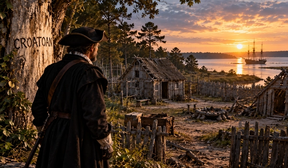
In 1587, more than one hundred English settlers established a colony on Roanoke Island in what is now North Carolina. Governor John White returned to England for supplies, expecting to come back relatively quickly.
War between England and Spain delayed him.
When White finally returned in 1590, the settlement had been abandoned.
There were no colonists waiting for him and no bodies suggesting that everyone had died there. Buildings had apparently been dismantled rather than destroyed in a sudden attack.
The most famous clue was the word CROATOAN carved into a post.
Croatoan was not a mysterious code. It referred to a nearby island and Indigenous community with whom the English had previously maintained relatively friendly relations.
White believed the colonists might have relocated there, but weather prevented him from investigating.
Modern historians generally consider relocation the strongest explanation. Some settlers may have moved toward Croatoan, while others may have traveled inland and eventually been absorbed into Indigenous communities.
Yet no archaeological discovery has conclusively accounted for every colonist.
The mystery survives because the settlers apparently told White where they were going.
History simply lost track of them afterward.
Theodosia Burr Alston Disappeared Into the Atlantic
Theodosia Burr Alston was the daughter of Aaron Burr, the former vice president remembered for killing Alexander Hamilton in a duel.
By 1812, Theodosia had experienced enormous personal tragedy. Her young son had died, her health was poor, and her father’s political career had collapsed.
At the end of that year, she boarded a schooner called the Patriot in South Carolina, intending to travel to New York to reunite with Burr.
The ship never arrived.
Neither Theodosia nor the other passengers and crew were ever confirmed to have been found.
The most likely explanation is straightforward. The Atlantic coast experienced dangerous winter weather, and the Patriot probably sank during a storm.
But the absence of wreckage allowed legends to grow.
Stories emerged claiming that pirates had attacked the ship. Various people supposedly made deathbed confessions decades later. Paintings and personal objects were occasionally presented as possible evidence that Theodosia had survived temporarily.
None of those stories has been convincingly proven.
The sea probably took the Patriot.
But because it left almost nothing behind, the disappearance became legend.
The Carroll A. Deering Was Found Without Its Crew
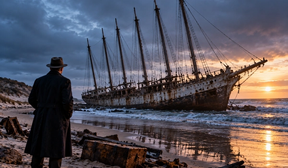
In January 1921, the five-masted schooner Carroll A. Deering was discovered grounded near Cape Hatteras, North Carolina.
The ship was largely intact.
Its crew was gone.
Some personal belongings and navigational equipment were missing, and the ship’s lifeboats were gone as well.
There was no confirmed explanation for what had happened to the people aboard.
The timing made the case particularly intriguing because several ships disappeared in the Atlantic around the same period.
Investigators considered mutiny, piracy, criminal activity, weather, and other explanations.
The case even became associated with later stories about the Bermuda Triangle, although the ship was found near North Carolina rather than mysteriously disappearing deep inside the region usually associated with that legend.
The most reasonable explanations involve conflict aboard the vessel or an emergency that caused the crew to abandon ship.
But abandoning a large sailing ship at sea was extraordinarily dangerous.
Whatever made the crew leave must have seemed worse than remaining aboard.
That is the part nobody has been able to explain conclusively.
Judge Joseph Force Crater Walked Into a New York Night and Vanished
On August 6, 1930, New York Supreme Court Justice Joseph Force Crater went to dinner in Manhattan.
Afterward, he entered a taxi.
Then he disappeared.
Crater’s disappearance became one of the most famous missing-person cases of twentieth-century America.
He had connections to New York’s complicated political world, and investigators discovered unusual financial activity around the time he vanished.
That immediately created theories involving corruption, organized crime, political enemies, secret relationships, and voluntary disappearance.
Crater’s wife initially believed he would return.
He never did.
The case received enormous newspaper coverage, and “pulling a Crater” briefly became slang for disappearing.
Despite investigations and countless theories, no confirmed remains were found and no explanation was established.
Decades later, new claims emerged suggesting that Crater may have been murdered and buried beneath what later became development in New York City.
Those claims were never conclusively proven.
His disappearance remains unsettling partly because it happened in Manhattan, not an isolated wilderness.
A prominent judge simply stepped into one of the busiest cities in the world and disappeared from history.
Amelia Earhart Vanished While the World Was Listening
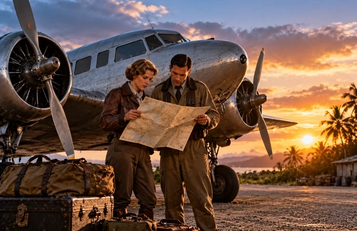
Amelia Earhart’s 1937 disappearance remains America’s most famous aviation mystery.
Earhart and navigator Fred Noonan were attempting an around-the-world flight when they departed Lae, New Guinea, for tiny Howland Island in the central Pacific.
The United States Coast Guard cutter Itasca waited near the island to assist them.
Radio operators heard Earhart’s transmissions.
She appeared to be approaching the area.
But she could not find Howland.
Her messages became increasingly urgent as fuel ran low, and eventually the radio fell silent.
No confirmed wreckage was found.
The strongest explanation remains that Earhart and Noonan failed to locate Howland Island, exhausted their fuel supply, and went down in the Pacific.
Another theory proposes that they reached Nikumaroro, then known as Gardner Island, and survived temporarily as castaways.
Researchers have investigated artifacts and historical evidence from the island, but nothing has conclusively established Earhart’s presence there.
The disappearance is haunting because rescuers were not searching years later.
They were listening while it happened.
Somewhere beyond the horizon, Earhart was trying to find an island that never appeared.
The Sodder Children Disappeared After a Christmas Eve Fire
One of America’s strangest family mysteries began on Christmas Eve in 1945.
George and Jennie Sodder lived in Fayetteville, West Virginia, with their children.
During the night, their house caught fire.
George, Jennie, and several children escaped.
Five children were believed to remain inside.
The house burned down.
Initially, the family assumed the five children had died.
Then questions emerged.
Searches reportedly failed to recover identifiable human remains belonging to the missing children. The family questioned whether the fire had been accidental and became suspicious about unusual events surrounding the disaster.
A ladder normally kept near the house had reportedly disappeared. The family’s attempts to use vehicles during the emergency were unsuccessful. Jennie Sodder later conducted experiments involving animal bones because she doubted claims that the fire could have completely destroyed the children’s remains.
The parents eventually became convinced that the children had been abducted.
Years later, the family received a photograph of a young man whom they believed might be one of the missing sons.
The image was never conclusively identified.
A billboard displaying photographs of the five children stood near the family’s property for decades.
The case has generated countless theories, but no definitive evidence has established whether the children died in the fire or survived it.
That uncertainty turned a family tragedy into one of America’s most persistent missing-person mysteries.
Flight 19 Helped Create the Bermuda Triangle Legend
On December 5, 1945, five U.S. Navy torpedo bombers took off from Florida for a training mission.
The group became known as Flight 19.
During the flight, the pilots became disoriented.
Radio communications indicated confusion about their position and direction.
Weather conditions deteriorated.
Eventually, communication stopped.
All five aircraft disappeared.
Then the mystery became even stranger.
A rescue aircraft sent to search for them also disappeared, although evidence suggests that it may have suffered a midair explosion.
The disappearance of Flight 19 later became one of the foundational stories of the Bermuda Triangle legend.
Books and television programs proposed unusual magnetic forces, extraterrestrial involvement, time distortions, and other extraordinary explanations.
The actual evidence points toward something much more familiar to aviation history: navigational confusion, worsening weather, and fuel exhaustion.
Yet the wreckage of the five aircraft has never been conclusively identified.
The supernatural explanations are unnecessary.
Five military aircraft disappearing during the same mission is strange enough without them.
The Martin Family Vanished During a Sunday Drive
On December 7, 1958, Kenneth and Barbara Martin left their home in Portland, Oregon, with their three daughters.
They planned to collect greenery for Christmas decorations in the Columbia River Gorge.
The family never returned.
Their abandoned vehicle was eventually found near the Columbia River.
Months later, the bodies of two of the daughters were recovered from the river.
The remaining family members were never found.
The discovery strongly suggests that the family’s vehicle may somehow have entered the water, but the circumstances have never been completely established.
Investigators also examined reports of suspicious activity in the area and considered whether foul play might have been involved.
The Columbia River’s powerful currents and difficult terrain complicated the search.
The case remains disturbing because part of the answer appears obvious.
Something catastrophic happened near the river.
But exactly how the family ended up there remains uncertain.
Three Men Escaped Alcatraz and Were Never Seen Again
On the night of June 11, 1962, Frank Morris and brothers John and Clarence Anglin carried out one of the most famous prison escapes in American history.
They escaped from Alcatraz.
The men had spent months enlarging openings in their cells using improvised tools.
They created dummy heads to place in their beds, climbed into utility corridors, reached the prison roof, and made their way toward the water.
They also constructed an improvised raft and flotation equipment from raincoats.
By the time guards realized what had happened, the men were gone.
Authorities concluded that the escapees probably drowned while attempting to cross the cold, powerful waters of San Francisco Bay.
But their bodies were never recovered.
That allowed another possibility to survive.
What if they made it?
Over the decades, relatives reported mysterious contacts, alleged sightings emerged, and a photograph surfaced that some investigators argued might show the Anglin brothers living in Brazil years later.
None of this has conclusively proven survival.
The official position has long leaned toward drowning, while the U.S. Marshals Service continued investigating the possibility that the men escaped successfully.
The case remains irresistible because the escape itself definitely worked.
The only unanswered question is whether they survived the final part.
The Springfield Three Vanished From a House Without an Obvious Struggle
In June 1992, three women disappeared from Springfield, Missouri.
Suzanne Streeter and Stacy McCall had recently graduated from high school. After attending graduation celebrations, they returned to the home Suzanne shared with her mother, Sherrill Levitt.
By the following morning, all three women were gone.
Their vehicles remained at the house.
Personal belongings were still there.
There was no clear scene explaining what had happened.
One unusual detail involved a broken porch-light globe, which friends reportedly cleaned up before realizing the women were missing, unintentionally altering part of the potential crime scene.
The women’s purses and other possessions remained behind, making a planned departure unlikely.
Investigators have pursued numerous leads over the decades, but no confirmed explanation has emerged.
The case is especially unsettling because three adults disappeared simultaneously from a residential neighborhood without leaving an obvious trail.
Whatever happened apparently happened quickly enough that nobody successfully raised an alarm.
Maura Murray Disappeared Beside a New Hampshire Road
On February 9, 2004, 21-year-old college student Maura Murray crashed her car along a rural road in New Hampshire.
A nearby resident spoke briefly with her and offered assistance.
Murray declined, reportedly saying that she had already contacted roadside help.
The resident returned home and contacted authorities anyway.
When police arrived only minutes later, Murray was gone.
Her belongings remained in the vehicle.
Searches of the surrounding area failed to locate her.
Investigators examined possibilities ranging from Murray walking away from the crash and becoming lost in the wilderness to accepting a ride from someone who harmed her.
Her actions before the disappearance also generated intense scrutiny because she had withdrawn money, purchased alcohol, and apparently left campus without clearly explaining her plans.
The case became one of the earliest missing-person mysteries to develop a massive online following.
That attention produced tips but also enormous amounts of speculation.
The central fact remains remarkably simple.
Murray was standing beside her damaged car.
A short time later, police arrived.
Somewhere within that narrow window, she disappeared.
Brian Shaffer Appeared to Enter a Bar but Was Never Clearly Seen Leaving
In March 2006, 27-year-old medical student Brian Shaffer went out with friends in Columbus, Ohio.
Late in the evening, security footage showed him near the entrance of the Ugly Tuna Saloona, a bar located inside a complex near Ohio State University.
Shaffer was seen speaking with two women outside the bar.
He then appeared to move back toward the entrance.
After that, there was no confirmed sighting of him.
Investigators reviewed available security footage but could not identify Shaffer clearly leaving through the main monitored exit.
That detail transformed the case into an internet mystery, with people sometimes describing it as though a man entered a building and somehow vanished inside it.
The reality is less supernatural. The building had other possible routes and areas that were not perfectly covered by cameras, and surveillance technology in 2006 was far from comprehensive.
Still, Shaffer’s disappearance remains unexplained.
His accounts showed no clear evidence of starting a new life, and extensive searches produced no confirmed trace.
A crowded nightlife district should have been one of the hardest places for someone to disappear.
Somehow, it was not.
The Jamison Family Case Became Stranger After They Were Found
In October 2009, Bobby and Sherilynn Jamison and their six-year-old daughter, Madyson, disappeared in Oklahoma.
Their pickup truck was later discovered abandoned in a remote area.
Inside were personal belongings, including wallets, identification, phones, and a substantial amount of cash.
The family’s dog was found alive in the vehicle.
The Jamisons themselves were nowhere nearby.
For years, their disappearance generated theories involving crime, drugs, family conflict, cult activity, and accidents.
Then, in 2013, hunters discovered skeletal remains several miles from where the truck had been found.
The remains were later identified as the missing family.
That solved one question.
It did not solve the larger mystery.
Investigators could not determine a definitive cause of death because of the condition of the remains.
The family had somehow traveled away from their vehicle and died in a remote area, but exactly why they left the truck and what happened afterward remains uncertain.
It is a useful reminder that finding missing people does not always solve a disappearance.
Sometimes it simply changes the question.
The Bermuda Triangle Is Probably Less Mysterious Than Its Reputation
No discussion of American disappearances feels complete without the Bermuda Triangle, the loosely defined area of the Atlantic between Florida, Bermuda, and Puerto Rico.
Stories about mysteriously disappearing ships and aircraft became enormously popular during the twentieth century.
The region acquired a reputation for unexplained compass failures, sudden disappearances, and unusually dangerous conditions.
The problem is that there is little evidence that ships and aircraft disappear there at an extraordinary rate compared with other heavily traveled areas of ocean.
Many famous Bermuda Triangle incidents have plausible explanations involving storms, navigation errors, mechanical failures, or incomplete historical reporting.
The ocean is enormous.
Weather changes quickly.
Before satellite navigation and modern communications, locating a missing ship or aircraft could be extraordinarily difficult.
The Bermuda Triangle demonstrates something important about historical mysteries.
Sometimes the mystery is real.
Sometimes the legend surrounding it becomes much larger than the evidence.
Why Do Some People Simply Seem to Vanish?
Modern life makes disappearance feel almost impossible.
Phones record locations. Credit cards leave transactions. Cameras cover streets and buildings. Cars contain computers. Social media records relationships and routines.
But large parts of the United States remain remarkably empty.
Mountains, deserts, forests, rivers, oceans, and rural landscapes can hide evidence surprisingly well.
Water is especially effective.
A vehicle entering a river or lake can remain undiscovered for decades even when people have searched nearby. Human remains in wilderness areas can be scattered or concealed by vegetation and terrain.
Older cases were even more difficult.
Investigators lacked DNA analysis, modern forensic databases, satellite imagery, digital records, and many of the search technologies available today.
A disappearance that might now generate hundreds of electronic clues could once leave almost none.
That does not require a conspiracy.
Sometimes geography is enough.
The Absence of an Answer Creates Its Own Story
Unsolved disappearances attract theories because uncertainty is uncomfortable.
If investigators find a body and establish a cause of death, a tragedy has an ending.
If they find nothing, almost anything remains imaginable.
Maybe the missing person started a new life. Maybe someone murdered them. Maybe they became lost. Maybe an accident occurred in a place nobody searched. Maybe investigators overlooked one crucial clue.
Over time, those possibilities can become legends.
Roanoke becomes a supernatural disappearance instead of a struggling colony that probably relocated. Flight 19 becomes evidence of the Bermuda Triangle rather than a likely navigational disaster. Amelia Earhart becomes a secret prisoner rather than a pilot who probably missed an extraordinarily small island.
The mysterious version often survives because it is more exciting.
But the real stories are usually more human.
America’s Strangest Disappearances Have One Thing in Common
The cases are separated by centuries, geography, technology, and circumstance, but they share the same frustrating feature.
Something is missing.
With Roanoke, we have the destination carved into wood but not the final fate of the settlers. With Earhart, we have radio transmissions but not the aircraft. With Alcatraz, we know how the prisoners escaped but not whether they reached land. With the Springfield Three, we have the house and belongings but no clear departure. With Maura Murray, we can narrow her disappearance to a remarkably short period but cannot determine what happened during it.
That missing piece creates the mystery.
Most of these cases probably have explanations that are far less extraordinary than the theories surrounding them. People become lost, aircraft crash, ships sink, accidents happen, crimes go undetected, and evidence disappears.
But probability is not proof.
Until the missing aircraft is found, the remains are identified, the wreckage appears, or another decisive piece of evidence emerges, the final paragraph cannot be written.
That is what makes these stories America’s closest equivalent to the Dyatlov Pass mystery.
We know enough to understand that something happened.
We simply arrived too late to see exactly what it was.