The Myths About American History That Just Won’t Die
By Gil Cohen on October 15, 2026

American history is full of stories that almost everyone knows. George Washington confessed to chopping down a cherry tree because he could not tell a lie. Benjamin Franklin wanted the turkey to become America’s national bird. Pilgrims and Native Americans sat down together for the first Thanksgiving exactly as modern families recreate it. Betsy Ross designed the first American flag, Paul Revere rode through Massachusetts shouting that the British were coming, and everyone in the colonies desperately wanted independence from Britain.
There is just one problem: many of these stories are either wrong, exaggerated, or so simplified that the real history has almost disappeared underneath them.
That does not mean American history is fake or that every familiar story should be treated with suspicion. Historical myths usually develop around real people and real events. Over generations, however, complicated stories become easier to remember when they are turned into simple lessons involving heroes, villains, memorable quotes, and dramatic moments. Schoolbooks repeat them, movies reinforce them, politicians reference them, and eventually the simplified version becomes more familiar than the evidence.
The real history is usually messier, but it is also far more interesting.
George Washington Probably Never Chopped Down the Famous Cherry Tree
The story seems designed for a children’s book because that is essentially what it was.
According to the legend, a young George Washington received a hatchet and damaged one of his father’s cherry trees. When confronted, Washington supposedly confessed because he could not tell a lie.
There is no reliable contemporary evidence that this happened.
The story became famous through Mason Locke Weems, a biographer who wrote about Washington shortly after the president’s death. Weems wanted to present Washington as a model of extraordinary moral character, and the cherry-tree story appeared in later editions of his biography.
It worked spectacularly.
Generations of American children learned a story intended to teach honesty, even though the story itself was probably invented.
Washington’s real life contains plenty of evidence of discipline, ambition, leadership, political calculation, mistakes, and contradictions. Turning him into a child incapable of lying actually makes him less interesting than the complicated historical person he was.
Benjamin Franklin Did Not Campaign to Make the Turkey the National Bird
This myth contains enough truth to keep surviving.
Benjamin Franklin did criticize the bald eagle in a private letter to his daughter, describing it as a bird of questionable character and speaking more favorably about the turkey.
That part is real.
What Franklin did not do was launch a serious campaign to make the turkey the national bird of the United States.
He was commenting humorously on the symbolism of the birds rather than proposing a national referendum on America’s official animal.
The United States did not even formally designate the bald eagle as the national bird through legislation until much later, although the eagle had appeared on the Great Seal since the eighteenth century.
Franklin’s amusing private remarks gradually became a much cleaner story: America’s eccentric founding father wanted a turkey instead of an eagle.
It is memorable.
It is just not what happened.
Betsy Ross May Have Sewn Flags, but the Famous Story Is Unproven
The traditional story says that George Washington visited Philadelphia seamstress Betsy Ross in 1776 and asked her to create a flag for the new nation. Ross supposedly suggested using five-pointed stars instead of six-pointed ones and then produced the design that became America’s first flag.
There is no contemporary documentation proving that meeting occurred.
The story became widely known decades later after Ross’s grandson presented the family’s account publicly in the nineteenth century.
Ross was a real upholsterer in Philadelphia and very likely produced flags during the Revolutionary era. Her connection to the flag-making business is therefore plausible.
What historians cannot establish is that she personally designed the first American flag or that the famous meeting with Washington happened exactly as later generations described it.
The problem is not that Betsy Ross had nothing to do with flags.
It is that “woman who probably made flags during the Revolution” gradually became “woman who designed the American flag.”
The second version fits much better into a textbook caption.
Paul Revere Was Not Alone, and He Probably Wasn’t Shouting “The British Are Coming!”
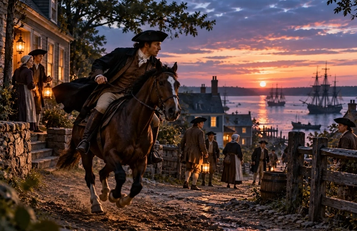
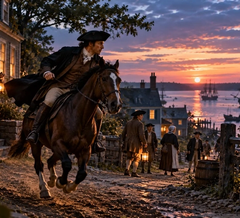
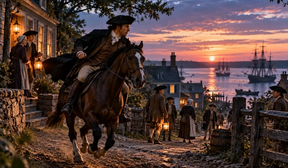
Paul Revere’s midnight ride is one of the most famous scenes of the American Revolution.
The popular version shows Revere galloping through the countryside shouting, “The British are coming!”
The real operation was more complicated.
Revere was part of a network of riders and messengers warning communities that British troops were moving from Boston toward Lexington and Concord. William Dawes and Samuel Prescott were among the other riders involved.
Revere himself was eventually stopped and detained by a British patrol before completing the entire route.
The famous phrase is also doubtful.
The colonists still considered themselves British, so shouting “The British are coming” would have sounded strange. The warnings were more likely phrased in terms of regular troops or British regulars moving out.
The simplified version owes much of its popularity to Henry Wadsworth Longfellow’s nineteenth-century poem about Revere.
The poem created an unforgettable national hero.
It also compressed a coordinated intelligence network into one man on one horse.
The Declaration of Independence Was Not Signed by Everyone on July 4
Americans celebrate July 4 as Independence Day, which makes it natural to imagine the Founders gathering around a table on July 4, 1776, and signing the Declaration of Independence together.
That is not how the process unfolded.
The Continental Congress voted for independence on July 2.
The wording of the Declaration was approved on July 4.
The famous handwritten engrossed copy was signed primarily on August 2, with some signatures added later.
John Adams himself believed July 2 would become the great American anniversary because that was when the actual independence resolution had been approved.
Instead, July 4 became the symbolic date because it appeared on the Declaration.
The familiar image of every signer dramatically gathering together on July 4 is a useful piece of national memory.
History happened through meetings, drafts, votes, revisions, printing, and signatures spread across several dates.
Apparently even revolutions involve paperwork.
Not Every Colonist Wanted Independence
The American Revolution is often remembered as though thirteen colonies collectively decided they had had enough of Britain and united behind independence.
Public opinion was much more divided.
There were committed Patriots who supported independence, Loyalists who remained loyal to the British Crown, and many people whose views were uncertain, pragmatic, or changed during the conflict.
Some colonists attempted to avoid choosing sides altogether.
The war also created difficult choices for Native nations, enslaved people, merchants, farmers, and families whose interests did not necessarily fit neatly into Patriot-versus-Loyalist categories.
Thousands of Loyalists eventually left the United States during or after the Revolution, with many relocating to Canada and other parts of the British Empire.
The Revolution succeeded.
That does not mean every person living in the colonies supported it.
The Boston Tea Party Was Not Exactly the Anti-Tax Protest We Remember
The Boston Tea Party is frequently summarized as Americans throwing tea into Boston Harbor because Britain raised taxes.
The reality was more complicated.
The Tea Act of 1773 did not simply impose a brand-new tea tax. In fact, it was structured partly to help the financially struggling British East India Company sell tea more effectively in the colonies.
The political issue was that accepting the tea would also mean accepting Parliament’s claimed authority to tax the colonies.
For many colonists, the dispute was therefore about representation and constitutional power rather than simply the price of a cup of tea.
Participants boarded ships in Boston Harbor and destroyed large quantities of East India Company tea.
Their actions triggered an aggressive British response through measures the colonists called the Intolerable Acts.
The Tea Party mattered enormously.
The myth is not that it happened.
The myth is that it can be explained as Americans getting angry because their tea suddenly became expensive.
The Pilgrims Did Not Create the Thanksgiving Americans Celebrate Today
There really was a harvest gathering at Plymouth in 1621 involving English colonists and members of the Wampanoag people.
But the modern Thanksgiving story compresses an extremely complicated history into a peaceful dinner scene.
The gathering probably lasted several days and looked very different from a modern Thanksgiving meal. Many foods now considered essential to the holiday were absent.
More importantly, relations between English colonists and Indigenous peoples did not remain permanently harmonious.
The Wampanoag had their own political reasons for developing an alliance with Plymouth, and the relationship existed within a region already devastated by diseases introduced through earlier European contact.
Over the following decades, expansion, land disputes, political conflict, and warfare transformed relations between settlers and Native communities.
The national Thanksgiving holiday developed much later and was shaped by nineteenth-century traditions as much as by the Plymouth gathering.
The 1621 event happened.
The problem comes when it is treated as the entire story of Indigenous-colonial relations.
Pocahontas Was Not an American Version of a Disney Romance
Pocahontas was a real Powhatan girl whose life became one of the most heavily romanticized stories in early American history.
The popular version centers on a romance between Pocahontas and English colonist John Smith.
There is no convincing evidence that the two had the romantic relationship later fiction imagined.
Pocahontas was probably around eleven or twelve years old when Smith encountered her.
Smith later claimed that she saved his life when her father, Powhatan, was preparing to have him killed, but historians have long debated what actually occurred and whether Smith misunderstood or embellished a ceremonial event.
Pocahontas later married English colonist John Rolfe, converted to Christianity, took the name Rebecca, traveled to England, and died there while still a young woman.
Her actual life involved diplomacy, colonization, cultural displacement, religion, politics, and competing societies.
Turning it into a simple love story removes almost everything historically significant about it.
Salem’s Accused Witches Were Not Burned at the Stake
The Salem witch trials of 1692 are often associated with images of women being burned alive.
That did not happen at Salem.
Nineteen people convicted of witchcraft were executed by hanging.
Giles Corey was pressed to death after refusing to enter a plea.
Others died while imprisoned.
No person convicted during the Salem witch trials was executed by burning at the stake.
The confusion probably comes from European witchcraft persecutions, where burning was used in some regions.
The American trials were horrific without adding fictional methods of execution.
They involved fear, questionable testimony, religious conflict, community tensions, and a legal system accepting claims that would later be recognized as deeply unreliable.
The real events are disturbing enough.
The Founders Did Not Agree on What America Should Become
The phrase “the Founding Fathers believed” should immediately raise a question: which ones?
Alexander Hamilton wanted a strong federal government and supported an ambitious national financial system.
Thomas Jefferson feared concentrated federal power and imagined an agricultural republic, although his own actions as president sometimes contradicted those principles.
John Adams had his own ideas about political stability and social hierarchy.
James Madison’s views developed considerably over his lifetime.
Arguments erupted over banking, foreign policy, constitutional interpretation, taxation, executive authority, and the relationship between states and the federal government.
The Founders were not a single political mind.
They disagreed intensely because many constitutional questions did not have obvious answers.
Modern Americans across the political spectrum frequently quote whichever founder supports a current argument.
The historical founders would probably have responded by arguing with one another.
The Civil War Was Fundamentally About Slavery
One of the most persistent myths in American history is that the Civil War was primarily about abstract “states’ rights” rather than slavery.
Southern states certainly used arguments involving state sovereignty.
The crucial question is what rights they were attempting to protect.
Their own secession documents, political speeches, and declarations repeatedly identified slavery and the future of slaveholding as central concerns.
The conflict had additional political, constitutional, economic, and regional dimensions, but removing slavery from the center of the explanation distorts why secession occurred.
There is also an irony in the states’ rights argument.
Slaveholding interests sometimes supported strong federal action when it protected slavery, including enforcement of laws requiring the return of people who escaped enslavement.
The issue was therefore not simply whether federal or state power should be stronger.
It was what those powers would do about slavery.
Abraham Lincoln Did Not Begin the Civil War Planning Immediate Nationwide Emancipation
Another simplification runs in the opposite direction by imagining that Abraham Lincoln entered office with a fully developed plan to immediately abolish slavery everywhere.
Lincoln personally opposed slavery, but his initial political position focused heavily on preventing its expansion into new territories.
When the Civil War began, preserving the Union was his immediate objective.
The war gradually transformed federal policy.
Enslaved people themselves played a major role by escaping to Union lines and forcing military and political authorities to confront what freedom would mean in practice.
Congress passed measures weakening slavery.
Lincoln issued the Emancipation Proclamation, which took effect on January 1, 1863 and declared enslaved people free in areas under rebellion, with important limitations.
The Thirteenth Amendment eventually abolished slavery throughout the United States.
Emancipation was therefore a process shaped by military necessity, abolitionist pressure, enslaved people’s actions, congressional legislation, presidential decisions, and constitutional change.
History is often taught as though one person made one decision.
Reality usually requires more people.
The Underground Railroad Was Not an Actual Railroad
Nobody who studies the subject seriously believes Harriet Tubman was secretly operating a locomotive, but popular imagery can still make the Underground Railroad seem more organized and centralized than it really was.
It was a loose network of routes, safe locations, free Black communities, abolitionists, religious groups, guides, and individuals who helped enslaved people escape.
There was no single headquarters controlling the entire operation.
Harriet Tubman became one of its most famous conductors after escaping slavery herself and repeatedly returning to help others reach freedom.
But enslaved people were not simply passive passengers waiting to be rescued by abolitionists.
Escape usually began with their own extraordinary decision to risk capture, punishment, separation, and possibly death in pursuit of freedom.
The Underground Railroad worked because countless people made individual choices within informal networks.
Its lack of central organization was part of what made it difficult to destroy.
Cowboys Were Not All White Men
Hollywood shaped the popular image of the American cowboy as a white man riding across an empty Western landscape.
The historical cattle industry was much more diverse.
Black cowboys made up a significant part of the workforce, particularly after the Civil War.
Mexican vaqueros had already developed many of the skills, equipment, terminology, and traditions later associated with American cowboy culture.
Native Americans also worked in ranching and cattle operations.
Even the English vocabulary of the American West reflects Spanish and Mexican influence through words connected with ranching and equipment.
The cowboy did not emerge from a purely Anglo-American tradition.
He emerged from the cultural mixing of the borderlands.
The Western movie simplified that history because a familiar hero was easier to market.
People in the Wild West Were Not Constantly Having Shootouts
The American frontier certainly contained violence, but popular culture has dramatically exaggerated the frequency of classic quick-draw gunfights.
Many Western towns had laws regulating the carrying of firearms.
Visitors could be required to surrender weapons when entering certain communities.
The famous gunfight at the O.K. Corral became famous partly because confrontations like it were notable, not because residents were participating in street duels every afternoon.
Violence in the West often took forms that movies found less glamorous, including domestic violence, racial violence, conflicts involving labor, attacks on Indigenous communities, and disputes over land and resources.
Hollywood transformed complicated frontier communities into landscapes where two men regularly solved disagreements at high noon.
Real life involved far more paperwork, farming, mining, ranching, business, family life, and boredom.
“Let Them Eat Cake” Has an American Cousin in Almost Every Era
Famous historical figures attract memorable quotes they probably never said.
American history is filled with them.
George Washington, Abraham Lincoln, Thomas Jefferson, Benjamin Franklin, and other major figures are routinely credited online with quotations that either originated elsewhere or were invented long after their deaths.
The internet has made this problem dramatically worse because a sentence placed beside a black-and-white portrait immediately looks authoritative.
Jefferson is particularly vulnerable because attaching his name to a political statement gives it instant historical weight.
The safest approach to an unusually perfect historical quotation is simple: check whether anyone recorded it near the time the person supposedly said it.
If the earliest appearance occurs a century later, skepticism is probably justified.
Rosa Parks Was Not Simply a Tired Seamstress Who Spontaneously Refused to Move
One of the most common versions of Rosa Parks’s story presents her as an ordinary woman who became physically tired after work and unexpectedly decided not to surrender her bus seat.
Parks was indeed a seamstress.
But she was also an experienced civil rights activist.
She had served as secretary of the Montgomery chapter of the NAACP and had been involved in racial justice work long before her arrest in December 1955.
Her refusal was courageous, but it did not occur in a political vacuum.
Black activists in Montgomery had been organizing around transportation discrimination, and Parks’s arrest became the catalyst for the Montgomery Bus Boycott because an existing community network was capable of organizing quickly.
The simplified version turns systemic activism into an accidental heroic moment.
The real version is more powerful because it shows how preparation allows individual courage to become collective action.
Americans Did Not All Live in Perfect Nuclear Families in the 1950s
Popular nostalgia often imagines the 1950s as an era when nearly everyone lived in a detached suburban house supported by one income while a mother stayed home with several children.
That family structure certainly became culturally influential and was more common in some groups than it would later be.
It was never universal.
Millions of women worked outside the home.
Black families faced housing discrimination and employment barriers that excluded many from the prosperity associated with postwar suburbia.
Rural poverty remained significant.
Divorce existed.
Single-parent households existed.
Families lived in apartments, cities, farms, and multigenerational homes.
Television programs presented an idealized version of middle-class domestic life.
Later generations sometimes mistake the ideal for a statistical description of the entire country.
Every era edits itself before becoming nostalgia.
America Was Never Completely Isolated From the Rest of the World
Another common story describes the United States as naturally isolationist until world events forced it onto the international stage.
Americans certainly had strong traditions of avoiding permanent European political entanglements, but the country was never truly disconnected from global affairs.
American merchants traded internationally from the beginning.
The United States fought wars involving North Africa, Mexico, Spain, the Philippines, and Indigenous nations across the continent.
American businesses invested overseas.
Missionaries traveled internationally.
Immigration connected American communities to events around the world.
By the end of the nineteenth century, the United States controlled overseas territories and possessed significant international economic influence.
The country sometimes tried to avoid particular kinds of foreign commitments.
That is different from isolation.
Why Do These Myths Survive?
Historical myths survive because they are efficient.
“The Civil War resulted from a complicated political crisis centered fundamentally on slavery, federalism, expansion, and secession” requires explanation.
“The Civil War was about states’ rights” fits on a bumper sticker.
“The first Thanksgiving developed within a complicated diplomatic relationship between English colonists and the Wampanoag” requires context.
“Pilgrims and Indians became friends over dinner” can be explained to a child in thirty seconds.
Simple stories are easier to teach, remember, dramatize, and repeat.
They also give nations useful symbols.
Washington becomes honesty.
Revere becomes patriotism.
Ross becomes national creation.
Parks becomes individual courage.
The problem begins when symbols replace people.
Good History Usually Makes the Story More Complicated
Correcting historical myths can sometimes sound like an attempt to ruin familiar stories.
It does not have to be.
Paul Revere becomes more interesting when we understand the intelligence network around him.
Rosa Parks becomes more impressive when we understand the years of activism behind her decision.
The American Revolution becomes more fascinating when we recognize that independence was controversial rather than inevitable.
The Civil War becomes more understandable when we read what secessionists themselves said they were fighting to preserve.
Pocahontas becomes a real historical person rather than a romantic character.
The past does not become less meaningful when myths disappear.
It becomes populated by actual human beings making difficult decisions inside circumstances they could not fully control.
The Biggest Myth Is That History Has a Simple Version
Perhaps the most persistent misconception about American history is the idea that somewhere there is one clean version containing all the correct heroes, villains, motives, and lessons.
History rarely works that way.
People contradict themselves.
Political movements contain competing factions.
Important events have multiple causes.
Good people make terrible decisions.
People responsible for serious injustices sometimes accomplish important things in other areas.
Progress can happen alongside exploitation.
Victories create unintended consequences.
Historical understanding therefore requires something more difficult than memorizing dates.
It requires becoming comfortable with complexity.
The familiar myths will probably never disappear completely because they are simply too useful as stories. Children will continue hearing about Washington and the cherry tree. Paul Revere will continue riding alone through movies and school plays. Betsy Ross will continue sitting beside the first American flag in paintings and illustrations.
But knowing the myths does not mean we have to confuse them with history.
The real American story is less polished, less predictable, and much harder to fit into a single sentence.
That is exactly what makes it worth learning.