The Real Story of How America Entered Every Major War
By Marie Wells on October 15, 2026
America rarely enters a war for just one reason.
Yet history is often remembered that way. The United States entered World War I because of German submarines. World War II began for America with Pearl Harbor. Vietnam was about stopping communism. The Gulf War was about liberating Kuwait.
Those explanations are not necessarily wrong. They are incomplete.
Wars usually emerge from years of political decisions, economic interests, alliances, security fears, territorial ambitions, ideological conflicts, and events that finally make continued neutrality politically impossible.
The United States is no exception.
From the early republic to the wars of the twenty-first century, understanding why America fought requires looking beyond the moment shooting started.
The War of 1812 Was About Much More Than One Dispute
The United States declared war on Britain in June 1812.
One major source of tension was Britain’s interference with American shipping during the Napoleonic Wars. The British Royal Navy also practiced impressment, taking sailors from vessels and forcing them into British service. Americans were furious when this affected sailors they considered American citizens.
But maritime rights were only part of the story.
Some American political leaders also blamed Britain for supporting Indigenous resistance to U.S. expansion in the Northwest. At the same time, expansionists looked toward British-controlled Canada.
National pride mattered too.
The United States had won independence from Britain only a few decades earlier, yet many Americans believed Britain still treated the young country as a subordinate power.
The result was a strange and difficult war that included failed American invasions of Canada, the British burning of Washington, and the famous American victory at New Orleans.
Ironically, the Battle of New Orleans occurred after negotiators had already signed the treaty ending the war, although news had not yet reached the armies.
The War of 1812 demonstrated an early pattern in American history: economic disputes, security concerns, national pride, and territorial ambitions could combine until war became politically possible.
The Mexican-American War Followed Expansion West
The Mexican-American War began in 1846, but its origins were tied to the rapid territorial expansion of the United States.
Texas had declared independence from Mexico in 1836 and was annexed by the United States in 1845.
Mexico still disputed the loss of Texas, and the two countries disagreed about the border. The United States claimed the Rio Grande, while Mexico maintained that the boundary lay farther north at the Nueces River.
President James K. Polk sent American troops into the disputed territory.
After Mexican and American forces clashed, Polk told Congress that Mexico had attacked American soldiers on American soil.
Critics challenged that description.
Among them was a young congressman named Abraham Lincoln, who demanded that Polk identify the exact “spot” where the attack had occurred.
Behind the border dispute was a much larger idea: Manifest Destiny.
Many Americans believed the United States was destined to expand across the continent.
The war ended with an enormous transfer of territory from Mexico to the United States, including lands that became California, Nevada, Utah, and parts of several other states.
It also intensified America’s internal argument over whether slavery would expand into the newly acquired territories.
A war of expansion abroad therefore helped accelerate the political crisis developing at home.
The Civil War Began With Secession, but Slavery Was at Its Center
The American Civil War was not a foreign war, but no account of America’s major conflicts can reasonably leave it out.
Eleven Southern states ultimately seceded from the Union after Abraham Lincoln’s election in 1860.
The central issue driving the sectional crisis was slavery, particularly its protection and expansion.
Secession declarations and statements from Southern political leaders repeatedly made the preservation of slavery central to their arguments.
Lincoln initially framed the federal war effort primarily around preserving the Union rather than immediately abolishing slavery everywhere.
But the nature of the conflict changed.
Enslaved people fled to Union lines, Black Americans pushed the government toward emancipation, and the military importance of slavery became increasingly obvious.
Lincoln issued the Emancipation Proclamation, which took effect in 1863 and declared enslaved people in areas under Confederate rebellion free.
Nearly 180,000 Black men eventually served in the Union Army, with additional Black sailors serving in the Navy.
By the war’s end, preserving the Union and destroying slavery had become inseparable outcomes of Union victory.
The conflict killed hundreds of thousands of Americans and permanently changed the constitutional relationship between the federal government, the states, and citizenship itself.
The Spanish-American War Was Fueled by Cuba, Journalism, and an Explosion
By the 1890s, Cuba was fighting for independence from Spain.
Reports of Spanish repression generated considerable sympathy in the United States.
American newspapers covered the conflict aggressively, and sensationalist reporting helped intensify public anger toward Spain.
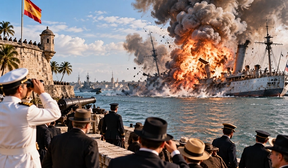
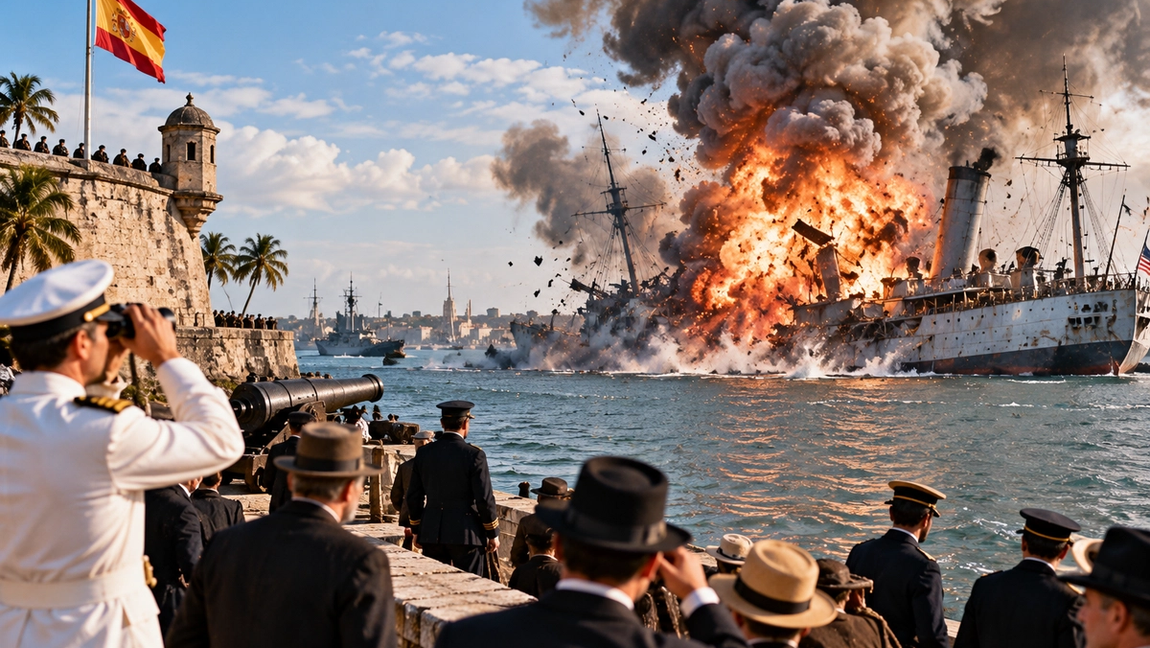
Then, in February 1898, the USS Maine exploded in Havana Harbor.
More than 260 American sailors were killed.
At the time, many Americans blamed Spain, although the exact cause of the explosion remained uncertain and later investigations produced competing explanations.
Public pressure for intervention increased dramatically.
The United States declared war against Spain in April.
The resulting conflict lasted only a few months but had enormous consequences.
Spain lost control of Cuba and ceded Puerto Rico, Guam, and the Philippines to the United States.
America had entered the war partly in the language of Cuban liberation.
It emerged from the conflict with an overseas empire.
That contradiction would become especially clear in the Philippines, where American forces soon fought Filipino independence fighters in a brutal war.
World War I Took Years to Pull America In
When World War I began in Europe in 1914, President Woodrow Wilson declared American neutrality.
Many Americans wanted nothing to do with Europe’s enormous conflict.
But remaining neutral became increasingly difficult.
Britain’s naval blockade affected trade, while Germany’s submarine warfare threatened ships traveling across the Atlantic.
In 1915, a German submarine sank the British passenger liner Lusitania, killing nearly 1,200 people, including more than 100 Americans.
The attack outraged the United States, but America still did not immediately enter the war.
The decisive crisis came in 1917.
Germany resumed unrestricted submarine warfare, meaning its submarines would attack ships in designated war zones without the traditional warning procedures.
Then came the Zimmermann Telegram.
Germany had secretly proposed that Mexico join a war against the United States if America entered the European conflict. Germany suggested Mexico could potentially recover territories it had lost to the United States.
British intelligence intercepted the message, and its publication shocked American opinion.
In April 1917, Wilson asked Congress for a declaration of war against Germany.
America had not been dragged into World War I by a single incident.
It had moved gradually from neutrality toward intervention as economic connections, submarine warfare, national security concerns, and German decisions narrowed the political space for staying out.
Pearl Harbor Brought America Into World War II
World War II offers the clearest famous trigger.
On December 7, 1941, Japan attacked the American naval base at Pearl Harbor in Hawaii.
The following day, the United States declared war on Japan.
But the confrontation had been developing for years.
Japan had expanded aggressively across East Asia, including its invasion of China. As Japanese expansion continued, the United States imposed increasingly severe economic restrictions.
In 1941, the United States froze Japanese assets and effectively cut off Japan’s access to American oil.
Japanese leaders faced a strategic choice.
They could reduce their expansion, negotiate an agreement, or attempt to seize resource-rich territories in Southeast Asia.
Japan chose war.
The attack on Pearl Harbor was intended in part to weaken the U.S. Pacific Fleet long enough for Japan to consolidate its expansion.
Several days later, Germany and Italy declared war on the United States.
America was now fully involved in both the Pacific and European wars.
Pearl Harbor was the immediate cause of American entry.
But the road to Pearl Harbor had been built through years of Japanese expansion, American economic pressure, failed diplomacy, and competing visions of power in the Pacific.
Korea Began With an Invasion and a Cold War Test
After World War II, Korea was divided roughly along the 38th parallel.
The Soviet Union supported the communist government in the North, while the United States supported the government in the South.
On June 25, 1950, North Korean forces invaded South Korea.
The United States responded quickly.
President Harry Truman viewed the invasion through the emerging logic of the Cold War.
American leaders feared that allowing communist expansion to succeed without resistance could encourage similar moves elsewhere.
The United Nations Security Council authorized assistance to South Korea, made possible in part because the Soviet Union was boycotting the council at the time.
American troops formed the majority of the international force.
The war eventually expanded dramatically when Chinese forces entered after U.N. troops advanced toward China’s border.
By 1953, the fighting ended with an armistice rather than a peace treaty.
Korea established an important precedent.
The United States was now willing to fight a major war not because American territory had been attacked but because leaders believed the global balance of power was at stake.
Vietnam Was an Escalation, Not a Single Decision
America did not suddenly enter the Vietnam War.
It slowly became trapped inside it.
After World War II, Vietnamese nationalist and communist forces led by Ho Chi Minh fought against French colonial rule.
The United States increasingly supported France, partly because American leaders viewed the conflict through the Cold War struggle against communism.
After France’s defeat in 1954, Vietnam was divided.
The United States backed the government of South Vietnam and gradually sent money, weapons, advisers, and military personnel.
Presidents from both parties deepened American involvement.
The major escalation came under President Lyndon B. Johnson after the Gulf of Tonkin incidents in 1964, when U.S. officials reported attacks involving American destroyers and North Vietnamese forces.
Congress passed the Gulf of Tonkin Resolution, giving Johnson broad authority to use military force.
Questions later emerged about the accuracy and interpretation of the reported second attack.
Regardless, the resolution became the political foundation for a massive escalation.
By the late 1960s, hundreds of thousands of American troops were serving in Vietnam.
The war demonstrated how military involvement can expand incrementally.
There was no single moment when America went from completely uninvolved to fully at war.
There were years of decisions, each making the next one easier.
The Gulf War Began With Iraq’s Invasion of Kuwait
In August 1990, Saddam Hussein’s Iraq invaded neighboring Kuwait.
The invasion alarmed governments far beyond the region.
Iraq now controlled Kuwait and threatened the balance of power around some of the world’s most important oil-producing areas.
President George H. W. Bush built a large international coalition against Iraq.
The United Nations demanded Iraqi withdrawal and authorized the use of force after a deadline.
When Iraq refused to leave Kuwait, the U.S.-led coalition launched Operation Desert Storm in January 1991.
The air campaign was followed by a short ground offensive that expelled Iraqi forces from Kuwait.
Importantly, coalition forces did not continue all the way to Baghdad to overthrow Saddam Hussein.
The stated military objective was the liberation of Kuwait, and the coalition stopped after achieving it.
That decision would become especially significant twelve years later.
Afghanistan Followed the September 11 Attacks
On September 11, 2001, al-Qaeda terrorists hijacked four passenger planes.
Two struck the World Trade Center in New York. Another hit the Pentagon. The fourth crashed in Pennsylvania after passengers fought back.
Nearly 3,000 people were killed.
Al-Qaeda’s leader, Osama bin Laden, was based in Afghanistan, where the Taliban government provided sanctuary to al-Qaeda.
The United States demanded that the Taliban hand over al-Qaeda leaders and dismantle the organization’s infrastructure.
When those demands were not met to U.S. satisfaction, American and allied forces began military operations in Afghanistan in October 2001.
The initial objective centered on disrupting al-Qaeda and removing the Taliban government that sheltered it.
The Taliban government fell quickly.
The war did not end.
The mission expanded into a much longer effort involving counterinsurgency, reconstruction, counterterrorism, and support for a new Afghan government.
American forces remained in Afghanistan for almost twenty years.
The longest war in U.S. history began with a relatively clear trigger.
What became much less clear was when the mission should be considered finished.
The 2003 Iraq War Was Built Around Weapons of Mass Destruction
The Iraq War of 2003 had a very different path.
Saddam Hussein had remained in power after the Gulf War and spent the following decade under sanctions, weapons inspections, and repeated confrontation with the United States and international community.
After September 11, the administration of President George W. Bush increasingly argued that Iraq represented an unacceptable security threat.
The central public case focused on weapons of mass destruction.
U.S. officials argued that Iraq possessed chemical and biological weapons programs and could potentially develop nuclear weapons.
The administration also discussed terrorism, Saddam Hussein’s history of aggression, and the possibility of transforming Iraq politically.
The United States and a coalition invaded Iraq in March 2003.
Baghdad fell rapidly.
But the large stockpiles of weapons of mass destruction used to justify much of the case for war were not found.
Investigations later documented major failures in prewar intelligence and in how uncertain intelligence assessments were presented publicly.
The invasion removed Saddam Hussein but was followed by insurgency, sectarian violence, political instability, and a long American military presence.
The Iraq War became one of the clearest modern examples of why the reasons presented before a war can become as historically important as the war itself.
America’s Wars Rarely Begin on the Day We Remember
History likes dramatic moments.
A ship explodes.
A telegram is revealed.
Planes attack Pearl Harbor.
Troops cross a border.
Terrorists strike New York and Washington.
Those moments are easy to remember because they provide a clear beginning.
But countries rarely arrive at war overnight.
Before the first battle usually come years of diplomacy, economic pressure, alliances, territorial disputes, ideological fears, domestic politics, military planning, and decisions that gradually reduce the available alternatives.
Sometimes America entered after being directly attacked.
Sometimes it responded to an ally or another country being invaded.
Sometimes leaders feared that failing to intervene would create a larger security threat.
And sometimes the reasons given for war became deeply disputed afterward.
That is why the most useful question is rarely simply, “What started the war?”
A better question is, “What happened before the event we remember as the beginning?”
That is usually where the real story starts.