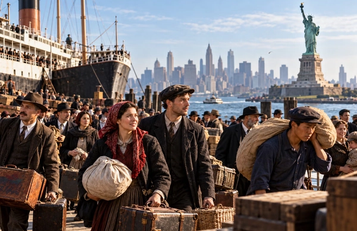
The Immigrants Who Quietly Built the American Economy
By Nomi Kander on October 15, 2026

The story of the American economy is often told through famous industrialists, groundbreaking inventions, and enormous companies. Rockefeller built an oil empire. Ford transformed automobile manufacturing. Carnegie dominated steel. Silicon Valley later produced another generation of celebrated entrepreneurs.
But there is another economic history running underneath that familiar one.
It belongs to the millions of immigrants who laid railroad tracks, worked in mines, staffed factories, opened neighborhood stores, harvested crops, built skyscrapers, started companies, cared for children, developed new technologies, and filled jobs that allowed entire industries to grow.
Most never became famous. Many arrived with little money and limited political power. Some faced laws specifically designed to exclude them.
Yet generation after generation, immigrant workers and entrepreneurs helped build the infrastructure, businesses, cities, and industries that made the United States one of the world’s largest economies.
Irish Immigrants Built More Than Railroads
Beginning especially during the Great Famine of the 1840s, large numbers of Irish immigrants arrived in the United States.
Many entered the economy near the bottom.
Irish workers took physically demanding jobs building canals, railroads, streets, and other infrastructure. They worked on docks, in factories, in mines, and as domestic servants. The work could be dangerous, poorly paid, and unstable.
Their labor nevertheless helped support the rapid expansion of nineteenth-century American cities and transportation networks.
Over time, Irish Americans also built political organizations, businesses, labor associations, churches, and community institutions. Later generations moved into a much wider range of professions.
Their experience established a pattern that would repeat throughout American history: a new immigrant population arrives, faces hostility and accusations that it does not belong, fills essential roles in the economy, and gradually becomes incorporated into the national story.
Chinese Workers Helped Connect a Continent
One of the most important infrastructure projects in American history depended heavily on Chinese immigrant labor.
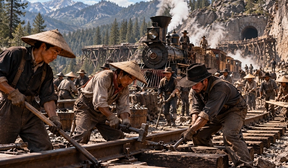
During construction of the first transcontinental railroad, thousands of Chinese workers were employed by the Central Pacific Railroad in the western United States.
Their work was extraordinarily difficult.
Crews blasted tunnels through the Sierra Nevada, built tracks through mountainous terrain, endured extreme weather, and handled dangerous explosives. Chinese workers often performed some of the project’s most hazardous jobs.
When the transcontinental railroad was completed in 1869, it dramatically changed the American economy. Goods and people could move across the country much faster, western markets became more closely connected with eastern ones, and settlement and commercial expansion accelerated.
Yet the Chinese workers who helped make that transformation possible soon faced increasingly intense discrimination.
The Chinese Exclusion Act of 1882 severely restricted Chinese immigration and became one of the most significant examples of immigration law explicitly targeting a particular nationality.
America benefited from Chinese labor while simultaneously restricting the people who provided it.
German Immigrants Built Businesses and Skilled Trades
German immigration shaped the American economy in a different way.
Millions of German-speaking immigrants arrived during the nineteenth century, bringing skills in farming, manufacturing, brewing, crafts, engineering, and commerce.
German immigrants established farms throughout the Midwest, opened workshops and small businesses, and helped develop industries in growing cities such as Milwaukee, Cincinnati, and St. Louis.
Their influence became particularly visible in brewing. Companies founded by German immigrants and their descendants helped transform beer production into a major American industry.
But their economic contribution went far beyond one product.
German communities included bakers, machinists, carpenters, merchants, printers, teachers, and manufacturers. They created businesses that employed other workers while building institutions that supported expanding immigrant neighborhoods.
Not every contribution to economic growth comes from a revolutionary invention. Sometimes it comes from thousands of skilled people opening businesses, practicing trades, and building communities over decades.
Italian Immigrants Helped Build America’s Growing Cities
Between the late nineteenth and early twentieth centuries, millions of Italians migrated to the United States.
Many found work in rapidly expanding urban economies.
Italian immigrants labored in construction, factories, mines, transportation, sanitation, and other physically demanding industries. Some worked on major infrastructure projects, while others became street vendors, shopkeepers, barbers, grocers, restaurateurs, and skilled tradespeople.
These small businesses mattered enormously.
A neighborhood grocery store or family workshop may never appear in an economic history textbook, but businesses like these provided services, created employment, circulated money within communities, and allowed families to build assets that could be passed to the next generation.
The children of Italian immigrants often entered different occupations, continuing a familiar pattern of economic mobility across generations.
What began as manual labor and small-scale entrepreneurship gradually became part of mainstream American economic life.
Jewish Immigrants Transformed the Garment Industry
Large numbers of Jewish immigrants from Eastern Europe arrived in the United States around the turn of the twentieth century, with many settling in New York City.
The garment industry became one of their most important sources of employment.
Immigrant workers cut fabric, operated sewing machines, pressed clothing, and worked long hours in crowded factories and tenement workshops. Women made up a substantial portion of this workforce.
Conditions could be brutal.
The 1911 Triangle Shirtwaist Factory fire, which killed 146 workers, many of them young Jewish and Italian immigrant women, became one of the defining tragedies of American labor history.
The disaster helped intensify demands for workplace safety reforms.
Immigrant garment workers were not simply employees. They also became organizers. Their strikes and union activity contributed to the broader labor movement and helped push debates about wages, hours, workplace conditions, and workers’ rights into American politics.
Their contribution was therefore economic in two ways: they produced the goods driving a major industry while also helping change the rules governing industrial work.
Immigrant Women Did Work the Economy Often Failed to Count
Traditional economic histories tend to emphasize factories, corporations, and major infrastructure projects.
That can make another enormous category of immigrant labor nearly invisible.
Women worked as domestic servants, seamstresses, laundresses, cooks, caregivers, boardinghouse operators, factory employees, agricultural workers, and small-business owners.
Much of that labor happened inside homes.
Domestic workers cleaned houses, prepared meals, cared for children, and supported households in ways that allowed other people to participate more fully in paid employment. Yet because domestic labor was historically undervalued, the women performing it rarely appeared in stories about economic development.
The same pattern continues in different forms today.
Care work is essential to an economy because someone has to care for children, older adults, sick family members, and households. When that labor becomes invisible, so do many of the immigrants performing it.
Mexican Workers Became Essential to American Agriculture
American agriculture has long depended heavily on Mexican and Mexican American workers.
That relationship expanded dramatically during the twentieth century.
During World War II, labor shortages contributed to the creation of the Bracero Program, which brought millions of temporary Mexican labor contracts to the United States between 1942 and 1964.
Workers harvested crops and performed other demanding agricultural jobs that helped maintain American food production.
Conditions were often difficult, and workers faced problems ranging from poor housing to wage abuses and discrimination.
Even after the Bracero Program ended, Mexican immigrant labor remained deeply connected to American agriculture.
The produce available in supermarkets can seem disconnected from immigration debates. In reality, the two have been linked for generations.
Food does not simply appear on shelves. Someone plants it, tends it, harvests it, processes it, transports it, and stocks it.
Immigrants have performed a significant share of that work.
Immigrants Did Not Just Work for Companies. They Created Them.
The immigrant contribution to the American economy is not limited to labor.
Immigrants have also repeatedly become entrepreneurs.
Sometimes that means opening a restaurant, grocery store, construction company, salon, repair shop, or trucking business. Sometimes it means creating a company that eventually becomes enormous.
Andrew Carnegie arrived from Scotland as a child before building his steel empire. Levi Strauss was born in Bavaria before moving to the United States and building the business associated with blue jeans. Sergey Brin was born in the Soviet Union before later co-founding Google. Numerous other immigrant founders have helped build companies in technology, manufacturing, retail, healthcare, and other industries.
But focusing only on billionaire founders creates another distorted picture.
Most immigrant entrepreneurship is much smaller.
The family restaurant that survives for 30 years may never become a national chain. The contractor employing eight people will never appear on a list of America’s most influential companies. The neighborhood shop may operate from a single location.
Together, however, businesses like these create jobs, pay taxes, occupy commercial spaces, purchase supplies, and provide services.
An economy is built from millions of small transactions as much as from billion-dollar corporations.
Every Generation Thinks the Newest Immigrants Are Different
There is a striking pattern in American immigration history.
Groups that are now considered completely ordinary parts of American society were once described as threats to it.
Irish immigrants faced intense anti-Catholic prejudice. Chinese immigrants were targeted by exclusion laws. Italians and Eastern Europeans were frequently portrayed as racially or culturally inferior. Jewish immigrants encountered antisemitism and immigration restrictions.
Over time, many of these communities became woven into American society so thoroughly that their immigrant origins can feel almost inevitable in retrospect.
They were not.
Integration happened gradually, often amid conflict and discrimination.
That history does not mean every immigration debate is identical or that immigration has no economic tradeoffs. Different periods involve different labor markets, policies, and migration patterns.
It does mean that arguments about who belongs in the American economy have appeared repeatedly alongside an economy that has repeatedly depended on newcomers.
The Economy Was Built From the Bottom Up
There was never a single group that “built America.”
That is precisely the point.
The American economy developed through the combined labor of Indigenous people, enslaved Africans and their descendants, immigrants from around the world, and generations of people born in the United States.
Immigrants were one essential part of that much larger story.
They laid tracks and bricks. They harvested crops. They sewed clothing. They dug mines. They staffed kitchens. They cared for families. They opened stores. They developed technologies. They created companies.
Most did not have buildings named after them.
They rarely appeared on magazine covers. Many never became wealthy. Some spent their entire lives doing jobs that history barely recorded.
But economies are not built only by the people whose names end up on companies.
They are also built quietly, shift after shift and generation after generation, by the people doing the work.