The Mystery of D.B. Cooper (The Only Unsolved Hijacking in American History)
By Gil Cohen on October 15, 2026
On the afternoon of November 24, 1971, a neatly dressed man walked into Portland International Airport, purchased a one-way ticket to Seattle, and boarded Northwest Orient Airlines Flight 305.
He gave his name as Dan Cooper.
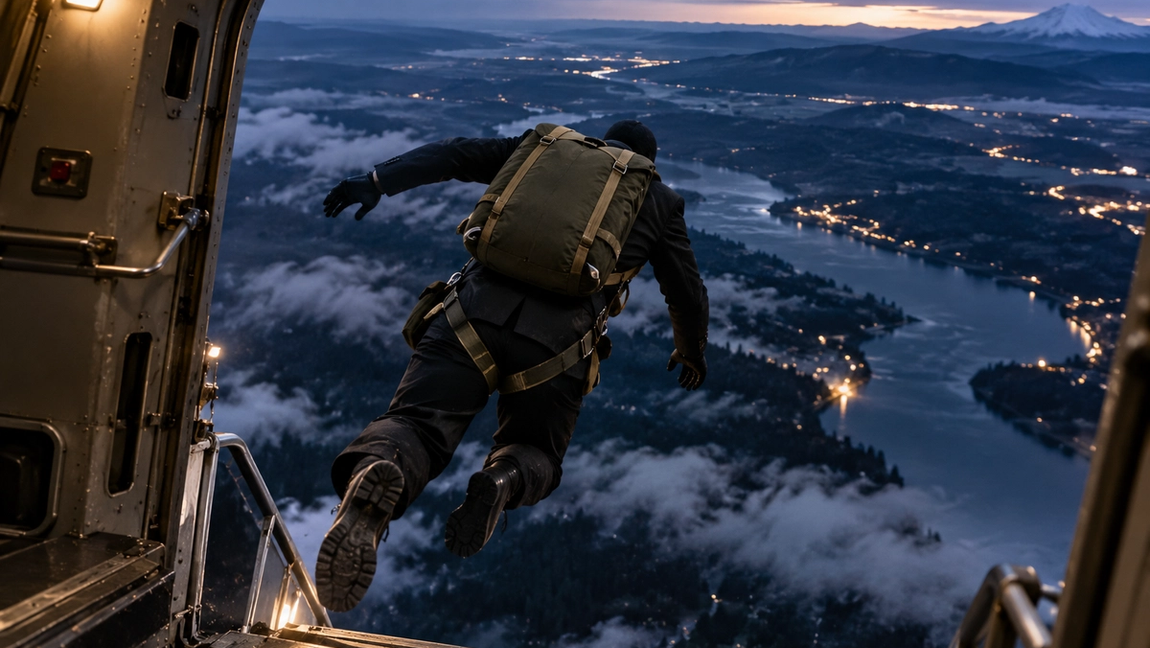
A few hours later, he had collected $200,000 in ransom money, received four parachutes, released the passengers, ordered the aircraft back into the sky, opened a staircase at the rear of the Boeing 727, and disappeared somewhere over the Pacific Northwest.
Neither Cooper nor his body was ever conclusively found.
The FBI investigated the case for decades, examining hundreds of suspects and following thousands of leads, but nobody was ever charged with the hijacking. Some investigators believe Cooper probably died during his jump, while others argue that he may have successfully escaped and quietly returned to ordinary life.
Then, nine years after the hijacking, a child digging along the Columbia River found bundles of Cooper’s ransom money buried in the sand.
Instead of solving the case, the discovery made it even stranger.
More than half a century later, the mystery survives because investigators know almost exactly what Cooper did aboard the airplane. What happened during the few minutes after he jumped remains unknown.
The Man Who Boarded Flight 305 Did Not Look Particularly Dangerous
The day before Thanksgiving in 1971, a man approached the Northwest Orient Airlines counter in Portland, Oregon, and purchased a ticket for Flight 305 to Seattle.
The flight was short, normally taking around half an hour.
The passenger identified himself as Dan Cooper.
Witnesses described him as a middle-aged white man wearing a dark business suit, white shirt, black tie, and dark shoes. He carried a briefcase and appeared calm.
After boarding the Boeing 727, Cooper took a seat toward the rear of the aircraft.
He ordered a drink.
Nothing about him initially suggested that one of the most famous crimes in American aviation history was about to begin.
Shortly after takeoff, Cooper handed flight attendant Florence Schaffner a note.
She initially assumed he was attempting to give her his phone number and placed it in her purse without immediately reading it.
Cooper leaned toward her and quietly explained that she should look at the note because he had a bomb.
The hijacking had begun.
Cooper Made His Demands Without Creating Panic
Schaffner sat beside Cooper.
He opened his briefcase enough for her to see what appeared to be wires and red cylinders.
Whether the device was actually a functioning bomb has never been established.
Cooper then explained what he wanted.
He demanded $200,000 in cash, four parachutes, and a fuel truck waiting when the aircraft landed in Seattle.
The crew informed authorities.
Meanwhile, the passengers were told that the flight had been delayed because of a mechanical problem.
Most had no idea that the man sitting near the back of the aircraft had threatened to blow it up.
Cooper remained remarkably composed throughout the process.
He drank bourbon and soda, smoked cigarettes, spoke politely with the flight attendants, and showed detailed awareness of the aircraft and the surrounding geography.
His behavior later contributed to theories that he might have had military, aviation, or parachuting experience.
However, appearing knowledgeable and actually possessing expert training are not necessarily the same thing.
That distinction would become important.
The FBI Had to Find $200,000 Quickly
Authorities in Seattle began assembling Cooper’s ransom.
The $200,000 consisted of $20 bills, an amount worth well over $1 million in today’s purchasing power.
Investigators recorded the serial numbers of the bills before delivering the money.
That decision gave law enforcement a way to identify the ransom if Cooper ever spent or deposited it.
The four parachutes were also obtained.
Cooper had requested multiple parachutes, which created an interesting tactical problem for authorities.
If police gave him a deliberately defective parachute, they risked killing an innocent hostage if Cooper forced someone to jump with him.
Investigators therefore had to assume that he might take another person along.
Flight 305 circled while preparations were completed.
Eventually, the aircraft landed at Seattle-Tacoma International Airport.
Cooper had gotten exactly what he requested.
He Released the Passengers
Once the ransom and parachutes were delivered, Cooper allowed the passengers and several crew members to leave.
That left only a small flight crew aboard.
He then gave instructions for the next stage of the hijacking.
The aircraft would fly south toward Mexico City.
Cooper wanted it kept at a relatively low altitude and slow speed, with the landing gear down and the cabin unpressurized.
Most importantly, he wanted to use the Boeing 727’s rear staircase.
The 727 had a distinctive set of stairs beneath the tail that could be lowered from inside the aircraft.
That feature made the airplane particularly useful for what Cooper apparently intended to do.
He was going to jump.
Cooper Knew Enough About the Boeing 727 to Make Investigators Curious
The hijacker’s familiarity with the aircraft became one of the most discussed elements of the case.
He appeared to understand that the Boeing 727 could fly with its rear staircase lowered.
He also gave the crew specific instructions about speed, altitude, and configuration.
This led some investigators to suspect that Cooper had experience with aviation, the military, or the aerospace industry.
The Boeing 727 had characteristics that made a rear exit possible in flight, and similar aircraft had military applications.
Yet Cooper’s parachute choices complicated the idea that he was an elite parachuting expert.
He selected a parachute that experienced skydivers might not have considered ideal for such a dangerous nighttime jump.
He also jumped wearing ordinary business clothing and shoes rather than specialized equipment.
If Cooper was an expert, he was taking enormous risks.
If he was not an expert, the entire plan was even more reckless.
Somewhere Over Washington, Cooper Opened the Stairs
Flight 305 departed Seattle with Cooper and the remaining crew aboard.
The aircraft headed south.
Cooper ordered the flight attendant to join the pilots in the cockpit, leaving him alone in the passenger cabin.
At some point, a warning light indicated that the rear staircase had been activated.
Then, around 8:13 p.m., the flight crew noticed a sudden movement in the aircraft’s tail.
Investigators later believed this was probably the moment Cooper jumped.
The exact location remained uncertain because the aircraft was moving through darkness and poor weather.
Below Cooper was the rugged landscape of southwestern Washington.
It was cold.
It was raining.
Clouds reduced visibility.
He was carrying a bag containing approximately 10,000 twenty-dollar bills.
And he was attempting a nighttime parachute jump from a moving jet.
Then he disappeared.
The Crew Did Not Know for Certain That He Was Gone
The pilots continued flying south.
Because Cooper had ordered them to remain in the cockpit, they could not immediately confirm whether he had actually jumped.
The aircraft eventually landed in Reno, Nevada.
Authorities surrounded it.
When they searched the cabin, Cooper was gone.
Investigators found several items he had left behind, including a black clip-on tie.
The rear staircase had been lowered.
The ransom money was gone.
The hijacker had apparently done something almost unimaginable.
He had jumped from a commercial airliner at night and vanished into the wilderness.
The largest question was whether he had survived.
The Search Area Was Enormous
Investigators attempted to calculate where Cooper had landed.
That was much harder than it sounds.
The aircraft’s exact position when he jumped was uncertain.
Wind speed and direction mattered.
The type of parachute mattered.
The moment he actually exited mattered.
Even a small error in the calculation could shift the landing area considerably.
Search teams examined rugged terrain in southwestern Washington.
The FBI interviewed residents.
Military personnel participated in searches.
Aircraft flew over potential landing zones.
Investigators looked for a parachute, clothing, ransom money, human remains, or anything else connected to the hijacking.
They found nothing conclusive.
If Cooper had died during the jump, the wilderness had hidden him remarkably well.
If he survived, he had somehow left the area without attracting enough attention to be identified.
Both possibilities created problems.
The Jump Was Much More Dangerous Than Movies Make It Look
Popular culture sometimes portrays Cooper’s escape as a perfectly planned parachute operation.
The actual conditions were terrible.
It was nighttime.
The weather was poor.
The terrain below included forests, rivers, and difficult ground.
Cooper was not wearing proper skydiving clothing.
He was carrying a heavy ransom package.
He had no obvious way to control exactly where he would land.
The parachute he apparently selected was not a highly maneuverable modern sport parachute.
This is one reason many investigators believed Cooper probably died.
A fatal landing, drowning, exposure, or serious injury would not have been surprising.
Yet no body was found.
Neither was the parachute.
And most importantly, almost none of the ransom money ever appeared in circulation.
That last detail became one of the strangest clues in the entire case.
The Money Should Have Been Easier to Track
Before handing Cooper the ransom, investigators recorded the serial numbers.
Banks and financial institutions received lists of the numbers.
Authorities hoped that eventually Cooper would spend the cash and one of the bills would be recognized.
Years passed.
Nothing happened.
No confirmed ransom bill appeared at a bank, store, casino, or other business.
That created an obvious question.
If Cooper survived, why did he apparently never spend the money?
He could have waited.
He could have laundered it slowly.
The tracking system may simply have failed to detect bills passing through ordinary circulation.
But $200,000 was an enormous amount of money in 1971.
The complete absence of confirmed spending strengthened the argument that Cooper never lived long enough to enjoy his ransom.
Then, in 1980, some of the money finally appeared.
In one of the last places investigators expected.
A Child Found Cooper’s Money Beside the Columbia River
In February 1980, eight-year-old Brian Ingram was vacationing with his family near the Columbia River at a location known as Tena Bar.
While playing in the sand, he discovered three deteriorating bundles of $20 bills.
The money totaled approximately $5,800.
Investigators checked the serial numbers.
They matched the ransom given to D.B. Cooper.
For the first time since the hijacking, physical evidence connected directly to Cooper had been found outside the airplane.
But the discovery created more questions than answers.
How had the money reached Tena Bar?
Had Cooper landed nearby?
Had the ransom fallen from his body during the jump?
Had the money entered a river somewhere else and traveled downstream?
Had Cooper or another person deliberately buried it?
The condition and location of the bundles became the subject of extensive scientific and amateur investigation.
No explanation has been universally accepted.
The money remains one of the strongest clues in the case and one of the hardest to interpret.
The Name D.B. Cooper Was Actually a Media Mistake
One of the funniest details in the case is that the world’s most famous unidentified hijacker was not actually known to have called himself D.B. Cooper.
The ticket was purchased under the name Dan Cooper.
During the early investigation, authorities examined a man named D.B. Cooper who was quickly eliminated as a suspect.
A news organization confused the names.
The mistake spread.
Soon newspapers across the country were calling the hijacker D.B. Cooper.
The name became permanent.
Some researchers have found the original alias interesting because “Dan Cooper” was also the name of a fictional Canadian comic-book pilot.
That has encouraged theories that the hijacker may have spent time in Canada or encountered the comic there.
It is an intriguing detail.
It is not proof of his identity.
The Tie Became One of the Most Important Pieces of Evidence
Cooper left a black clip-on tie aboard Flight 305.
At the time, investigators could not extract the kind of information modern forensic science might seek from such an object.
Decades later, researchers examined microscopic particles found on the tie.
Some particles appeared to be associated with specialized industrial environments involving metals and manufacturing.
That led to theories that Cooper may have worked in aerospace, chemical engineering, electronics, or another technical industry.
Because Boeing was a major employer in the Pacific Northwest, some researchers wondered whether Cooper might have worked for the company or one of its suppliers.
The evidence is fascinating but far from conclusive.
A tie can accumulate particles from workplaces, other people, storage environments, and many other sources.
The particles can suggest possibilities.
They cannot provide a name.
The FBI Investigated Hundreds of Suspects
Over the decades, numerous people were proposed as the real D.B. Cooper.
Some had parachuting experience.
Some resembled the witness sketches.
Some had aviation or military backgrounds.
Some disappeared around the time of the hijacking or suddenly seemed to have money.
Others were identified years later by relatives who became convinced that a father, uncle, husband, or friend had been Cooper.
The FBI investigated many of these claims.
One of the most famous suspects was Richard Floyd McCoy Jr., who carried out a remarkably similar aircraft hijacking several months after Cooper’s crime and escaped using a parachute.
The similarities were obvious.
But there were also significant differences, and the FBI ultimately did not conclude that McCoy was Cooper.
Other widely discussed suspects included Duane Weber, Kenneth Christiansen, Robert Rackstraw, and several additional men.
None has been conclusively identified as the hijacker.
The Surviving Witnesses Matter More Than Internet Comparisons
Flight attendants spent significant time close to Cooper.
Their descriptions formed the basis for the famous composite sketches.
This creates a problem for many modern suspect theories.
A person may have an interesting biography, military experience, a mysterious absence, or some connection to aviation, but if witnesses did not believe he resembled Cooper, the theory becomes harder to sustain.
Photographic comparisons are also unreliable.
A researcher convinced that someone was Cooper can usually find a photograph taken at the right age and angle that appears similar to the sketch.
Hairlines, facial proportions, glasses, and expressions can create striking coincidences.
The same problem appears in the Zodiac Killer case.
A resemblance can generate a suspect.
It cannot identify one.
Cooper May Not Have Been a Professional Skydiver
For years, one popular assumption held that anyone capable of planning the hijacking must have been an experienced parachutist.
Investigators were less certain.
Some of Cooper’s decisions were unusual for an expert.
He jumped at night in poor weather over difficult terrain while wearing a business suit and loafers.
He apparently did not request specialized equipment that would have made the jump significantly safer.
He also chose a parachute that offered limited maneuverability.
An experienced sport skydiver might have considered the plan unnecessarily dangerous.
However, military parachuting experience could have produced a different set of expectations from recreational skydiving.
Cooper may have known enough to understand that the jump was possible without being skilled enough to make it safe.
That middle ground may explain much of the mystery.
He could have been knowledgeable but reckless.
The FBI Eventually Stopped Actively Investigating
The FBI investigation became known as NORJAK, short for Northwest Hijacking.
Agents spent decades examining evidence and evaluating potential suspects.
In July 2016, the FBI announced that it was redirecting resources away from the active investigation after 45 years.
That did not mean the agency had solved the case.
It meant investigators had reached a point where continuing to pursue every new theory was no longer considered an effective use of resources.
The FBI retained the physical evidence and indicated that significant new evidence could still receive attention.
Private researchers have continued investigating the mystery, examining everything from the ransom money and tie particles to flight paths, parachutes, witness statements, and possible suspects.
The official investigation may have slowed.
The public investigation definitely did not.
So Did Cooper Survive?
This is the central question, and there is still no definitive answer.
The argument that Cooper died is straightforward. He jumped into terrible weather at night over rugged terrain with questionable equipment while carrying a heavy bag of cash. Most of the ransom money never appeared. No confirmed evidence shows that he contacted anyone afterward or suddenly began spending large amounts of money.
That makes death during or shortly after the jump entirely plausible.
But there are problems.
No body was found.
No parachute was conclusively recovered.
No clothing was discovered.
The landscape was difficult to search, but complete disappearance still leaves room for doubt.
Supporters of the survival theory argue that Cooper may have understood the region better than investigators realized, landed successfully, concealed the equipment, and escaped.
If he then avoided spending the identifiable ransom money carelessly, he might have returned to ordinary life.
The evidence allows both possibilities.
Neither can be proven.
Why Has Nobody Found the Rest of the Money?
The ransom is perhaps the most puzzling part of the story.
If Cooper died in the wilderness with the money attached to him, investigators might expect some portion of it eventually to have been discovered.
If he survived, investigators might expect at least some bills to have entered circulation.
Instead, nearly all of the $200,000 simply vanished.
Only the $5,800 discovered at Tena Bar has been conclusively recovered.
The location of those bundles does not clearly explain the rest.
Researchers have spent decades modeling river currents, flood events, sediment movement, and possible landing zones in an attempt to determine how the money reached the beach.
The ransom was supposed to be law enforcement’s easiest way of tracking Cooper.
Instead, it became another mystery inside the mystery.
The Hijacking Changed Aviation Even Without Being Solved
Cooper’s crime had consequences far beyond the investigation.
The hijacking occurred during an era when airport security was extraordinarily relaxed by modern standards.
Passengers could often purchase tickets with little identification and board aircraft without the security screening that later became normal.
A wave of hijackings during the late 1960s and early 1970s forced the United States to reconsider aviation security.
Airports introduced stronger passenger screening and other measures.
Boeing 727 aircraft were also modified with a device that prevented the rear staircase from being lowered during flight.
The device became informally known as the “Cooper vane.”
The man disappeared.
The aviation industry remembered exactly how he did it and made sure repeating the same escape became much harder.
Why the D.B. Cooper Story Refuses to Die
The Cooper case has almost everything a historical mystery needs.
There is an anonymous man with a memorable appearance, a commercial aircraft, a bomb threat, ransom money, parachutes, a nighttime escape, an enormous wilderness, missing cash, mysterious physical evidence, and no confirmed ending.
Unlike many famous criminal mysteries, nobody was killed during the hijacking.
That has allowed Cooper to acquire a strange folk-hero reputation in parts of popular culture.
He is sometimes portrayed as the polite outlaw who beat the system and disappeared with the money.
That romantic version overlooks the reality that he threatened passengers and crew with what they believed was a bomb and placed many lives at risk.
Whether or not the bomb was real, the danger was.
The mystery can be fascinating without turning the hijacker into a hero.
What We Actually Know
The essential facts are surprisingly clear.
A man calling himself Dan Cooper boarded Flight 305 in Portland on November 24, 1971. He claimed to have a bomb and demanded $200,000 and four parachutes. After receiving them in Seattle, he released the passengers and ordered the aircraft back into the air.
Somewhere over the Pacific Northwest, he lowered the Boeing 727’s rear staircase and apparently jumped.
He was never conclusively seen again.
In 1980, $5,800 of the ransom money was discovered along the Columbia River.
No suspect has ever been proven to be Cooper, and the remainder of the ransom has never been conclusively recovered.
Everything after that becomes interpretation.
He may have died.
He may have survived.
He may have been an experienced parachutist, or simply someone with enough technical knowledge to attempt an extraordinarily dangerous plan.
The evidence does not allow the final step from probability to certainty.
The Mystery Comes Down to a Few Minutes in the Dark
Investigators reconstructed almost the entire hijacking.
They knew where Cooper boarded.
They knew where he sat.
They knew what he drank.
They knew what he demanded.
They knew how much money he received.
They knew which aircraft he used.
They knew approximately when the rear staircase opened.
They knew roughly when he jumped.
Then there is a gap.
Somewhere between the Boeing 727 and the ground, the trail disappears.
If Cooper died, his remains and equipment may still lie somewhere in the Pacific Northwest, hidden by terrain, water, or decades of environmental change.
If he survived, then one of the strangest possibilities in American criminal history becomes real: a man carried out an unprecedented hijacking, parachuted from a passenger jet with $200,000 strapped to him, walked away, and somehow kept the truth from being proven for the rest of his life.
Either ending would be remarkable.
More than fifty years later, we still do not know which one happened.
That is why D.B. Cooper remains so compelling. The mystery is not really how he hijacked the plane, because investigators know that part remarkably well.
The mystery is whether, after stepping into the rainy darkness thousands of feet above Washington, he actually got away.