The Natural Disasters That Reshaped American Communities
By Sonia Frankel on October 15, 2026
Natural disasters are often remembered through numbers: how many people died, how strong the storm was, how much property was destroyed, or how many acres burned. But the disasters that matter most in American history did something more lasting. They changed where people lived, how cities were designed, which communities recovered, how governments prepared for emergencies, and what Americans expected to happen when nature overwhelmed the systems built to protect them.
Some cities rebuilt almost immediately and became stronger. Others lost populations that never fully returned. Some disasters exposed engineering failures, while others revealed inequalities that had existed long before the hurricane, earthquake, flood, or fire arrived.
The destruction might happen in a few minutes or a few days, but rebuilding can shape a community for generations.
The Great Chicago Fire Changed How American Cities Thought About Fire
Chicago was growing at extraordinary speed when fire swept through the city in October 1871. Much of the rapidly expanding city had been built with wood, including houses, businesses, sidewalks, and other structures, making fire an enormous threat.
The blaze destroyed thousands of buildings and left roughly 100,000 people without homes. Hundreds of people died, although the exact number remains uncertain.
The famous story that the fire began when a cow belonging to Catherine O’Leary kicked over a lantern became part of American folklore, but there is no solid evidence establishing that version of events.
What mattered more was what happened afterward.
Chicago rebuilt rapidly. New construction increasingly used materials such as brick, stone, iron, and later steel, while building and fire regulations became more important.
The disaster occurred during a period when American cities were becoming larger and denser. Chicago demonstrated what could happen when urban growth moved faster than safety infrastructure.
The fire destroyed a large part of the city, but reconstruction also helped create the conditions for the modern Chicago that followed.
The Johnstown Flood Showed What Happens When Infrastructure Fails
On May 31, 1889, heavy rainfall overwhelmed the South Fork Dam above Johnstown, Pennsylvania.
The dam failed.
A massive wall of water rushed down the valley toward the city.
More than 2,200 people were killed, making the Johnstown Flood one of the deadliest disasters in American history.
The tragedy immediately raised questions about responsibility because the dam and surrounding property were connected with a private recreational club whose members included wealthy industrialists.
The disaster therefore became more than a story about extreme weather. It became a story about infrastructure, engineering, wealth, and accountability.
The American Red Cross, which had been founded only a few years earlier, carried out one of its first major disaster-relief operations in Johnstown under the leadership of Clara Barton.
The flood helped demonstrate that large disasters required organized responses extending beyond individual families and local charities.
Modern disaster relief was beginning to take shape.
The Galveston Hurricane Changed the Future of an Entire City
In 1900, Galveston, Texas, was one of the most important commercial cities on the Gulf Coast.
Then a hurricane nearly destroyed it.
The storm struck on September 8 with an enormous storm surge that swept across the low-lying island.
An estimated 6,000 to 12,000 people died, making it the deadliest natural disaster in United States history.
The destruction fundamentally changed Galveston’s future.
The city undertook an extraordinary engineering response. A massive seawall was constructed, and large sections of the city were physically raised to reduce the danger from future storms.
But Galveston’s economic position changed as well.
Houston, located farther inland, continued developing as a major commercial and industrial center and eventually surpassed Galveston.
The hurricane therefore did more than destroy buildings.
It helped alter the economic geography of Texas.
Sometimes a natural disaster does not simply rebuild a city differently. It changes which city becomes dominant.
The San Francisco Earthquake and Fire Rebuilt a Major American City
Shortly after 5 a.m. on April 18, 1906, a powerful earthquake struck Northern California.
San Francisco suffered catastrophic damage.
But much of the destruction came afterward.
Broken gas lines and damaged infrastructure contributed to fires that burned for days. Water systems were damaged, making firefighting extraordinarily difficult.
Thousands of buildings were destroyed, and hundreds of thousands of residents were displaced.
The disaster transformed San Francisco’s physical landscape.
Reconstruction happened quickly because the city remained economically important, but debates followed over building standards, infrastructure, insurance, and earthquake preparedness.
The earthquake also demonstrated the danger of secondary disasters.
A city might survive the initial shaking only to face fire, infrastructure collapse, and shortages afterward.
That lesson continues to influence earthquake planning in California today.
The Great Mississippi Flood Changed American Migration
In 1927, enormous flooding spread across the Mississippi River basin.
Heavy rainfall and overwhelmed levees flooded vast areas, particularly across the lower Mississippi Valley.
Hundreds of thousands of people were displaced.
Black communities in the South were especially affected, and relief efforts frequently reflected the racial discrimination of the era.
In some places, Black flood victims were forced into segregated camps or pressured to remain in affected areas because landowners feared losing agricultural labor.
The disaster contributed to existing migration patterns as Black Southerners increasingly moved toward Northern cities in search of greater economic opportunity and personal freedom.
The flood also strengthened demands for greater federal involvement in flood control.
In 1928, Congress passed major legislation authorizing an expanded federal role in managing the Mississippi River.
The disaster changed both communities and government policy.
Flood control was increasingly viewed as something too large for individual towns or states to handle alone.
The Dust Bowl Turned an Environmental Crisis Into a Migration
During the 1930s, drought struck the Great Plains.
But drought alone did not create the Dust Bowl.
Years of intensive farming had removed native grasses that helped hold the soil in place. When rainfall disappeared and strong winds arrived, enormous quantities of exposed topsoil became airborne.
Dust storms darkened skies.
Crops failed.
Farmers lost incomes.
Families already struggling through the Great Depression faced another disaster layered on top of the first.
Many abandoned farms and traveled west, particularly toward California.
They were often collectively called “Okies,” even though not all came from Oklahoma.
Their migration became one of the defining movements of Depression-era America.
The Dust Bowl also changed agricultural policy and land-management practices. Governments promoted soil conservation, different farming techniques, and programs intended to reduce erosion.
The lesson was uncomfortable but important.
Natural conditions can create disasters, but human decisions can make them dramatically worse.
The Alaska Earthquake Changed How Scientists Understood Earthquakes
On March 27, 1964, Alaska experienced one of the strongest earthquakes ever recorded.
The magnitude 9.2 Great Alaska Earthquake lasted several minutes and caused enormous geological changes.
Ground shifted, landslides occurred, and tsunamis struck coastal communities.
The disaster caused destruction across Alaska and generated waves that affected areas far beyond the state.
Because Alaska’s population was relatively small, the death toll was far lower than it might have been in a densely populated region.
Scientifically, however, the earthquake was enormously important.
Researchers studied the dramatic movement of the Earth’s crust and gathered evidence that strengthened the emerging theory of plate tectonics.
The disaster therefore changed more than rebuilding practices.
It helped scientists understand why earthquakes happen.
Sometimes the most important legacy of a disaster is knowledge that makes future disasters easier to understand.
Hurricane Andrew Changed How Florida Built Houses
When Hurricane Andrew struck South Florida in August 1992, entire neighborhoods were devastated.
The storm destroyed tens of thousands of homes and caused enormous financial losses.
The scale of the destruction raised troubling questions about construction quality.
Investigations found that inadequate enforcement and weaknesses in building practices had contributed to some of the damage.
Florida responded by strengthening building standards.
The disaster also shook the insurance industry as companies confronted enormous claims and reconsidered the risks associated with hurricane-prone areas.
Andrew became an important turning point in how Florida approached hurricane-resistant construction.
Homes built afterward increasingly incorporated stronger requirements for roofs, windows, structural connections, and wind resistance.
The hurricane demonstrated that building codes can look like boring paperwork until the day a roof has to survive extreme winds.
Then they become life-safety infrastructure.
Hurricane Katrina Exposed More Than a City to Water
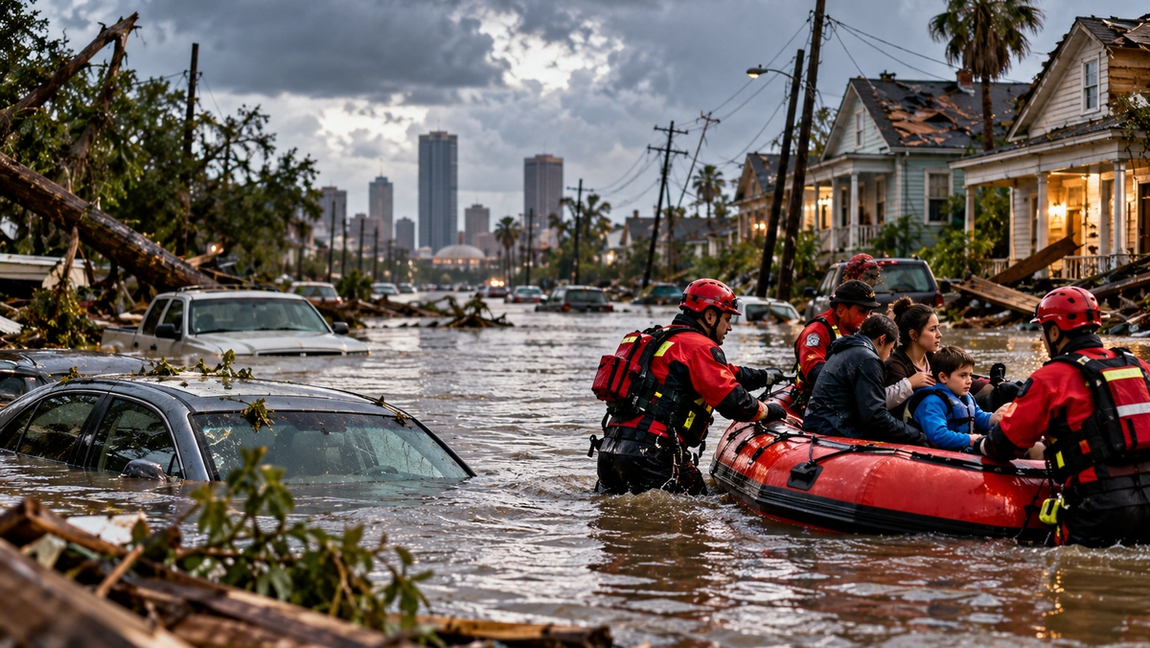
When Hurricane Katrina approached the Gulf Coast in August 2005, New Orleans faced an extraordinary vulnerability.
Much of the city sits below sea level and depends on levees, floodwalls, pumps, and drainage infrastructure for protection.
Katrina made landfall along the Gulf Coast, and failures in the flood-protection system allowed water to pour into large sections of New Orleans.
Neighborhoods flooded.
Residents became trapped.
The evacuation and emergency response became chaotic.
More than 1,800 people died across the affected region.
But Katrina became more than a hurricane story.
It exposed deep inequalities involving race, poverty, transportation, housing, and access to government assistance.
Residents with cars, money, hotel options, and relatives elsewhere generally had more ways to leave.
Many poorer residents did not.
Television images of people stranded at the Superdome, the convention center, rooftops, and flooded neighborhoods shocked the country.
The disaster demonstrated that vulnerability is not determined only by where a storm travels.
It is also determined by who has the resources to escape it.
New Orleans After Katrina Was Not the Same City
Hundreds of thousands of people left the New Orleans area after Katrina.
Many eventually returned.
Others never did.
Some neighborhoods rebuilt rapidly, while others struggled for years.
Schools, hospitals, public housing, businesses, and local government institutions underwent major changes.
The city’s population decreased significantly, and its demographic composition shifted.
Reconstruction also generated difficult debates about who rebuilding was actually for.
Should every neighborhood be rebuilt? Who would receive assistance? What happened to renters? Could longtime residents afford to return? Would redevelopment preserve communities or replace them?
These questions appear after many disasters.
Rebuilding sounds like a simple return to normal.
In reality, there is rarely one version of normal everyone wants to restore.
Superstorm Sandy Showed That New York Was Vulnerable Too
When Sandy struck the northeastern United States in October 2012, it brought catastrophic flooding to parts of New York and New Jersey.
Lower Manhattan lost power.
Subway tunnels flooded.
Homes burned in Queens.
Coastal communities in New Jersey suffered enormous destruction.
The storm disrupted one of the largest metropolitan regions in the world.
For New York, Sandy challenged assumptions about what kinds of climate and disaster risks the city faced.
Discussions about seawalls, coastal defenses, resilient infrastructure, flood zones, building standards, and climate adaptation became more urgent.
The storm also demonstrated how dependent modern cities are on interconnected systems.
Electricity fails, and elevators stop.
Subways flood, and workers cannot travel.
Hospitals lose power, and patients must be evacuated.
Communication networks fail, and information becomes harder to distribute.
A modern city is not simply buildings.
It is a network.
Damage enough parts of the network and the entire place struggles to function.
Wildfires Have Begun Reshaping Western Communities
Wildfire has always been part of many American ecosystems, particularly in the West.
But the risks surrounding wildfire have changed as development expanded into fire-prone landscapes, decades of fire suppression altered some forests, and warmer, drier conditions increased wildfire danger in many regions.
Recent fires have demonstrated how quickly entire communities can be transformed.
The 2018 Camp Fire virtually destroyed the town of Paradise, California, killing 85 people.
Thousands of homes disappeared.
Survivors scattered across the region.
Rebuilding raised familiar questions about whether homes should return to areas facing significant future fire risk and what construction standards should apply.
Similar debates are happening throughout the West.
Insurance companies are reconsidering coverage in high-risk regions. Homeowners are being asked to create defensible spaces around properties. Communities are changing evacuation plans and vegetation management.
Wildfire is no longer simply a problem for remote forests.
It has become an urban-planning and housing problem.
Disasters Reveal Inequality Very Quickly
Natural hazards do not choose victims based on income.
Their consequences often do.
A hurricane may pass over an entire city, but not everyone lives in equally safe housing.
A wildfire evacuation is easier when someone owns a reliable car.
Recovering from a flood is easier when a family has savings and insurance.
Leaving temporarily is easier when someone can afford a hotel or has relatives with extra space.
Communities with fewer resources can therefore experience longer recoveries even when they face the same physical disaster.
Historical discrimination also matters.
Housing policies have sometimes concentrated lower-income and minority communities in areas more vulnerable to flooding, industrial hazards, or inadequate infrastructure.
The disaster itself might last hours.
The conditions determining who recovers fastest may have developed over decades.
Sometimes Rebuilding Creates a Better City
Disaster recovery is not always simply about replacing what was destroyed.
Cities occasionally use catastrophe as an opportunity to improve infrastructure.
Chicago adopted stronger construction practices after its great fire.
Galveston built its seawall and physically raised parts of the city.
San Francisco reconsidered earthquake-resistant construction.
Florida strengthened building codes after Hurricane Andrew.
Communities affected by repeated flooding have sometimes relocated homes entirely rather than rebuilding in the same vulnerable locations.
The challenge is that safer rebuilding usually costs more.
That creates a difficult political question.
How much should society spend today to prepare for a disaster that might not happen for decades?
History repeatedly offers the same answer.
Preparedness seems expensive until compared with rebuilding.
Climate Change Is Changing the Disaster Conversation
American communities increasingly have to consider whether historical disaster patterns remain reliable guides to future risk.
Sea levels are rising along much of the U.S. coastline. Extreme rainfall events are becoming more intense in many regions. Heat waves are becoming more severe, and wildfire conditions are changing across parts of the West.
That means infrastructure designed around past conditions may not always provide the same protection in the future.
A flood described as extremely rare can become less rare.
Coastal properties that flooded occasionally can experience problems more frequently.
Communities therefore face decisions not only about responding to disasters but about adapting before they happen.
That can mean stronger buildings, redesigned drainage systems, expanded flood protections, different land-use policies, improved evacuation systems, or, in some cases, moving development away from particularly vulnerable locations.
The question is gradually shifting from whether communities will rebuild after disasters to how they should build before them.
The Disaster Ends Before the Story Does
News coverage of disasters usually follows a predictable pattern.
The storm arrives. The earthquake hits. The fire spreads. Cameras show destroyed houses and exhausted survivors. Rescue crews arrive. Donations pour in.
Then the cameras leave.
For the community, that is often when the longest part begins.
Insurance claims must be processed. Schools need to reopen. Businesses need customers. Families need housing. Roads, hospitals, electricity, and water systems need repairs. Residents decide whether to return or begin somewhere else.
Some communities recover within years.
Others are permanently changed.
That is why America’s most important natural disasters cannot be understood simply through wind speeds, earthquake magnitudes, rainfall totals, or acres burned.
The real measure comes afterward.
It is found in the neighborhoods that disappeared, the families that moved, the laws that changed, the infrastructure that was rebuilt, and the cities that learned, sometimes painfully, that surviving a disaster and recovering from one are two very different things.