The Overlooked Women Who Shaped American History
By Marie Wells on October 15, 2026
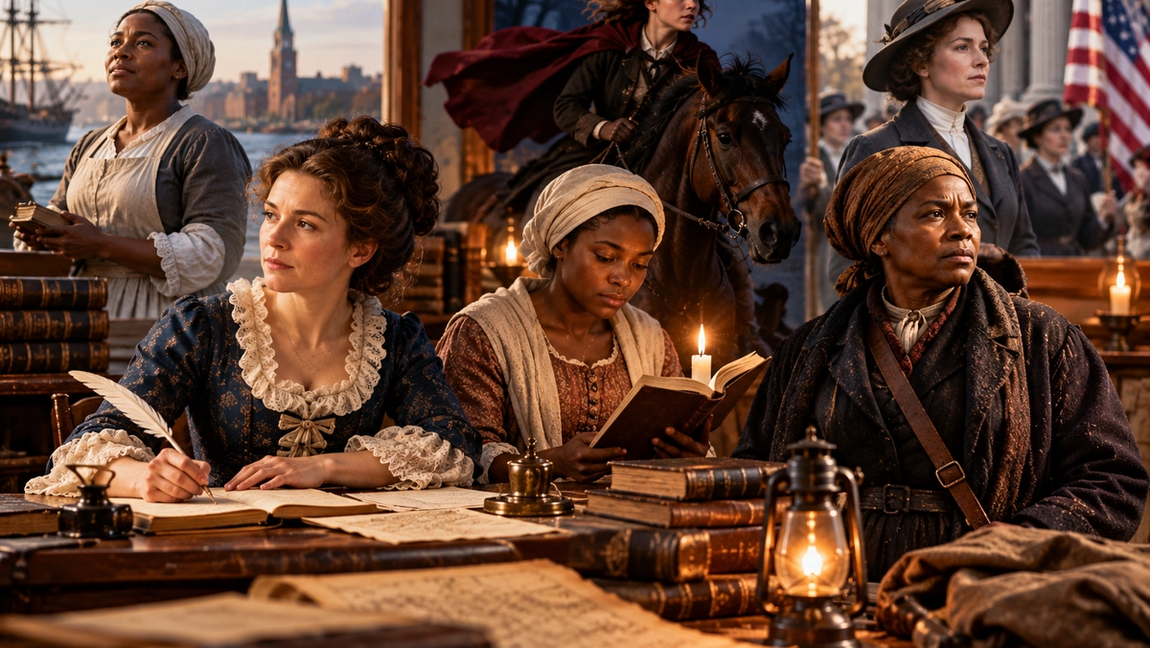
American history is full of names that almost everyone recognizes. George Washington. Abraham Lincoln. Benjamin Franklin. Martin Luther King Jr. Thomas Edison. Franklin D. Roosevelt.
But behind the familiar version of the country’s history is another group of people whose influence is much easier to miss.
Women organized resistance before the American Revolution, escaped slavery and returned to rescue others, fought for voting rights, built businesses, transformed journalism, made scientific breakthroughs, challenged segregation, and changed the laws governing American life. Some became famous eventually. Others remain little more than footnotes beside the men whose stories received far more attention.
Their absence from the traditional narrative does not mean they were absent from history.
Here are some of the women whose stories deserve a much bigger place in it.
Mercy Otis Warren Used Words as a Revolutionary Weapon
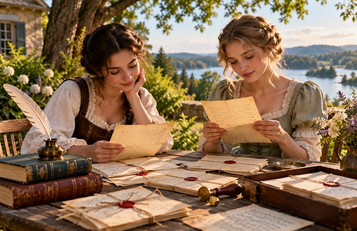
Before the United States existed, Mercy Otis Warren was already using her writing to challenge British authority.
Born in Massachusetts in 1728, Warren grew up surrounded by political discussion despite living in a society where women had few opportunities to participate formally in politics. She became a writer of political plays, poems, and essays that criticized British colonial rule and supported the revolutionary cause.
Her home also became a gathering place for prominent political figures.
What makes Warren particularly interesting is that she did not stop questioning power once independence had been achieved. During debates over the Constitution, she opposed ratification without stronger protections for individual liberties.
In 1805, she published a three-volume history of the American Revolution, making her one of the earliest major historians of the nation’s founding.
At a time when politics was overwhelmingly considered a male arena, Warren had found another way into the conversation: she wrote herself into it.
Phillis Wheatley Forced America to Confront a Contradiction
Phillis Wheatley arrived in Boston as an enslaved child from West Africa.
By her teenage years, she was writing poetry.
In 1773, Wheatley published a collection of poems in London, becoming one of the first African American women to publish a book. Her achievement was extraordinary in a society where Black people were enslaved and intellectual ability was routinely used as part of racist arguments about human hierarchy.
Wheatley’s work engaged with religion, classical literature, freedom, and contemporary political events. She even wrote a poem addressed to George Washington, who later invited her to visit him.
Her life embodied a contradiction at the heart of revolutionary America. Colonists were demanding liberty from Britain while hundreds of thousands of people remained enslaved within the colonies themselves.
Wheatley did not merely live inside that contradiction. Her existence as a celebrated writer made it harder to ignore.
Sybil Ludington Became Part of Revolutionary Legend
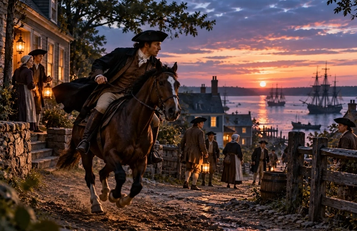
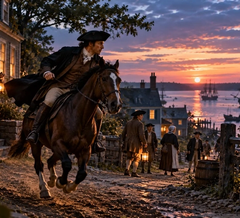
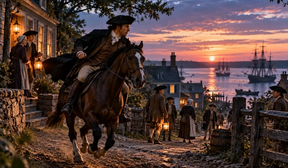
Most Americans learn the story of Paul Revere’s midnight ride. Far fewer hear about Sybil Ludington.
According to accounts that became popular long after the Revolutionary War, 16-year-old Ludington rode through the countryside of New York in April 1777 to alert local militia forces after British troops attacked nearby Danbury, Connecticut.
The traditional story describes her traveling roughly 40 miles through the night, significantly farther than Revere’s famous ride.
Modern historians have questioned how much of the dramatic version can be firmly documented, because detailed accounts appeared decades after the supposed event.
That uncertainty is important. History becomes more interesting, not less, when we distinguish between evidence and legend.
But Ludington’s fame also points toward a broader reality that is not in doubt: women participated in the Revolution in numerous ways, including carrying information, supplying armies, managing farms and businesses, raising funds, and sometimes entering combat zones.
Elizabeth Freeman Took Her Freedom to Court
Elizabeth Freeman was born into slavery in the eighteenth century and spent much of her life enslaved in Massachusetts.
Then she sued for her freedom.
Known at the time as Mum Bett, Freeman reportedly recognized the contradiction between Massachusetts’ new constitutional language about equality and the reality of slavery. In 1781, she and another enslaved man, Brom, brought a legal case against their enslaver.
They won.
Freeman’s case became part of a broader series of legal developments that helped undermine slavery in Massachusetts.
Her story is powerful because freedom was not simply handed down to her by famous political leaders. She used the language of the new republic and demanded that its promises apply to her.
The ideals written into founding documents could become more radical when people excluded from those ideals insisted on taking them seriously.
Harriet Tubman Was Far More Than an Underground Railroad Conductor
Harriet Tubman’s work on the Underground Railroad is famous, but that represents only part of her extraordinary life.
Born enslaved in Maryland around 1822, Tubman escaped to freedom in 1849. Instead of remaining safely in the North, she repeatedly returned to slaveholding territory to help relatives and others escape.
During the Civil War, her role expanded dramatically.
Tubman worked for the Union as a nurse, scout, guide, and spy. In 1863, she participated in the Combahee River Raid in South Carolina, an operation that struck Confederate resources and helped free hundreds of enslaved people.
After the war, Tubman continued advocating for civil rights and later supported the women’s suffrage movement.
Reducing her story to the Underground Railroad misses what made her life so remarkable. She was involved in several of the defining struggles of nineteenth-century America, from slavery and the Civil War to women’s political rights.
Ida B. Wells Used Journalism to Challenge Violence
Ida B. Wells understood that information could be dangerous to people who depended on silence.
Born into slavery in Mississippi during the Civil War, Wells became a teacher and journalist. In the 1890s, after three Black men she knew were lynched in Memphis, she began investigating lynching across the United States.
Her reporting challenged widely circulated claims used to justify racial violence. She gathered evidence, documented cases, analyzed patterns, and published her findings.
The consequences were serious.
While Wells was away from Memphis, a white mob destroyed the newspaper office where she worked. Threats made returning dangerous, but she continued her anti-lynching campaign from elsewhere, including through speaking tours abroad.
Wells later became involved in women’s suffrage and civil rights organizing.
Long before the term “data journalism” existed, she was using documented evidence to expose the gap between public narratives and reality.
Mary McLeod Bethune Built Power Through Education
Mary McLeod Bethune was born in South Carolina in 1875 to parents who had been enslaved.
She became one of the most influential Black educators and political organizers of the twentieth century.
In 1904, Bethune founded a school for Black girls in Daytona Beach, Florida, with very limited resources. That institution eventually developed into what is now Bethune-Cookman University.
But education was only part of her work.
Bethune founded and led national organizations for Black women, advocated for voting rights and economic opportunities, and became an adviser to President Franklin D. Roosevelt’s administration. She used her access to push for greater Black representation within federal programs and government.
Her career demonstrated that political influence did not always begin with elected office. Institutions, networks, education, and organization could create another form of power.
Frances Perkins Helped Build the Modern American Safety Net
Millions of Americans have benefited from policies shaped by a woman whose name many have never heard.
Frances Perkins became secretary of labor under Franklin D. Roosevelt in 1933, making her the first woman to serve in a U.S. presidential Cabinet.
She had spent years working on labor reform and workplace safety. The 1911 Triangle Shirtwaist Factory fire in New York, which killed 146 workers, had a profound impact on her work and strengthened her commitment to reforming dangerous labor conditions.
As labor secretary, Perkins became deeply involved in New Deal policymaking. She played an important role in the development of Social Security, unemployment protections, labor standards, and other reforms.
Her influence can still be felt in basic assumptions Americans now make about the government’s role in protecting workers and providing economic security.
Yet she rarely receives the same public recognition as the president whose administration enacted those policies.
Katherine Johnson Helped Put Americans in Space
The space race is often told through astronauts, rockets, and presidents.
But before astronauts could leave Earth, someone had to calculate how they would get there—and how they would return.
Katherine Johnson was one of the mathematicians whose work helped NASA solve those problems.
A Black woman working in a field dominated by white men, Johnson calculated flight trajectories for some of the most important missions in early American spaceflight. Her work contributed to Alan Shepard’s 1961 mission, John Glenn’s orbital flight in 1962, and later Apollo missions.
When NASA began using electronic computers to calculate Glenn’s orbit, Glenn reportedly requested that Johnson personally verify the machine’s numbers before he flew.
Her story eventually became much more widely known, particularly through the book and film Hidden Figures. But for decades, the public celebrated the astronauts while knowing relatively little about women such as Johnson who helped make their missions possible.
Dolores Huerta Turned Organizing Into Lasting Change
The American labor movement has many famous male figures. Dolores Huerta deserves to be remembered alongside them.
Working with César Chávez, Huerta helped establish the organization that became the United Farm Workers. She organized agricultural workers, negotiated contracts, coordinated boycotts, and advocated for better wages and working conditions.
She also helped popularize the phrase “Sí, se puede”—“Yes, it can be done” or “Yes, we can.”
Her work was particularly significant because farmworkers had historically been excluded from many of the labor protections available to other American workers.
Huerta’s career also demonstrates something that appears repeatedly throughout American history: major social changes rarely happen because of one famous speech or one political leader. They usually require years of organizing by people whose names the public may never learn.
History Changes Depending on Who We Remember
These women did not simply participate in American history. They changed its direction.
Some challenged slavery. Others expanded education, exposed racial violence, organized workers, influenced federal policy, advanced science, or demanded that America’s promises of liberty and equality apply to people originally excluded from them.
And they represent only a fraction of the story.
There are countless other women whose contributions remain less familiar because historical memory is selective. Textbooks have limited pages. Monuments celebrate particular people. Families preserve some stories while others disappear. For generations, historians themselves focused disproportionately on presidents, generals, businessmen, and other powerful men.
Looking again does not require removing those figures from history.
It means widening the frame.
Because once you do, American history looks different. The country’s defining moments were not created solely in presidential offices, battlefields, courtrooms, or congressional chambers.
They also happened in classrooms, newspaper offices, factories, laboratories, farms, homes, protest meetings, and communities.
And women were there all along.