The TV Shows That Defined How America Saw Itself
By Marie Wells on October 15, 2026
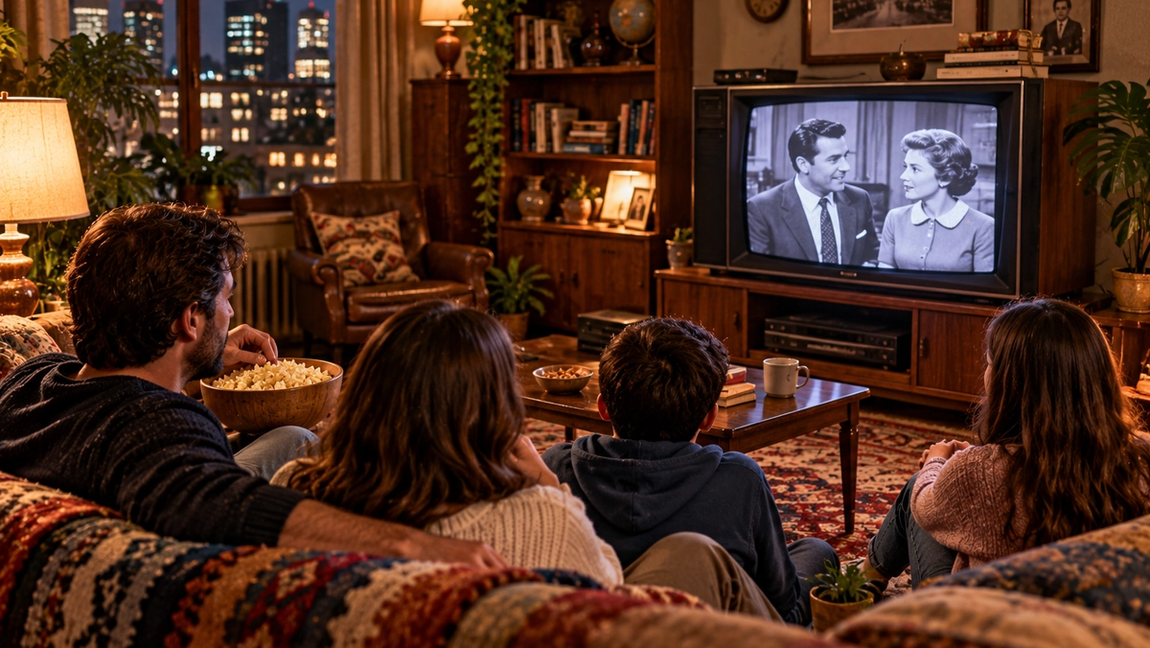
Television did not simply show Americans what was happening around them. For much of the twentieth century, it helped tell them what America was supposed to look like.
The families on television suggested what a normal household looked like. Sitcoms reflected changing ideas about marriage, work, race, gender, and class. News programs brought wars and political crises into living rooms. Dramas turned police officers, doctors, lawyers, and presidents into familiar characters. Reality television eventually blurred the line between ordinary life and entertainment altogether.
At its most influential, television became a kind of national mirror.
The reflection was never completely accurate. Some Americans barely appeared on screen, while others were represented through stereotypes. But as television changed, the version of America it presented changed too.
Looking at the shows that became cultural landmarks reveals something larger than the history of entertainment. It shows how Americans imagined themselves.
I Love Lucy Changed What a Television Family Could Be
When I Love Lucy premiered in 1951, television was still establishing the rules of the sitcom.
Lucille Ball and Desi Arnaz helped rewrite them.
The show centered on Lucy Ricardo, whose endless schemes repeatedly disrupted the orderly domestic life expected of a 1950s television wife. Lucy wanted excitement, independence, and often a place in her husband Ricky’s entertainment career.
That alone gave the show’s domestic comedy an unusual energy.
Its marriage was also significant. Ball was American and Arnaz was Cuban-born, making their on-screen relationship an uncommon representation of an interracial or interethnic marriage on early American television.
Behind the scenes, the pair were equally influential. Their production company, Desilu, helped pioneer production practices that became important to television, including the use of multiple cameras before a live studio audience.
Lucy Ricardo may have been constantly trying to get onto Ricky’s stage.
Lucille Ball was quietly helping build the television industry around it.
Leave It to Beaver Helped Create the Myth of the Perfect American Family
If you wanted to imagine the stereotypical 1950s American family, television gave you plenty of material.
Shows such as Leave It to Beaver presented comfortable suburban households with married parents, children, tidy homes, and problems that could usually be resolved before the credits rolled.
That world reflected part of postwar American life.
Suburbanization was expanding, homeownership was increasing, and the baby boom was reshaping communities.
But television’s idealized family also excluded huge parts of the country.
Poverty, racial segregation, troubled marriages, single-parent households, and many other realities rarely appeared in the same way.
The result was powerful.
Television did not merely reflect the American family. It helped establish expectations about what a successful American family was supposed to be.
For viewers whose lives looked nothing like the Cleavers’, the supposedly normal family on television could feel surprisingly distant.
Star Trek Imagined a Different American Future
When Star Trek premiered in 1966, America was living through the Cold War, the civil rights movement, the space race, and enormous social change.
The show imagined a future in which humanity had survived its divisions and was exploring the universe together.
The crew of the USS Enterprise was unusually diverse for American television of the period.
Nichelle Nichols played Lieutenant Uhura, a Black woman serving as a skilled communications officer rather than a domestic worker or background character. George Takei played Hikaru Sulu, giving Asian American viewers a prominent character at a time when television offered relatively few.
The show’s stories frequently used science fiction to explore racism, war, authoritarianism, prejudice, and political conflict.
It was not subtle all the time. That was part of the fun.
But underneath the aliens and spaceships was a remarkably optimistic idea: humanity could eventually become better than it was.
During a decade defined by conflict, Star Trek gave viewers a future worth imagining.
All in the Family Put America’s Arguments in the Living Room
By the early 1970s, the polished television families of earlier decades were becoming harder to maintain.
All in the Family arrived with something very different.
Its central character, Archie Bunker, was a working-class man with deeply conservative social attitudes and openly prejudiced views. His daughter Gloria and son-in-law Mike represented a younger, more liberal generation.
Their home became a stage for America’s political and cultural arguments.
The show addressed racism, women’s rights, sexuality, religion, class, the Vietnam era, and generational conflict with a directness unusual for network television.
Archie was not presented simply as a villain. He could be funny, vulnerable, affectionate, frustrating, and offensive.
That complexity was precisely what made the show culturally important.
Families watching at home could recognize versions of arguments they were already having around their own dinner tables.
Television was no longer pretending everyone agreed about what America should become.
The Mary Tyler Moore Show Redefined the Single Working Woman
Mary Richards was revolutionary partly because her life did not look revolutionary.
When The Mary Tyler Moore Show premiered in 1970, its central character was an unmarried woman in her thirties building a career at a Minneapolis television station.
She was not waiting for the show to give her a husband.
Her work, friendships, ambitions, mistakes, and independence were the story.
That reflected major changes taking place in American society as more women entered professional careers and challenged traditional expectations surrounding marriage and domestic life.
The show did not present Mary as rejecting relationships or family. It simply allowed her to have an identity that was not defined entirely by them.
That distinction mattered.
Television had spent years showing women what a successful wife might look like.
Mary Richards offered another possibility.
Roots Forced Millions of Americans to Look Backward
In January 1977, Roots became a television event.
Based on Alex Haley’s book, the miniseries followed generations of a Black family beginning with Kunta Kinte, an African man captured and enslaved in America.
The subject was hardly unknown.
But presenting slavery and its legacy across multiple nights of prime-time network television brought the story into American homes on an extraordinary scale.
Millions watched.
For Black Americans, the series offered a rare television production centered on Black history across generations. For many white viewers, it confronted aspects of slavery that popular entertainment had often minimized, romanticized, or ignored.
Roots also demonstrated television’s ability to create a shared national experience.
In an era before streaming and hundreds of channels fragmented audiences, enormous portions of the country could watch the same program at roughly the same time.
The next morning, America had something to talk about.
The Cosby Show Changed What Black Success Looked Like on Television
When The Cosby Show premiered in 1984, it presented a Black American family that television audiences rarely saw.
The Huxtables were affluent, educated, professionally successful, and stable. Cliff was a doctor. Clair was a lawyer. Their children grew up in a comfortable Brooklyn home.
The show’s cultural impact was significant because Black television characters had often been portrayed through narrow stereotypes or stories focused heavily on poverty and struggle.
The Huxtables offered another image.
At the same time, the show’s legacy has become deeply complicated by the criminal conviction and numerous sexual assault allegations involving its star, Bill Cosby. The conviction was later overturned on procedural grounds, not through a determination that the allegations themselves were false.
That makes discussing the series today uncomfortable but historically important.
A television program can have enormous cultural influence while the later history of the person at its center changes how audiences experience it.
The Simpsons Turned the Perfect Family Upside Down
By 1989, America had spent decades watching television families.
Then came the Simpsons.
They were not elegant. Their house was messy. Homer was incompetent at work and frequently ridiculous. Bart was a troublemaker. The family argued constantly.
Yet they were recognizable.
The Simpsons used animation to satirize almost every part of American life: family, school, religion, politics, corporations, advertising, television itself, and the strange rituals of suburbia.
Its fictional town of Springfield became a miniature version of America.
The show also represented a shift toward greater cynicism in popular culture. Institutions were no longer automatically trustworthy. Adults did not necessarily know what they were doing. Corporations were greedy. Politicians were absurd.
The American family remained at the center of television.
It was simply allowed to be dysfunctional now.
The Fresh Prince of Bel-Air Explored Two Versions of Black America
The Fresh Prince of Bel-Air began with an irresistible premise.
A teenager from West Philadelphia moves in with his wealthy relatives in Bel-Air.
Much of the comedy came from the contrast between Will and the Banks family.
But beneath the jokes, the show explored class differences within Black America, racial profiling, absent parents, identity, education, and expectations surrounding success.
The Banks family challenged the idea that Black American life could be represented through a single economic or cultural experience.
Uncle Phil was wealthy, educated, authoritative, and deeply connected to his family’s history and identity.
Will brought a different cultural experience into the household.
Neither side represented the only authentic version of Black life.
That tension allowed a mainstream sitcom to explore questions about race and class without giving up its ability to be genuinely funny.
Friends Reflected the Fantasy of Young Adulthood
Few shows captured the aspirations of 1990s young adulthood as effectively as Friends.
Six attractive twenty-somethings lived in New York City, spent enormous amounts of time together, dated, changed careers, and somehow always found a seat at their favorite coffee shop.
The lifestyle was not particularly realistic.
That hardly mattered.
The show reflected a cultural shift in which marriage and children were increasingly presented as things that could happen later. Friendship itself became a kind of chosen family.
The apartments, hairstyles, clothing, relationships, and coffeehouse culture became enormously influential.
But Friends also reflected the limitations of mainstream television at the time. Its version of New York was overwhelmingly white despite being set in one of the most diverse cities in the world.
What television includes tells us something about a culture.
What it leaves out can tell us just as much.
The Sopranos Changed Who Could Be the Main Character
By the end of the twentieth century, American television was becoming comfortable with something earlier network shows rarely attempted: asking audiences to spend years with deeply flawed protagonists.
The Sopranos, which premiered in 1999, centered on Tony Soprano, a New Jersey mob boss experiencing panic attacks and attending therapy.
He was violent, manipulative, funny, anxious, affectionate, selfish, and often frightening.
The series refused to make him easily likable or easily condemnable.
That complexity helped usher in a new era of prestige television built around morally ambiguous central characters.
It also captured a particular kind of American anxiety at the end of the century.
Tony had money, a large suburban home, a family, and considerable power.
Yet he remained deeply dissatisfied.
The traditional symbols of American success were all there.
They simply were not making him happy.
Television Eventually Stopped Showing One America
For decades, the enormous power of television came partly from scarcity.
There were relatively few networks and channels. When a major program aired, millions of Americans watched the same thing.
That created shared cultural reference points.
By the late twentieth and early twenty-first centuries, cable television, streaming services, and the internet began breaking that common audience into smaller pieces.
That fragmentation allowed more kinds of stories to appear.
Television increasingly had room for different races, cultures, sexual identities, family structures, regions, political perspectives, and lifestyles.
There was no longer one television version of America.
In many ways, that was probably more accurate.
America Watched Itself Change
Television’s greatest cultural power may have been its intimacy.
Movies required people to go somewhere. Newspapers had to be read. Television simply sat in the living room.
Night after night, the people on the screen became strangely familiar.
Lucy Ricardo challenged the perfect housewife. The Cleavers helped define the suburban ideal. Star Trek imagined a more diverse future. Archie Bunker embodied America’s cultural arguments. Mary Richards made independence look ordinary. Roots confronted the country with its past. The Huxtables challenged stereotypes about Black families. The Simpsons mocked the suburban dream. Friends turned friendship into family. Tony Soprano questioned whether achieving that dream was enough.
None of these shows represented America perfectly.
No television show could.
But together they reveal something fascinating about the country.
For generations, Americans turned on their televisions to escape from real life.
And ended up watching themselves.